

Listings(s)
'Imaginary Fact: Contemporary South African Art and the Archive'
Sue Williamson, Wim Botha, Athi Patra Ruga, David Koloane, Donna Kukama, James Webb, Penny Siopis, Andrew Putter, Joanne Bloch and Others at Venice, ItalyArt influences and reflects its world around us and, as the world changes, so too does its forms. In South Africa, during its turbulent twentieth century, visual art focused on political resistance and became a vehicle for insurgency against human rights abuses. After the advent of democracy it shifted towards an exploration of issues of identity, with race and gender gaining prominence. Today, contemporary South Africa is witness to a further significant movement – a renewed and invigorating focus on how and why histories continue to impact on the world today. To do this, contemporary artists are turning to the archive as the repository of these histories. This essay outlines the concept behind 'Imaginary Fact: Contemporary South African Art and the Archive', an exhibition that draws on South Africa’s key practitioners who, in very different and vibrant ways, draw on the archived record in order to make sense of our worlds today.
What is it about the record that artists find so enticing? At the simplest level, it is the rare combination of memory with ‘thing’ – a coming together of the tangible and the intangible – which makes the record such a powerful force. It allows the artist to construct new bridges between history and the contemporary, thus to create an architecture of meaning. The agency of archives has been demonstrated by their ability to both construct and destroy ideologies. Working with archives, in a creative way, therefore allows the artist to create work with the potential to change the course of our contemporary world.
A literary example from Italo Calvino (1998) complicates this question when he writes: ‘Perhaps the mistake lies in establishing that at the beginning I and a telephone are in a finite space such as my house would be, whereas what l must communicate is my situation with regard to numerous telephones that ring; these telephones are perhaps not calling me, have no relation to me, but the mere fact that I can be called to a telephone suffices to make it possible or at least conceivable that I may be called by all telephones.’
Calvino’s text is taken from In a network of lines that enlace, a chapter in his book titled 'If on a winter’s night a traveller'. These titles – hinting at the relation of one concept to another – seem to set the stage for a continuous tale. But each chapter is discrete – different in character and narrative to the one before and the one following. It is only when the characters in different chapters start demonstrating commonalities, or when the effect of relationships between characters in different stories can be seen, that the interplay between chapters becomes legible. A dynamic crossing is established between all players in a complex game of interrelationships.
In all case studies, artists appear to function partly as facilitator to release the potential energy stored within the seemingly latent records, and partly as activist in allowing the agency to do its work within societies. The most common methods used are translation (into new and evolving languages), interpretation (into new and evolving meanings), and mediation (from one medium to another), sometimes used individually, sometimes in combination, but often to startling effect.
Brenton Maart
01 June 2013 - 24 November 2013
'The Future White Women of Azania'
Athi Patra Ruga at Whatiftheworld / Gallery‘You should think of myth as a process, as a verb ‘to myth’, then you understand the function of it much better. [That is myth’s] underlying function is to help us think about what human existence is like. But instead of closing meaning off, they push you and point you in different directions.’
Prof Mary Beard
Athi-Patra Ruga is one of a handful of artists, working in South Africa today, who has adopted the tropes of myth as a contemporary response to the post-apartheid era. Ruga has always worked with creating alternative identities that sublimate marginalized experience into something strangely identifiable. Amongst many notable creations to date has been the ambivalently gendered Beiruth, whose name, with its middle-eastern associations, evoked ideas related to Edward Said’s 'Orientalism' and the Illuwane, again an ambivalent sexual entity rooted in Xhosa Mythoglgy.
But Ruga is now bringing a new set of mythical characters a little closer to home. In 'The Future White Women of Azania' he is turning his attention to an idea intimately linked to the apartheid era’s fiction of Azania – a Southern African decolonialised arcadia. It is a myth that perhaps seems almost less attainable now than when the Pan Africanist Congress (PAC) appropriated the name in 1965 as the signifier of an ideal future South Africa – then at least was a time to dream more optimistically largely because the idea seemed so infinitely remote.
But Ruga, in his imaginings of Azania, has stuck closer to the original myth, situating it in Eastern Africa as the Roman, Pliny the Elder, did in the first written record of the name. Here Ruga in his map The Lands of Azania (2014-2094) has created lands suggestive of sin, of decadence and current politics. Countries named Palestine, Sodom, Kuntistan, Zwartheid and Nunubia are lands that reference pre-colonial, colonial and biblical regions with all their negative and politically disquieting associations. However, in what seems like something of a response to the ‘politically’ embroidered maps of the Italian artist Alighiero e Boetti, Ruga infers that the politicization of words are in a sense prior to the constructed ideology of the nation state.
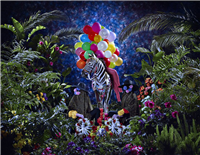
What is more Azania is a region of tropical chromatic colours, which is populated with characters whose identities are in a state of transformation. At the centre of the panoply of these figures stands The Future White Woman whose racial metamorphosis, amongst a cocoon of multi-coloured balloons, suggests something disturbing, something that questions the processes of a problematic cultural assimilation. And it is here that the veracity of the myth of a future arcadia is being disputed if not entirely rejected.
To be sure, unlike Barthes’s suggestion in his essay ‘Myth Today’, Ruga is not creating myth in an act that depoliticizes, simplifying form in order to perpetuate the idea of an erroneous future ‘good society’. Instead, placing himself in amongst the characters in a lavish self-portrait Ruga imagines himself into the space of the clown or jester (much like the Rococo painter Watteau did in his painting ‘Giles’), into the space of interpreter as well as a cultural product of the forces outside of his own control.
Ruga’s Azania is a world of confusing transformations whose references are Rococo and its more modern derivative Pop. But whatever future this myth is foreshadowing, with its wealth, its tropical backdrop, its complicated and confusing identities, it is not a place of peaceful harmony - or at least not one that is easily recognizable. As Ruga adumbrated at a recent studio visit, his generation’s artistic approach of creating myths or alternative realities is in some ways an attempt to situate the traumas of the last 200 years in a place of detachment. That is to say at a farsighted distance where their wounds can be contemplated outside of the usual personalized grief and subjective defensiveness.
27 November 2013 - 08 February 2014
'Public Intimacy'
Jo Ractliffe, Athi Patra Ruga, David Goldblatt, Donna Kukama, Penny Siopis, Santu Mofokeng, Kemang Wa Luhelere and Others at YBCADisrupting expected images of South Africa, the 25 contemporary artists and collectives featured in 'Public Intimacy' eloquently explore the poetics and politics of the everyday. This collaboration with Yerba Buena Center for the Arts presents pictures from SFMOMA’s collection of South African photography alongside works in a broad range of media, including video, painting, sculpture, performance, and publications — most made in the last five years, and many on view for the first time on the West Coast. Coinciding with the 20th anniversary of democracy in South Africa, 'Public Intimacy' reveals the nuances of human interaction in a country still undergoing significant change, vividly showing public life there in a more complex light.
'Public Intimacy' includes works by Ian Berry, Ernest Cole, David Goldblatt, Handspring Puppet Company, Nicholas Hlobo, ijusi (Garth Walker), Anton Kannemeyer, William Kentridge, Donna Kukama, Terry Kurgan, Sabelo Mlangeni, Santu Mofokeng, Billy Monk, Zanele Muholi, Sello Pesa and Vaughn Sadie with Ntsoana Contemporary Dance Theatre, Cameron Platter, Lindeka Qampi, Jo Ractliffe, Athi-Patra Ruga, Berni Searle, Penny Siopis, Mikhael Subotzky and Patrick Waterhouse, and Kemang Wa Lehulere.
21 February 2014 - 29 June 2014
'Artists Engaged? Maybe'
Wim Botha, Athi Patra Ruga, Paul Edmunds, Simon Gush, Conrad Bothes and Others at Fundacao Calouste Gulbenkian'Artists Engaged? Maybe' brings together artists from Europe, Africa and South America whose work is engaged with politics, with beauty, with art, with language(s), or with the communities in which they live or work. The exhibition features a variety of works in diverse formats: photography, sculpture, painting, drawing, film and video, and installation. Says curator António Pinto Ribeiro, 'In this exhibition we have sought to avoid the idea of a hegemonic theme justifying the impositions of a curator… It is an exhibition of fragments, doubts and images in transition or mutation'.
Artists include Athi-Patra Ruga, Berna Reale, Bouchra Khalili, Bruno Boudjelal, Celestino Mondlane, Conrad Botes, Demián Flores, Eduardo Basualdo, Eva Grubinger, Fredy Alzate, Johanna Calle, João Ferro Martins, Luiz Zerbini, Miguel Jara, Paul Edmunds, Pedro Barateiro, Raul Mourão, Sandra Monterroso, Simon Gush, Solon Ribeiro, Wim Botha.
21 June 2014 - 07 September 2014