

Current Review(s)
Under the Rainbow
Dathini Mzayiya at Greatmore Studios‘Fascism… is not an external opposite to liberal democracy but has its roots in liberal democracy’s own inner antagonism’. – Zizek
What is the significance of the post-1994 metaphoric rainbow? It was supposedly a symbolic representation of, and an ethical plea for, tolerance and multiracialism after the tumultuous years of apartheid. But to our misfortune, this nicety has merely become the agitprop of our neocolonial state’s legitimation. Concepts like the rainbow nation aren’t necessarily negative but they are pervasive. As Biko argued of ‘integration’, they function as face-value schemes, whereby the structurally excluded become included as the excluded. In fact, as the liberal John Kane-Berman said ‘whites, generally speaking, lived under a democratic system while blacks were subject to the dictatorial powers of the massive, coercive, bureaucratic apparatus’. Again to pillage from Biko, this inclusion is about smuggling blacks into the civilizing machine and edifice. Therefore inclusion itself, within the same relations –whether democracy or the rainbow – operates within the same set of discursive patterns as ‘acculturation’.
28 February 2013 - 15 March 2013
Listings(s)
‘Onder die Reenboog Strale’
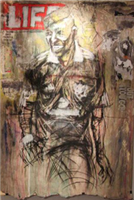
Dathini Mzayiya at Greatmore StudiosDathini Mzayiya celebrates the completion of his tenure at Greatmore Studios with a retrospective exhibition entitled ‘Onder die Reënboog Strale’, translated in English as 'under the rainbow rays’.
‘Onder die Reenboog Strale’ unpacks the hype of post-apartheid South Africa as a rainbow nation. If art is a mirror of society then Dathini Mzayiya’s work is a full-length mirror of the contradictory nature of the space we call South Africa.
As the title suggests, the exhibition takes the biblical allusion of the rainbow as a fiction on which post-apartheid national identity has been imagined. Whilst marginalized South Africans are metaphorically kneeling, looking up to the skies without any guarantees of redemption or of a different life, the symbols of the rainbow nation appear increasingly hollow. The rainbow’s mysterious beauty blends colour through prisms of water and sunlight. Yet, unproblematically, it has been imposed as a political image of reconciliation and as a theological sign of hope and peace.
The rainbow is an illusion of light and reflection, so the artist includes these tools to examine the farce and the tragedy of the failed pretence of reconciliation. Working from the everyday experience of life ‘under the rainbow’, Mzayiya’s subjects are both overlooking and under looking; they are bosses, landlords and security guards, white; they are beggars with children, job seekers, landless, pavement-dwellers, maids, black. Mzayiya observes layers of racialised violence that mark everyday social and economic interactions. And he notices structural violence that is so normalized it is not regarded as worth noticing.
28 February 2013 - 15 March 2013
Rewind
Dathini Mzayiya and Gabrielle Goliath at Center of African StudiesTo be updated at a latter date
01 October 2012 - 27 October 2012