




Current Review(s)
Deborah Poynton’s Model for a World: A survey of 25 years of painting
Deborah Poynton at The New ChurchThe semi-domestic space of The New Church serves as a comfortable temporary home for the collection of paintings brought together for Deborah Poynton’s retrospective: ‘Deborah Poynton’s Model for a World: 25 years of Painting’. The breadth of the artist’s practice follows a clear trajectory, that spans her family, friends and reflects on the places where she grew up – most significantly the dense tropical scenes of Kwa-Zulu Natal. The domestic and the ‘wild’ feature prominently throughout the retrospective, and in this juxtaposition, bring together a perspective of a very particular kind of South African experience – one of comfort and a flirtation with danger, generally induced through the experience of the untamed wilderness, or through physical exposure.
13 May 2014 - 26 July 2014
Listings(s)
'Model for a World'
Deborah Poynton at The New Church'Pictures are really just thin paint on canvas.
Deborah paints on average 7 hours a day. As curator, I feel my way through this exhibition, morning until evening. I stalk it. Looking. Talking. Looking. Reading. Looking. Ruminating. Looking, listening, listening. Deborah keeps painting.
I stop mapping the territory, the coordinates of a 25 year career, the exhibitions, the catalogues. I begin to claim land. I see Poyntonesque paintings in everything, everywhere. The view through a window, into the house next door. There are shoes and a cup on the windowsill. Children playing in a park. Everything is still. Somebody has not made a bed.
'I have just carried on doing what I did as a child. It’s been one long continuous stream of making pictures to feel a sense of connectedness. Painting this way is a wordless exclamation….Sometimes people get cross with it because they hate that it’s not about anything, and that I just carry on with all this realism. This fiddle-faddle, this knitting.'
The constructions apparent in Poynton’s childhood drawings are evident in her works to date. Ordered with an idiosyncratic rhythm, an uncanny formula. The watercolour still life of tea cup and lighter, the imagined garden. Copying Leonardo Da Vinci studies and then constructing imagined variations of them… the old antique warrior, the middle-aged antique warrior, the young antique warrior. The construction remains today, the mastering of medium and technique has continued.The early paintings offer everything in one picture plane. The worlds constructed seem easier to contain that way, but that would be my projection of truth. In the later works, the constructed, imagined worlds spill onto many canvas panels. Environments are created for the viewer to move through, but never enter or exit. Generous. Deflective. Contained.
'Who cares if you can paint something that looks real? It is totally banal. There is no worth in that, except as a kind of sport, an exercise in hand-eye co-ordination. Now painting something that seems to contain reality – that is truly moving.'
Seems to… but realism is deceptive, realism is not reality.
Generously deflective, the viewer is mesmerized by a painted illusion, the Renaissance stances alluding to metaphor, allegory. The domestic relationships… the grouped objects …The viewer bounces within the works looking for the path out, the moral, the end result, the meaning, the reality, in the end finding their own projection.
I offer you, the viewer, my own construction. A personally calibrated material experience. A survey designed to function as a collection of marker pegs, staking a spot from which to gain a perspective of 25 years of Deborah Poynton’s paintings.
'There is relief in dwelling in a not-new picture, in embracing the foolishness of the formula, in discovering the beauty of each small detail that is woven into the picturesque whole. And while we are there, noticing the leaves, the clouds, the way the paint has described the folds of silk, perhaps something indescribable can be felt.'
The New Church Museum acknowledges with deep gratitude the generosity of the private and corporate collections who loaned the paintings that manifested this exhibition, the Stevenson for their unfaltering logistical support, and the artist for the generosity in which she allowed the curator into her world.
All quotes from Deborah Poynton’s selected writings and artist talks, jointly published in the catalogue for 'Pictures' by Stevenson, 2013.
13 May 2014 - 26 July 2014
'Scenes of a Romantic Nature'
Deborah Poynton at STEVENSON in JohannesburgSTEVENSON is pleased to present Deborah Poynton's seventh solo exhibition with the gallery, 'Scenes of a Romantic Nature'.
Poynton will exhibit 21 large canvases and, for the first time, two series of corresponding drawings. This new body of work reflects her assertion that: 'Art is an offering, a show that mirrors the show we form around ourselves as we move through our scenery. Art is always artful, a ruse, a trick. It is part of the dream that we inhabit.'
In the painting series 'Scenes of a Romantic Nature', she continues her investigation into 17th to 19th century European painting, with particular focus on the works of German Romantic landscape painter Caspar David Friedrich. Poynton's signature scenes constructed with elements cut from the world around us - flora and fauna, man-made objects, people and natural environments - are saturated with colour and detail; these canvases function as pictures to be looked at, or scenes for observation, rather than worlds to be entered.
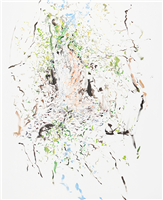
A related series of 'Proposition' paintings is rooted in her research into Ukiyo-e Japanese woodblock prints, literally 'pictures of the floating world'. In vast fields of white canvas, Poynton experiments further with attention to detail and the calligraphic action of mark-making. Deposits of pure colour read like descriptions of micro-worlds, as intense as the 'Scenes of a Romantic Nature' but suggesting a more essential treatment that is equivalent in conceptual content and rigour.
Seen together and interlinked, the two series compound what Poynton has always suggested, that for her 'there is a great emptiness in every kind of image. A finished, perfected work remains as insubstantial as the slight lines that first form a proposition on the canvas. All images are just propositions, in that they show up the difficulty we have in perceiving the world except through the filter of ourselves.'
In the series of drawings 'Scenes of a Romantic Nature', Poynton focuses on landscapes, natural scenes and close-ups of figures, building up the surface with a meticulous attention to detail, but with a deep sense of the subject's unfathomable distance. In the Proposition drawings, her lines lie scattered across the paper as if detached from any origin in the real world. Poynton communicates her attraction to the distant and the detached with a quote from the author John Banville who, she believes, best captures the mystery of perception:
Sometimes the beauty of things, ordinary things - those unseen flowers, this burnished foliage, the honeyed sunlight on the pavement at her feet - pressed in upon her urgently while at the same time the things themselves seemed to hold back, at one remove, as if there was an invisible barrier between her and the world. (John Banville, writing as Benjamin Black, 'The Silver Swan')
12 February 2015 - 20 March 2015
'Land of Cockaigne'
Deborah Poynton at STEVENSON in JohannesburgDeborah Poynton's latest exhibition, her first at Stevenson's Johannesburg space, is titled 'Land of Cockaigne'.
The Land of Cockaigne was the medieval idea of a paradise of plenty. For Poynton, the act of painting is an attempt to enter this fantastical world - but in an unexpected way. As the artist writes:
'In the Land of Cockaigne every wish was granted. I have used this title not because I wanted to illustrate paradise, but because painting itself is that land of never-realised fulfillment. Every painting I do comes from the same need to inhabit this land, to create a sense of engulfment, of complete enclosure, to blind and deafen and numb myself through the senses in order to find some peace. I persist with the image until no uncertainty remains within it, and I am thus provided with the illusion of certainty.'
This exhibition consists of seven large paintings, each presenting a discrete world made up of different elements - figures, fabric, plants, objects. In each of the paintings, there is no horizon, no means of escaping the sensual detail which seems to engulf the onlooker.
04 April 2012 - 12 May 2012
'Pictures'
Deborah Poynton at STEVENSON in Cape TownStevenson presents Deborah Poynton's sixth solo show with the gallery. Titled 'Pictures', it comprises 12 large-scale figurative and landscape paintings, continuing her ongoing contemplation of the interplay between our perceptions of reality and of the painted surface.
Poynton purposefully describes these new works as pictures rather than paintings to emphasise the constructs of perception and imagery. In so doing, she reminds us of the act of seeing, and the devices and pictorial references which have invariably been consciously assembled within the image to create a desired meaning and effect.
Rather than the narratives and expressive emotions that are often emphasised when looking at figurative and landscape paintings, Poynton prompts us to look at the fiction of an image that resembles realism. She writes:
The paintings I've done for this exhibition remind me of my favourite paintings and favourite tales. They are mannered. I have used a few well-worn formulas, a little romanticism, some classical poses, the drama of light and colour.
In spite of this mildly distasteful posturing, I believe completely and passionately in my fictions, my pictures, and wish to touch and entrance you with them. I hope they are beautiful in spite of their beauty, so to speak.
This exhibition will be accompanied by a new publication on her paintings of the past few years.
05 September 2013 - 12 October 2013
'Nightclub Photographs', 'Drawing Picasso' and 'Arcadia'
Billy Monk, Rineke Dijkstra and Deborah Poynton at STEVENSON in Cape TownDeborah Poynton's new exhibition, Arcadia, comprises 11 large paintings hanging together in one room. The installation creates the space of a decayed concrete folly at twilight, with the viewer looking out through the pillars into a liminal, overgrown landscape on all sides - a wilderness once tamed and now reverting to its natural state. A Grecian pastoral idyll, Arcadia is a place where human beings lived in peace with nature, impossible to re-enter, like the Garden of Eden. In this work the folly creates the illusion of a threshold, but also acts as a framing device, symbolic of the human need to construct an illusion of safety within an otherwise unpredictable world. In addition to Arcadia, there will be 16 smaller works on show, in the form of boxed dioramas.
Michael Stevenson also presents Nightclub Photgraphs a selection of 47 images by the legendary photographer Billy Monk taken in Cape Town nightclubs in 1967-9 when he worked as nightclub bouncer. His close and long friendships with many of the people in the images allowed him to photograph them with extraordinary intimacy. The contact sheets and negatives from these photos were discovered 10 years later by Jac De Villiers who organized an exhibition in Johannesburg in 1982. Monk was tragically killed before he saw the show. Monks original images will be on exhibition as well as others not included in De Villliers selection.
Internationally acclaimed photographic and video artist Rineke Dijkstra shows Ruth Drawing Picasso (2009) as part of the Forex series. Dijkstra's work often focusses on adolescents, teenagers and young adults - in this video, a schoolgirl sits on the floor of a museum, drawing Picasso's painting Weeping Woman (1937). As viewers, we do not see the painting, only the girl lost in concentration, drawing what she observes.
01 March 2011 - 09 April 2011