Current Review(s)
'Stills'
Karin Preller at ArtSpaceIn the catalogue for the Hayward Gallery’s 2007 ‘The Painting of Modern Life’ 2007, New York artist Judith Eisler said that her work was about find peripheral moments in narratives that would otherwise remain undetected. ‘I want to hear the sound of a pause’, she stated. Describing her methodology of painting from film stills, Eisler stated a resistance to the notion of appropriating the film’s narratives and structures in her works. Rather, she is ‘interested in the new narratives that inevitably emerge within the frame of the painting’.
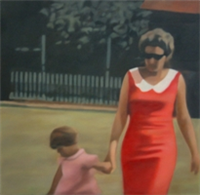
Karin Preller’s paintings are arguably kindred spirits of Eisler’s. With ‘Stills’, her 2009 exhibition at Johannesburg’s Artspace, Preller mines personal history and nostalgia for her subject matter, using still images from old 8mm home movies made by her family.
Yet the works are also crucially about the act of slowing down the moving image, and providing the viewer with a chance to ruminate on the frozen moment. Preller’s decontextualised images paradoxically evoke the terms of memory (images in the Brixton, 1960’s series is literally rose-tinted, and the rough edges of detail softened) and deny its operation (narratives separated out from their flow, fragmented, and images arbitrarily cropped).
06 June 2009 - 27 June 2009
'City and Suburban'
Karin Preller at Standard Bank GalleryKarin Preller’s ‘City and Suburban', an exhibition of new paintings and a film projection, occupied the downstairs section of the Standard Bank Gallery concurrently to Nicholas Hlobo’s headline show ‘Umtshotsho’, a body of work made after he won the Standard Bank Young Artist of the Year Award in 2009. Preller and Hlobo share an interest in representing identity, but Preller’s view is far more detached than Hlobo’s. For her, ‘identity’ is elusive, inseparable from memory, and located somewhere between the public and private geographies of Johannesburg in the 1960s and 1970s. The locations around which she centers her enquiry are the city and suburban settings that are recorded in her personal pictorial archive, and she explores the potential of the medium of oil on canvas to complicate notions of memory and history within these locations.
04 May 2010 - 19 June 2010
Just above the mantelpiece an interview
Karin Preller at ArtSpaceIn a quirky take on the 18th- and 19th century It-narrative (recounting of the adventures of a non-human protagonist), a literary craze often dominated by the doings of bits of currency (half-pennies, shillings and sovereigns abounded), the opening paragraphs of Londoner Mary Mister’s The Adventures of a Doll read like a manifesto for the entire genre. With vanitas commentary to make Flemish painting from two centuries back jealous, Mister sets up the Doll of the title for a tragic fall, as, it could be argued, must betide every shiny new object, inanimate or otherwise. ‘In a large shop, in the great metropolis of the British empire, I first opened my eyes on this changeful scene of life; and as the days of youthful beauty and vanity are now over, I may be allowed to describe, for the amusement of my readers, those charms which so long attracted the admiration of every youthful passenger. My face was fair as the finest wax could make it; a bloom, resembling the down of a peach, was spread over my cheeks; my eyes were soft blue of a summer’s sky, now opening with animating brightness, and now closing with languishing softness… But my greatest charm was that peculiar expression of superior understanding, which enables me to recount this my eventful history…’
Melville-based Karin Preller is fairly well-known for trawling the collective Johannesburg memory through her quasi-photoreal paintings generated from old family snapshots and magazine photos. ‘Just above the mantelpiece’, her latest show at ArtSpace in Parkwood ventures into the realm of still life. But it’s still-life with a twist, as the paintings are generated from photographs of still lives. Meanwhile, the stoic, mute authority of the curios, figurines and bibelots in Preller’s finely-wrought works seems a foil to the busy street outside the gallery, and indeed to a trash culture in which so little is kept and so much is binned.
Michael Smith: Karin, your new paintings are chromatically rather sumptuous. Cadmium reds, roses and crimsons play off against the cool-eye cerulean and Payne’s Greys for which you’re better known.
Karin Preller: Still life has remained an interest and was the subject of my first solo exhibition in 1996. The focus then was on the banal; items related to the household; the overlooked. The estrangement was facilitated by means of stark contrasts between light and dark and selective colour juxtaposed with monochromatic backgrounds. In ‘Just above the mantelpiece’ colour is more dominant. In terms of a purely visual apprehension, colour adds enigma and allure, and in works like Still life with red doll, Still life with twins and Still life with pink soccer doll accentuates unease in the face of idiosyncratic objects and painted surface.
Photography again played a significant role, as a means of filtering and documenting the subject. Colours are altered and intensified, or obliterated by overexposure. In monochromatic works such as Voodoo doll and Pinocchio, the greys invoke the documentary aspect of photography (many of the paintings are of objects documented as they are displayed, not set up or staged).
MS: The works are a bit smaller than some of the images derived from family photos, especially the ones which the Johannesburg Art Gallery purchased a few years ago. Is there something about making work about domestic accoutrements that suggested a more domestic scale?
KP: Although the objects depicted are bigger than life-size, the smaller scale of these more recent works lends itself to a more intimate engagement with the object and the painted surface, echoing the confinement and containment of the domestic sphere. Still life with Pinocchio and Still life with Two Tintins are quite large-scale works, the scale here accentuating the disturbing presence of the objects, familiar yet strange, inanimate yet somehow alive – the viewer a voyeur; the ‘gaze’ of the objects perhaps more palpably directed back at the viewer. Professor Federico Freschi, in opening the exhibition, remarked that the work seems to be less about the ‘materiality of things’ than about ‘how things signify human relationships’. As with the paintings of snapshots, my interest was indeed more on the relationship between objects (or photographs, in previous work) and their human and social context, than on ‘describing’ the objects themselves.
MS: The works are all of inanimate objects, which marks a shift from your previous work in which languid, fashionable young ’50s and ’60s Johannesburgers from Langlaagte coolly populated a tenuous suburban idyll. But there’s a twist, in the sense that the still lives are clearly generated from photographs. You’ve spoken about how photography influences the colour in this body of work, but is using it also about inserting a distance between yourself and familiar objects?
KP: Photography does provide a clinical distance that has always been an important aspect of my work. In previous photo-based work the emphasis was on the interaction between photography and painting; the translation of one idiom into another, and the questions this raised around aspects of representation as such. In these works photography is used as a tool to capture discrepancies that only emerge from that one photograph out of many, as well as the play of light and shadow that is an integral part of the work. Photography flattens and simplifies, it defamiliarises the familiar. It is at another remove from the object, another layer that creates distance.
MS: In Still life with voodoo doll the titular character seems to play off against a child’s naked female doll and a figurine in blackface. Is there an element of social critique in this work?
KP: I did not intend any kind of overt social critique. But the juxtaposition of objects necessarily sets up dialogues that can be read in different ways. While not wishing to impose meaning, the nature of the objects depicted, of still life itself, brings into play aspects and perspectives of the society that looks upon them; consumerism, cultural commodification, possession, the bestowment of value, the ‘politics of taste’ being associations that impact on the reception of the work. The visually pleasing re-presentation of objects, ostensibly devoid of physical human presence or agency, is perhaps also the very thing that provokes and accentuates a disruption that alters the meaning of the work; the objects becoming carriers of meaning other than those that would be attributed to them in different contexts; the narrative falling outside of the frame. It also goes to what it is that is owned or desired, how value is ascribed and why. Ironically, objects acquired and/or discarded here becomes part of another commodity, the painting itself.
MS: In StillLife with red doll, a figurine lies horizontal, bathed in afternoon sunlight. It’s hard to escape a reading of the work as a direct reference to Friedrich Nietzsche’s assault on cultural decadence, Twilight of the Idols.
KP: Reference to Nietzche was not intended and did not inform the work and I hesitate to venture into an analysis of links with his complex concept of ‘decadence’. However, ‘Twilight of the idols/dolls’ would be an apt alternative title for the show.
Many of my preoccupations were centered on the obsession with objects; with collection and display, ownership and possession. But possession is forever deferred, almost like a photograph that promises an objective ‘trace of the real’ that it can ultimately never deliver. As in my paintings based on family photographs and film stills, the work is about presence and absence; perhaps about the impossibility to possess what these images represent. The mantelpiece becomes a space of memory and obsession, a shrine to existence, yet simultaneously a space that defines the particularities as well as the flux, fragility and transience of human existence.
05 June 2013 - 03 July 2013
Listings(s)
'Stills'
Karin Preller at ArtSpaceAce painter Karin Preller presents ‘Stills’, a show of new works at Artspace during June. The works take as their subjects still film images from home movies made in the 1960’s in Preller’s childhood suburbs of Montgomery Park and Langlaagte.
06 June 2009 - 27 June 2009
'City and Suburban'
Karin Preller at Standard Bank GalleryKarin Preller's solo exhibition in the downstairs area of the Standard Bank Gallery pieces together fragments of a home video made by her father in the Johannesburg of the 1960's. This exhibition of oil paintings traces the complex relationship between memory and representation.
04 May 2010 - 19 June 2010