Listings(s)
Under the Umdoni Tree: The Art of Ebrahim and Omar Badsha
Omar Badsha and Ebrahim Badsha at Durban Art GalleryEbrahim Badsha was a member of a little-recognized pioneer generation of black artists in South Africa whose work explored questions of home, modernity, and the challenge of seeing the country in ways that transcended the imposed optic of white domination. Excluded from the commercial galleries and largely overlooked in South African art history, Ebrahim and his peers had a significant influence on the generation of black artists who came to the fore in the 1960s. The pieces in this exhibition were chosen from a collection of drawings, woodcuts and mono prints that Omar Badsha found after his father’s death in 2003. None of them have been seen for more than forty years.
Although best known as a social documentary photographer and public historian, Omar also began his career as a visual artist and was one of the first prize recipients in the non-racial Art South Africa Today exhibitions. A member of the post-Sharpeville generation of protest artists, Omar played a central role in the debates over the relationship between art and politics that developed in Durban during the mid-1960s.
'Under the Umdoni Tree', the title of which references a tree in the family's backyard, is a critical reminder that the rewriting of South African art history and the full recognition of black South Africans’ contributions remains an unfinished task.
27 January 2010 - 19 March 2010
'Rise and Fall of Apartheid: Photography and the Bureaucracy of Everyday Life'
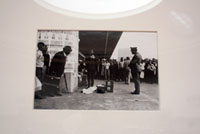
Jo Ractliffe, Guy Tillim, Sue Williamson, Jane Alexander, Omar Badsha, David Goldblatt, Peter Magubane, Santu Mofokeng, Ernest Cole, Jurgen Schadeberg and William Kentridge at Haus der Kunst'Rise and Fall of Apartheid: Photography and the Bureaucracy of Everyday Life' is a photographic exhibition examining the legacy of the apartheid system and how it penetrated even the most mundane aspects of social existence in South Africa, from housing, public amenities, and transportation to education, tourism, religion, and businesses. Complex, vivid, evocative, and dramatic, it includes nearly 500 photographs, films, books, magazines, newspapers, and assorted archival documents and covers more than 60 years of powerful photographic and visual production that forms part of the historical record of South Africa. Several photographic strategies, from documentary to reportage, social documentary to the photo essay, were each adopted to examine the effects and after-effects of apartheid's political, social, economic, and cultural legacy.
Curated by Okwui Enwezor with Rory Bester, the exhibition proposes a complex understanding of photography and the aesthetic power of the documentary form and honors the exceptional achievement of South African photographers.
From the work of members Drum Magazine in the 1950s to the Afrapix Collective in the 1980s to the reportage of the so-called Bang Bang Club, included in the exhibition are the exceptional works of pioneering South African photographers including Leon Levson, Eli Weinberg, David Goldblatt, Peter Magubane, Alf Khumalo, Jürgen Schadeberg, Sam Nzima, Ernest Cole, George Hallet, Omar Badsha, Gideon Mendel, Paul Weinberg, Kevin Carter, Joao Silva, and Greg Marinovich, and the responses of contemporary artists such as Adrian Piper, Sue Williamson, Jo Ractliffe, Jane Alexander, Santu Mofokeng, Guy Tillim, Hans Haacke, and William Kentridge. In addition, the exhibition will feature the works of a new generation of South African photographers such as Sabelo Mlangeni and Thabiso Sekgale, who explore the impact of apartheid as it continues to resonate today.
15 February 2013 - 26 May 2013