cape reviews
One in Nine
Tracey Derrick at AVA
By Sue Williamson18 October - 12 November. 0 Comment(s)
Tracey Derrick
'One in Nine',
Detail.
Poster
.
Documentary photographer Tracey Derrick has spent the past twenty years photographing women in the struggle, sex workers, immigrant families and their children, religious ceremonies, war torn Mozambique, sangomas, farm labourers, and women in prisons. In doing so, she has earned herself a place on such shows as ‘Africa Remix’ and in books like the prestigious overview of 20 contemporary photographers, ‘Blink’.
Success came, but Derrick’s aim was always more about raising consciousness about issues she felt to be important and insufficiently recognized. Working in classic black-and-white, and utilizing the full frame provided by the lens – i.e., ‘no cropping’ has become something of a mantra for her – Derrick has always undertaken all her own developing and printing. To get her shots, she hopped on army planes in Mozambique, drove through the back roads of Namibia, and wielding her camera, waded waist-deep into icy waves off a Cape Town beach to photograph a dawn baptism.
art events calendar
VIEW FULL CALENDAR
buy art prints
edition of 60: R7,000.00
About Editions for ArtThrob
Outstanding prints by top South African artists. Your chance to purchase SA art at affordable prices.
FIND OUT MORE Editions for artthrob


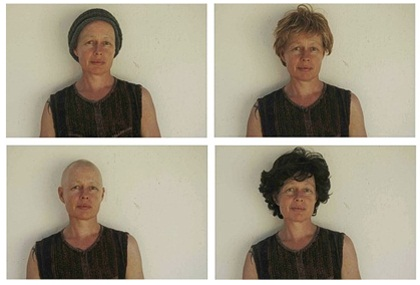
In March 2008, Derrick discovered that a lump found in her breast was cancerous and learned she would have to lose her breast. In her recent show at the AVA, ‘One in Nine: my year as a statistic’, Derrick turns her camera upon herself to record this life changing event, and her subsequent fight against the return of the disease. (One-in-nine is the proportion of women in South Africa who contract breast cancer).
Ever the photographer, Derrick had herself photographed on the operating table, with a difficult-to-view image of her breast being cut away from her body. Chemotherapy followed the mastectomy, and the relaxed woman with the long blonde hair laughing up at the camera in Ignorance is Bliss - inattentive, pay no heed, have no time for, choosing to deny the lump (2007) becomes the drawn-faced, shaven-headed conscript in the frontlines in Trial – the art of trying, examination, by a test, suffering, attempts, a piece of ware used to test the heat of the kiln (2008). Metamorphosis – emerging one year later, changed person man or woman, permanence, progression, reclaim (2009) shows the exhausting battle won. Derrick, with her newly-grown short hair stands with her shirt open, showing the breastless side of her body, Where the breast once was, the curving tendrils of a vine-like tattoo cascade down over her shoulder, the symbol of growth, life and affirmation.
Other photographs show Derrick with her daughters, Tess and Amy, and the costuming and paraphernalia of battle – wigs and hats. Not on the show for lack of space, but certainly a part of this body of work and included in the small catalogue are portraits of other women who had contracted breast cancer, women Derrick met during her own treatment, not all of whom made it through to recovery.
In her efforts to convey all of her emotions and feelings to her viewing audience, Derrick has appended lists of associative words to her titles: a photograph of a fabric replacement breast pegged to a washing line is entitled Hang on? – come unstuck, detach, unfasten, free. Why reconstruct, whose ideals? These titles may well convey more information about the object and Derrick's attitude to the disease she is fighting, but, at the same time, the string of words and phrases seem a bit of an information overload, giving the show a little too much of an educational twist. But once an activist, always an activist, and perhaps that is what Derrick intended.
The show also represents the first time Derrick has used a digital camera and colour for some of her images and of necessity, a few of the photographs have been taken by others. In her efforts to remain true to her professional principles, Derrick decided against using Photoshop to tweak any of the images; this quickly reveals that our viewing eyes have become accustomed the enhancements that digital editing provides and one registers that some images need a little more contrast or a touch of sharpening. In the end, using these techniques to get the most out of an image is no different from dodging or burning in the darkroom.
But these are minor quibbles. In ‘One in Nine’, the tenacity and vision that drove Derrick forward on her earlier forays have been turned in on herself and her own battle, a battle foregrounded on behalf of all women, and a documentation of a truly awful year spent in the ‘kingdom of the sick’, as Susan Sontag has called it. Although some of the photographs function purely as notes for the record, the show includes certain iconic images which, no doubt, one will see in a number of contexts in the years ahead as emblematic of this everyday yet riveting struggle.