artthrob artbio
Anton Karstel
By Chad Rossouw
Anton Karstel
Prime Minister,
2009.
Oil on Canvas
35 cm x 28 cm (Detail).
Anton Karstel has been active as an artist for over 20 years. Working in a variety of media, although most consistently in paint, his career has spanned from the infamous Laager exhibition at the Africus Biennale in 1995 through to a large retrospective with a comprehensive catalogue at SMAC Art Gallery in 2009.
art events calendar
VIEW FULL CALENDAR
buy art prints
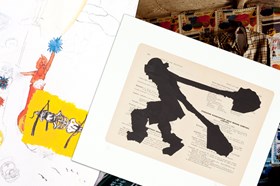
edition of 60: R70,000.00
About Editions for ArtThrob
Outstanding prints by top South African artists. Your chance to purchase SA art at affordable prices.
FIND OUT MORE Editions for artthrob



MODUS OPERANDI
Karstel’s work has two distinctive currents: paintings and installations, although both are connected by an incisive conceptualism and interest in 20th Century South African history. Karstel’s painting is characterised by a thick impasto, which disrupts the surface and dissolves the forms of his images. This breaking down of images is not, however, in service of an Impressionistic shimmer, but rather attempts to break through representation.
In his work Extract (2001), he painted a series of views of South African cities from early 20th Century photographs, which seems to both present and undermine a sense of South African cities as modernist utopias. This use of the form of paint to ‘crack through’ conventional interpretations of images is further exemplified in two other series. In Kerkraad NG Gemeente Lyttelton-Oos (2008), Karstel presented a massive installation of 65 portraits of the members of the 1988 Dutch Reformed Church (NGK) council in Lyttelton-East in Pretoria. Rendered in sickly greens, yellows and reds, in the artist’s dense impasto, the portraits seem to bear the weight of South African history, a sagging awfulness hanging off portraits whose original photographs would have been intended as honorifics.

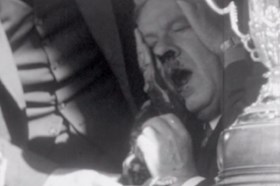
In Prime Ministers and Beach Girls, official portraits of old South African prime ministers are rendered in muddy fat strokes and juxtaposed with pictures of beach babes in sexy poses, dissolving under Karstel’s relentless paintwork. The similar handling forges an uncomfortable relationship between apartheid’s power structures and white desire. In his most recent series of paintings, Youth Day (2012), he repaints old film footage, frame by frame, interrogating representations of the past (read a review of that show here)
Karstel’s work does not simply involve painting however. His installations have taken various forms, often focusing on the photographic image. A work entitled Wild Thing (2004) is a photographic dissection of a Nyala (an apartheid-era police armoured personnel carrier), made from a composite of square photographs, and laid out in a flat topographical manner on the floor. Looking partly like an animal-skin carpet, it closely shows the rust, flaking paint and old rubber of a vehicle in ruin. Here, a shift into this medium reveals the incisive gaze of the photograph, which becomes deeply troubling and engaging.


ARTIST'S STATEMENT
Like many post '60s painters I get a perverse pleasure from working with unadulterated ingredients; that is, I don't stray from the inherited oil on canvas. But instead of attempting to resuscitate the medium I sift through its products, sampling bits of technique. I'm not expressive in my painting and I'm not interested in nurturing a unique signature. I'd rather apply extracts from existing handwork. I also confine myself to the existing forms contained in photographs. The paintings are transcriptions that recontextualize. The isolation of images on the canvas intrigues, similar to the Surrealist strategy of extricating objects in order to discharge meanings.
I have, as an arbitrary constraint, decided to dwell as a subject on images from books, films and photographs that I collected from my family home. This project of extracting material has been ongoing since the mid 1990s. I intend to spend the rest of my adult life rummaging through these husks. A parallel project is to compulsively paint five South African prime ministers. The moral consensus that condemns these men to infamy grants me a license to assault their representations. The portraits range from disfigurement to honorific portraiture. Showing the Apartheid leaders in a positive light elicits reproach, as does the gratuitous violence of their disfigurement. The point of these paintings is to wade around in this quagmire.
I often install paintings in large combinations. I have also felt free to venture outside painting practice to do installations with found objects, photographs, etc. These projects echo the material in my paintings and include things like the church, the police and labour; subjects that haunt this country's collective memory.


WHAT OTHERS HAVE SAID
Tongue-in-cheek and fingers crossed, he poses necessary questions about cultural censorship, the social and historical construction of identity and the problematics of political comfort-zones. –Brenda Atkinson, Mail & Guardian 1997
Karstel’s cloyingly lovely paintings address the failures of 20th-century millenarrism, and vividly remind us of our disappointed hopes. They possess elegiac overtones and project an undertow of yearning, absence and irretrievable loss. –Lloyd Pollock, Cape Times 2001
Anton Karstel is a formidable painter, and one who operates at a contemporary cutting edge. He mesmerizes viewers with an ability to create imagery that slips in and out of fixed visual comprehension and hard-and-fast narration, all the while honouring the solidness and uniqueness of the age-old medium. –Melvyn Minaar, Cape Times 2008
In simultaneously fixating upon and relinquishing the promise of photographic realism, Karstel becomes the restless mapmaker determined to entice the viewer, not by the detail of topographical place, but rather by the promise of a series of spatial absences. For one, the representational act embodies a ferocious gutting that disarms the vehicle of its dimensional presence and violently relegates it to the increasingly visible past. - Rory Bester on Wild Thing, Art South Africa 2004.
CURRENTLY
Karstel is moving studios, with no particular or definite future plans. As he states, he works towards opportunities and ideas as they present themselves.
CURRICULUM VITAE:
Born Pretoria 1968, South Africa
BA(FA) University of Pretoria 1990
MA(FA) University of Pretoria 1995
Selected solo exhibitions
2012 Youth Day, Smac Art Gallery, Cape Town
2010 Nirox Project Space, Johannesburg
2009 Paintings and Photographic Installations (1989-2009), SMAC Art Gallery, Stellenbosch
2008 Kerkraad NG Gemeente Lyttelton-oos, Joao Ferreira Fine Art, Cape Town
2004 Wild Thing, Franchise, Johannesburg
108314N, Pretoria Art Museum
2003 Trail-blaze, Association of Visual Art, Cape Town
2001 Extract, Joao Ferreira Fine Art, Cape Town
1998 Wonderful South Africa, Millennium Gallery, Pretoria
Pol-aesthetic, Civic Gallery, Johannesburg
1997 Too Close for Comfort, The Rembrandt Van Rijn Gallery, Johannesburg
Selected group exhibitions
2002 Once were Painters (KKNK), Oudshoorn
1997 Graft (Second Johannesburg Biennale), National Gallery, Cape Town
Purple and Green, Pretoria Art Museum
1996 Earth and Everything, Arnolfini Gallery, Bristol, UK
The Way West, Newtown Galleries, Johannesburg
1995 Springtime in Chile, Museo de Arte Contemporaneo, Santiago, Chile
Brown and Green, Pretoria Art Museum
Laager, Africus Biennale (fringe), Newtown, Johannesburg
1993 Real Art, ICA, Johannesburg
Collections
University of Pretoria
Development Bank of Southern Africa
Gencor
The Pretoria Art Museum
Pretoria Technicon
Sasol
Vodacom
UNISA