‘For What It’s Worth’
Dillon Marsh at Brundyn
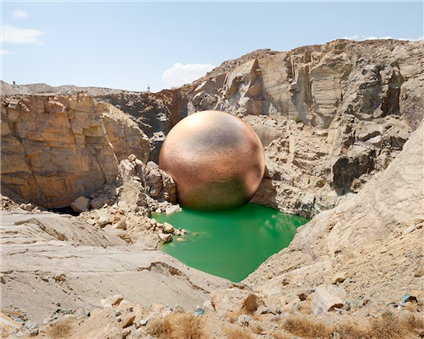
Brundyn+ is pleased to present ‘For What It’s Worth’, an exhibition of photographic works by Dillon Marsh. Marsh explores a pertinent part of the history of South Africa, one that is effectively shaped by the mining of natural resources such as copper, gold and diamonds. From the discovery of diamonds in Kimberley in the 1800s, the inhumane living conditions of miners under apartheid rule, and the recent Marikana shootings, activities in and around mines seem to correlate with the current political conditions of the state. He critiques the process by visualising the total amount of raw material extracted from specific mines. Marsh’s juxtaposition lays bare the startling reality of how little is actually extracted relative to the amount of damage inflicted (to both the natural landscape and the miners themselves).
The titles of Marsh’s works present statistical information about the mines. Elaborating, the artist states that:
South Africa’s first ever commercial mine, the Blue Mine in Springbok, began operating in 1852. More mines opened soon after as copper deposits were discovered in the surrounding areas. This, in turn, boosted the development of small towns in a relatively remote area of the country, as workers settled nearby. By 2007, however, most of these mines had run their course and production had stopped almost completely. This presents an uncertain future for the towns and people of the region.
Upon engaging with the images, the viewer is aware that 3 535 tonnes of copper were extracted from the Blue Mine in Springbok between 1852 to 1912; or that West O’okiep Mine in Okiep provided 284 000 tonnes of copper between 1862 and the early 1970s. These amounts appear colossal, however, when contrasted against the carefully compiled imagery of this data, the gigantism of the numbers suddenly diminishes.
The representation of the amount of copper and diamond mined at these various locations is an indication of the imperial capitalism that motivated the existence of these structures. Through the silence that has poignantly been captured, the lack of inclusion of human beings, the ghosts and souls of the occupiers of the space are felt through the photographic image.
‘For What It’s Worth’ thus speaks to the fact that most of the mines are no longer in use, and most of the towns seem desolate and lack immediately visible human life. The land was mined and exploited for all its worth, and then deserted. Some exist as monuments, signifying the reinforcement of a capitalist society and economy driven state, while others are just simply forgotten or never even occupied the consciousness of the South African public.
04 December - 24 January
'Anyway, the Wind Blows'
Various artists
The function of myth is to empty reality: it is, literally, a ceaseless flowing out, a hemorrhage, or perhaps an evaporation, in short a perceptible absence.?-Roland Barthes, Mythologies (1957)
Brundyn+ is pleased to present 'Anyway, the Wind Blows', a group exhibition conceptually framed around the notion of myths.
In his influential text Mythologies, Roland Barthes proposed that in semiology, myth removes history and context from signs and replaces them with loaded or reductive connotations posing as common sense and assumed truths. Taking this view as a starting point, the exhibition examines the demystification of contemporary myths as well as the potential for myths to be deliberately implemented as a strategy of critical examination.
Sanell Aggenbach both interrogates and intentionally perpetuates the assumptions and iconography of the momento mori genre, examining the shifts that take place in moments of personal significance when viewed through that particular lens.
Similarly, Alex Emsley uses the language of still life painting to turn a focus on seemingly banal, ubiquitous objects. In so doing, Emsley’s obsessively detailed paintings elevate these objects from the quotidian in a similar vein to Barthes’ location of modern myths within the everyday.
Incorporating signifiers with specific contextual relevance, Mohau Modisakeng looks at the idea of a post-1994, “new” South Africa as myth, focusing on the pervasive existence of oppressive (often violent) structures from the past that continue to have bearing on the present.
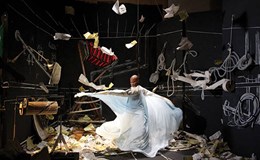
Sethembile Msezane looks at the politics of memorialisation within the context of public holidays (specifically Youth Day, Heritage Day and Freedom Day) by documenting a series of site-specific performances in which the artist assumes the role of various characters who engage with the mythologising of specific historical events into the demarcated leisure of public holidays.
While embracing a sense of freedom in contemporary gay experience in Cape Town, Jody Paulsen’s latest work simultaneously turns a critical eye towards a perceived lack of acknowledgement of the history of individuals such as anti-apartheid and gay rights activist Simon Nkoli, whose struggles have been crucial in paving the way for this freedom.
With one foot simultaneously placed in the past and present, Ezra Wube turns to historic Ethiopian folklore, reintegrating these myths into contemporary art practice and, by doing so, presents a form of storytelling that our current technological age is unaccustomed to.
Reflecting on the significance of the Haitian Revolution (the first successful slave insurrection in history), Jeannette Ehlers references stories of a Vodou ceremony at Bois Caïman wherein hundreds of slaves drank the blood of a sacrificed black pig to draw power for the approaching revolution.
Richard Forbes looks at the idea of emptying reality into nothingness in a tangible sense, visualising notions of void and absence as a sort of mythologising taken to its absolute extremity.