'Chroma'
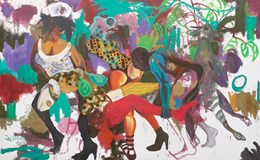
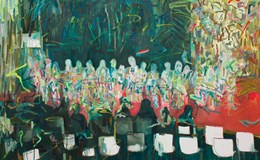
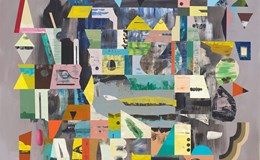
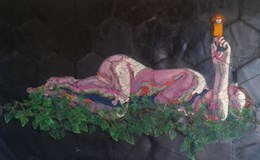
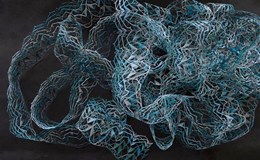
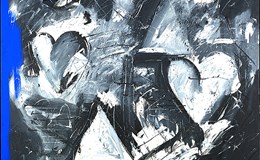
Group Show at STEVENSON in Cape TownSTEVENSON is pleased to present its summer 2014 exhibition, 'Chroma'.
The blood of sensibility is blue.
I consecrate myself
To find its most perfect expression.
- Derek Jarman
The exhibition takes its title from a book of musings on colour by filmmaker Derek Jarman. Written just before his death in 1994, when his vision was failing, the book draws from art history, philosophy, science, medicine and literature, alongside Jarman's acute observations of his own life, to reflect the extraordinary multiplicity of ways in which colour is experienced and comprehended by the human eye and mind. The exhibition sets out to explore colour from diverse perspectives, and various quotations cited here are extracted from his text.
Learning that colour is a fiction of light is one of the primary shocks of growing up.
- Tacita Dean, 'The Magic Hour'
Science declares colour to be an expression of vibration and wavelength: what we see is determined by the spectrum of light that an object absorbs or reflects, as perceived by the human mind and eye. Colour as we experience it is a phenomenon of perception, as colour itself does not have a physical and tangible materiality. This seeming paradox ensures that colour is grist for the philosopher's mill, prompting metaphysical questions about the nature of both physical reality and the construct of mind. Yet, because colour can only be perceived through the prism of mind, it is simultaneously, and inextricably, poetic and psychological; rarely do we speak about colour without invoking the realms of emotion and of meaning.
Red. Prime colour. Red of my childhood. Blue and green were always there in the sky and woodland unnoticed. Red first shouted at me from a bed of pelargoniums in the courtyard of Villa Zuassa. I was four. This red had no boundary, was not contained. These red flowers stretched to the horizon.
- Derek Jarman
The symbolism and metaphorical significance of colour has been contemplated since the dawn of artistic expression; however, in Western art history colour only become a subject in itself early in the 20th century. Malevich's Black Square, painted a century ago, in 1915, is perhaps the most radical manifestation of a shift that allowed more conceptual and abstract notions, including those of colour, to become part of the subjectivity of art. The scientific approach to the aesthetics of colour was arguably most carefully articulated in the work of Josef Albers, whose series of paintings of chromatic interactions started in 1949 and who published his theoretical treatise, The Interaction of Colour, in 1963, arguing that the perception of colour is governed by an internal and deceptive logic.
If one says 'red' (the name of a colour) and there are fifty people listening it can be expected there will be fifty reds in their minds, and one can be sure that all these reds will be different.
- Josef Albers
At the time of these aesthetic debates about colour and subject in the 1950s and 60s, South Africa was dominated by apartheid, which limited conceptual considerations of colour as subject: racial classification brought the focus to issues of black and white, literary and figuratively. It is interesting that in the 1990s the analogy of the rainbow, with its spectrum of colours, has been widely used to heal the fractures in this society, and in recent years the shifts that have taken place have allowed more spacious considerations of the experience of colour in art. This exhibition presents both works that see colour as their primary leitmotif and others that, often with new strategies, reflect on the politics of colour in recent years.
27 November - 17 January