'Shift'
Michael Smith at Res GallerySometime in 1987, while in High School in the small, rather backwards Natal town of Ladysmith, I was herded into the school hall with my peers for a weekly assembly.
Ladysmith was a cultural wasteland; no theatre, no movie theatre, radios barely able to catch Casey Kasem’s American Top 40 on 702 on a Sunday night; DEFINITELY no record shops.
Nonetheless, I was 14 going on 15; the first awakenings of what would become a lifelong obsession with rock music had begun to stir, in my head and elsewhere in my body. My good friend John Barnard had just introduced me to the Sex Pistols, The Sugarcubes, Joy Division and The Clash. The first 5 bars of ‘Anarchy in the UK’ were probably the most thrilling cultural experience I’ve ever had.
At this assembly, the usual parade of teachers and heads trooping onto the stage at the beginning of the session was foregone. Instead, the sight of a set of turntables and large speakers greeted us.
Now this was the late 80s: the entire notion of entertaining school pupils was completely foreign. Pupils had to be subjugated, subdued, and frequently told they were wrong. (This pervasive Calvinist mentality didn’t stop the local girls and boys from sexing up a storm: at one stage the Standard 9 and 10 groups took to calling Ladysmith High School ‘the baby factory’, because of the huge numbers of pregnancies amongst the senior girls. The idea that so many of those ‘skynheilige’ [sanctimonious] matrics up on their balcony would be singing ‘Praise, my soul, the King of Heaven’ on Friday mornings, and ripping their clothes off at the drive-inn on Friday nights, introduced me to the notion of contradiction.)
So we knew the turntables weren’t a cause for celebration.
A travelling pastor, Afrikaans but with a good command of English, came on the mic. He started, “Rock ‘n Roll is the Devil’s music. And in the next hour, I’ll show you why.”
Pastor Jim (it seems like a reasonable name: I honestly can’t remember that far back), spent the next 60 minutes quoting song lyrics, referencing band names and showing slides of album covers, all to track the alleged Satanism and anti-Christianity of popular music (predominantly heavy rock, but Queen got a mention, too). The tirade (and this was a tirade to make a Bible Belt Baptist quake in his loafers: spittle flying, fists bashing on wooden surfaces, New Testament verses thick on the ground), culminated in a demonstration of the dangers lurking for us in backmasked music.
Backmasking is the infamous practice of placing hidden messages in reversed tracks of popular or rock music. As early as 1982 in the USA, the religious right (as it would come to be known) was leading the charge against this perceived scourge. Whether overt in their challenge to Christianity (Black Sabbath, Judas Priest, Mercyful Fate), or more standard-issue libertine of ilk (Queen, Madonna, Led Zeppelin), the good pastor spun their records forwards and then backwards, revealing to a thoroughly malleable audience that rock and pop artists had, as their main goal, the winning of our souls for the Devil.
Variously horrified, guilt-stricken, but almost to-a-man convinced, the student body made a hushed retreat from the hall. Many pledged there and then to destroy their record and tape collections; to foreswear Madonna, Queen, and especially Black Sabbath, because Jesus needed them to. An eternity in damnation seems like a big ask for listening to some records.
(A week later, in a Friday assembly, I saw a guy in my standard, Kevin Buchler, had scratched out all the Gods and Heavens in his hymn pamphlet and written ‘Satan’ and ‘Hell’ in their place.)
Cut to the early 2000s, when I started working at Trinityhouse High School in Johannesburg; the tirades against pop culture had morphed into something more nuanced, more strategic. We hated television, we hated the blasphemy of movies, but some concessions had been made...
Assemblies had Pentecostal-style praise-‘n-worship sessions, replete with a rock band, emphatic love songs to the Lord and hands-aloft audience members. Christianity had, it seemed come to embrace rock’s language, its cues, its emotional triggers, its crowd-pleasing mannerisms, with aplomb. Youth pastors from Rhema and other charismatic churches visited regularly, looking for all the world like wannabe rock stars; being cool, looking edgy had become ‘tools of ministry’.
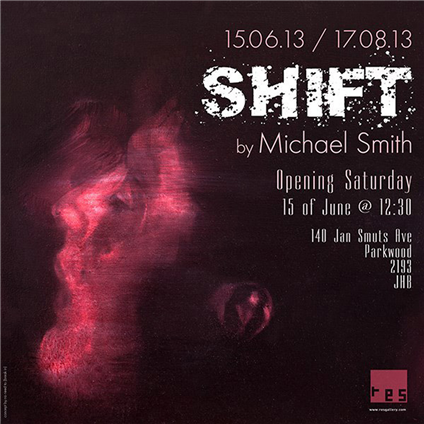
‘Shift’, my latest body of work, explores this overlap between rock and contemporary Christianity. The work seems to ask whether ideologies should ever be believed, given how interchangeable their moralities are. The work attempts to explore ideas of control and surrender, and how Christianity came to accept an emotive, sexualised set of representations in order to capitalise on an increasingly secularized culture.
15 June - 15 August