'Event Horizon'
Odili Donald Odita at STEVENSON in Cape Town
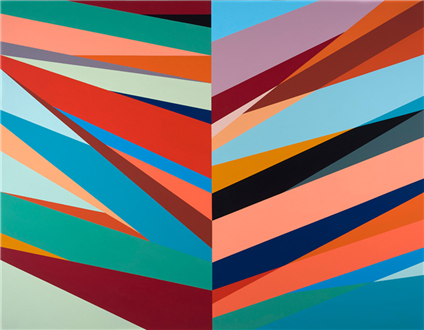
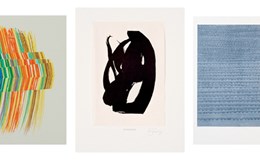
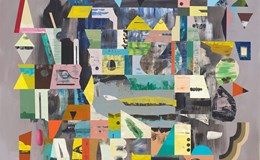
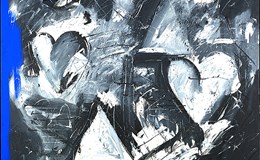
Stevenson presents an exhibition of six new paintings by Odili Donald Odita.
In an interview from 2011, the artist uses a countryside stream as a metaphor for his approach to painting:
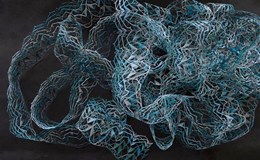
'During the summer of 2009 I was in Williamstown, MA, and spent some time on a farm by a rolling stream watching the water undulate and move over a rock-bed beneath it. For me this rock-bed, like a drawing, was structure and armature. Additionally, the water was like colour, moving this way and that in a flow based not only on the structure of the rock-bed beneath it, but also on its own condition of what it was, as well as what it could become with other forces such as the wind and sun that beat down on it.'
18 October - 24 November
'Magog'
Steven Cohen
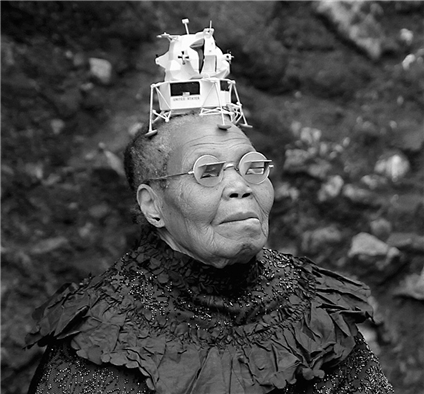
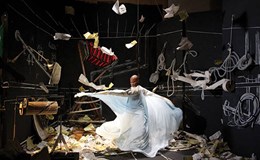
'Magog', Steven Cohen's second solo exhibition at Stevenson, focuses on works made by the artist with Nomsa Dhlamini, the domestic worker who helped raise him and who, aged 92, continues to play a pivotal role in his life and work.
The intimate relationship between Cohen and Dhlamini is foregrounded in The Cradle of Humankind, the performance piece that showed at the National Arts Festival, Grahamstown, in July this year. Including video shot at the Sterkfontein Caves, where many of the world's oldest hominid fossils have been found, Cradle 'was supposed to be about evolution', Cohen has said, but 'turned out to be a work about love'. In their various encounters, Cohen and Dhlamini appear as first humans, direct descendants of the apes; as people of contrasting skin colours, subject to anthropological classification; as luminous beings clad in brilliant costumes of fiber-optic light. The exhibition features new works relating to the Cradle performance and conceived for the gallery, including a video of Cohen and Dhlamini's interventions in the caves, and studio photographs.
Dhlamini takes centre stage as the subject and star of the video piece Maid in South Africa (2005), in which she sheds traditional clothing and performs the role of a domestic, cleaning and cooking while dressed in provocatively sexy attire. Of this challenging work, Cohen wrote at the time of its making:
'I am interested in the politics of nudity, not in sex as commerce. This work is more about the slave trade than the flesh trade. This is a personal film and a portrait of apartheid, a naive striptease and a personal confession. ... For 58 years, Nomsa Dhlamini maintained the houses of white people, cleaned their homes, fed their families and looked after their dogs. Maid in South Africa is not titillation but the simple truth ... We are unable to enjoy the luxury of not looking. We look. We see Nomsa's life, without glamour, spending her time cleaning the uncleanable, and her dignity in the face of exploitation.'
The connected roles of Dhlamini and Cohen's mother are dramatised in the 1998 photograph titled (in Yiddish) As die Muter Shreit Oifen Kind 'Mamzer', Meg Men Ir Gloiben (When a Mother Shouts at Her Child 'Bastard', You Can Believe Her), in which Cohen, in leopard-print stockings and heels, is flanked by these two muses, who respectively apply make-up to his chest and light a firecracker inserted in his arse.