cape reviews
A History of Failure
Chad Rossouw at Brundyn
By Clare Butcher20 March - 02 May. 0 Comment(s)

Chad Rossouw
The De La Rey (Launch),
2011.
Photograph
44.5 x 29.5cm.
Remember the furore when the de la Rey number reemerged a couple of years ago? At the time, the Department of Arts and Culture acknowledged the composer’s right to free speech, warning however of the tune’s subversive potential. Interesting: that line between subversion and critical potential. And it is the de la Ray which has once again surfaced as a vehicle of critique – a float, as it were, upon which to suspend what Chad Rossouw’s exhibition calls ‘A History of Failure’.
The young Rossouw (writer, lecturer and artist – the order given by his exhibition pamphlet) is a recent graduate of Michaelis, UCT, and the exhibition was submitted in part towards his Masters thesis there. As Rossouw’s first solo show with the Brundyn + Gonsalves gallery, there is a certain irony to his chosen title, allowing little room for expectation or the possibility of underachievement. Indeed it is the imminence of an Icarus landing which greets the viewer in the artist’s The Union of South Africa (2011).
art events calendar
VIEW FULL CALENDAR
buy art prints
edition of 60: R4,000.00
About Editions for ArtThrob
Outstanding prints by top South African artists. Your chance to purchase SA art at affordable prices.
FIND OUT MORE Editions for artthrob


Here, a one-meter wide disc on the floor sets a dusty, veld stage for an upwardly spiralling toy railway. Double the height of the average onlooker, the spiral abruptly ends midair while a small, three-carriage train set (modelled on the 1937 LNER Class 4488, the comprehensive exhibition brochure informs us), frozen in time, hovers only moments from the brink. The form of the work makes me think of Stuart Hall’s writing on the complex of global modernities emerging in the latter half of the 20th century. In his Culture, Community and Nation (1999), Hall envisages shifting power structures in postcolonial society as a double helix of ascending and descending nationalisms. According to Linda Stupart’s essay in the exhibition brochure however, this doubling is more aptly the result of ‘colonial clusterfuck.’
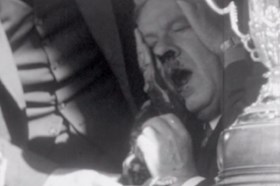
For a number of young artists and researchers attempting to recalibrate representations of a not-so-distant South African past, the shift lies more perhaps in the power of speculation, rather than in power in general. Appropriately, the bulk of Rossouw’s project is situated in the City of Gold and its dangerously ambitious history of tainted glory. The artist begins a five-part fictional narrative of aviation disaster with a soft-focus black and white photograph depicting the launch of a zeppelin, named The De La Rey (2012). In accompaniment to this, an engineering sketch (Plan), a series of (Postcards), warped and torn (Poster)s as well as a tattered linen (Fragment) (2012), deconstruct the rise and fall of an aircraft developed (supposedly) for Johannesburg’s Empire Exhibition of 1936. Missives in the displayed correspondence bear the stamps and seals of a bygone imperial era, where the sky was, quite literally, the limit. And while Rossouw’s attention to detail is commendable – the meticulous ageing of each postcard, with their antiquated choice of design and typefaces – the arrangement of this set of objects in a form mimicking that of the imagined zeppelin is a little overdetermined.
The cycle is broken refreshingly by two separate works: The Essex Castle (2011) and The Long Goodbye (2011). The boat, The Essex Castle, as we are told by the exhibition brochure’s omniscient narrator, never really existed. However, each element of the small installation - a mahogany wall mount, brass plaque and a model boat encased in a glass bottle - plays its part sincerely in the language of historical display. The artist allows further moments of slippage apart from the more obvious cues given by the accompanying text. The lid of the bottle reads ‘Three Ships Whiskey’ and the brass plaque neglects to mention where the celebrated sea voyage was leaving from and moving towards. These material and didactic ambiguities allow for a more nuanced interpretation of the artist’s hoped-for critical subversion.
Around the corner, a lone wooden bar, topped by a bottle of Rose’s lime cordial, gin and a half-filled tumbler, provides the recipe for a Gimlet as well as a Long Goodbye. Standing as documentation of Rossouw’s bar-tender piece first performed at Michaelis Galleries last year, I check for signs of authenticity – a smudge of old lipstick round the rim of the tumbler, a sticky trace of cordial on the shiny bar top. Stupart’s quoting of Susan Sontag in the exhibition essay rings true: ‘Devotion to the past is the most disastrous form of unrequited love’ (1977).
The self-proclaimed ‘bathos’ of the show is made incarnate in Rossouw’s Mars series (2011). The final stop in the show projects us 100 years into the future from when the National Party won South Africa's elections. There in 2048, we are told, the Reverend Enoch Nxele has relocated his 8000-strong congregation of The Church of Universal Kingdom of Christ to the final frontier – the red planet. This story of sci-fi conquest, again mapped out assiduously by Rossouw, is told by way of various faux-specimens. Three plinth-cum-lecterns are mounted individually by a rusted machete blade, an aged book, and a machine gun. Behind the line of objects, a framed colour image presents the new society, once more encapsulated, this time in a glass bubble (no sign of whiskey or any other alcoholic beverages).
I couldn’t tell if Rossouw’s other work, Cenotaph (2011) – a memorial-like structure of MDF, pine, paint and Jelotong (which I discovered is a member of the Oleander tree’s subfamily) – was meant to be so tightly juxtaposed with the Mars series. I had been informed by one gallerist upon entering that they were busy transporting some other pieces from the gallery storeroom and so I shouldn’t be surprised by a couple of misnomers in the exhibition space. And indeed, I wasn’t. Maybe I was too much caught up, but Rossouw’s exhibition had, it seemed, succeeded in erasing that separation between misnomer and intended subversion.
The DA, in response to the Department of Arts and Culture, stated that though the de la Rey lyrics may have been questionable, they were nowhere near as problematic as Jacob Zuma’s reviving of Umshini wami (‘Bring me my machine gun’). And while there may be no victors in a history of failure, Rossouw seems to suggest that we might as well go down singing.