
Current Review(s)
Ayanda Mabulu
Ayanda Mabulu at Commune.1In the time where dialogue sutures our moral and ethical aptitude, Andile Mngxitama, on the contrary, as an opening speaker in Ayanda Mabulu’s exhibit ‘The Native Opinion’ at Commune 1, called for the end of dialogue. He argued that in fact Mabulu’s work invites us to this termination of the dialogical charade. This is dialogue with the status quo. Mngxitama is neither a hysterical liberal nor dubious militant yelling ‘stop talking and start doing’. Rather, he understands and locates the over-saturation of dialogue as part of the schematic obscurity of the black grammar of suffering. That is, it disarticulates and passivizes formidable radicalization of direction, since the CODESSA negotiations that gave us our ‘negotiated revolution’.
14 March 2013 - 20 April 2013
Listings(s)
'Imvo Zabantsundu' / 'The Native Opinion'
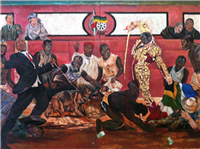
Ayanda Mabulu at Commune.1Commune.1 is presenst a solo show of poet and artist Ayanda Mabulu’s large-scale paper works and paintings. Best known for his provocative imagery, perhaps most notably his painting spotlighting Zuma’s private parts, this is Mabulu’s most comprehensive show to date and will include paintings that have never before been exhibited.
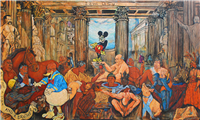
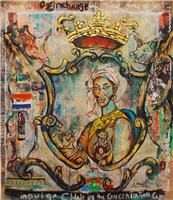
The title of the exhibition, 'Imvo Zabantsundu' / 'The Native Opinion', is the namesake of the first black South African newspaper published in King William’s Town. It provides an accurate starting point for Mabulu’s outspoken work that aims to create a dialogue around South Africa’s current political and social climate within the frame of post-colonial discourse. More specifically the work employs symbolism and political references that speak of the creation of identity through language, racism, poverty, religion, abuse and the corruption of power.
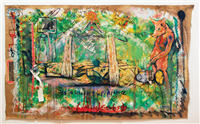
Mabulu’s paper works have an overt tactility; surfaces are worked and reworked with charcoal, paint, wallpaper, gold-leaf, magazine and newspaper clippings. Their colourful demeanor at a closer look reveals hard-hitting visuals. Poetic declarations of anger and indignation stand sprawled alongside explicit pornographic imagery which all seem to revolve around a primary central figure. The principal figures are figurative depictions- rendered in a stylistic mockery of traditional Western portraiture- that represent specific demographic sections of society while on occasion depict key political figures in South African history: Steve Biko, Desmond Tutu, Nelson Mandela, President Zuma and F.W. de Klerk.
A significant piece in the exhibition is Mabulu’s triptych Eve(2012). Two African woman stand on either side of a stockinged nude, she wears a crown resembling that of the Queen of England and holds in her hand a nibbled on apple. The two figures flagging her each carry a child on their back and aim a revolver at the reclining Toulouse-Lautrecian nude. The gun toter on the left stares directly at the viewer, her gaze both imploring and challenging, perhaps asking permission to pull the trigger; her twin on the far right has no gaze, she has been rendered blind.
14 March 2013 - 20 April 2013