cape listings
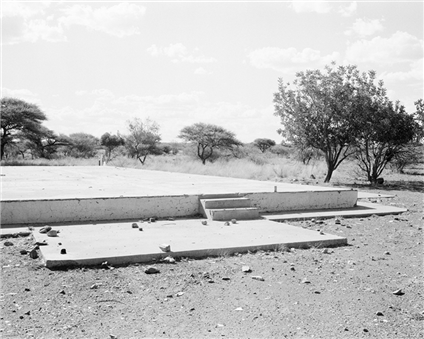
Jo Ractliffe
Platform, Schmidtsdrift,
2012.
Silver gelatin print
Image size: 36 x 45cm.
'The Borderlands'
Jo Ractliffe at STEVENSON in Cape Town
STEVENSON presents a solo exhibition of new work by Jo Ractliffe.
Since 2007 Ractliffe's photography has focussed on the aftermath of the war in Angola. 'Terreno Ocupado' (2008) explored the social and spatial demographics of Angola's capital city, Luanda, five years after the civil war had ended. That series was followed by 'As Terras do Fim do Mundo' (2010), which looked at the landscapes of war in southern Angola.
Ractliffe traces her interest in Angola back to the mid-1980s when she first read 'Another Day of Life' (1976), Ryszard Kapuscinski's account of events leading up to Angola's independence and subsequent civil war. The book resonated strongly with what was happening in South Africa at the time: great political upheaval and mass mobilisation against the apartheid government. Also, by then the South African Defence Force (SADF) was entrenched in Angola, fighting against the exiled Namibian liberation movement, SWAPO, and the Angolan army, FAPLA - a conflict later referred to in South Africa as the 'Border War'. Ractliffe writes:
For most South Africans Angola was perceived as a distant elsewhere - 'the border' - where brothers and boyfriends were sent as part of their military service. Now, over two decades since Namibia's independence and the withdrawal of SADF troops from the region, the 'Border War' remains something with which much ignorance and shame - for some, even betrayal - are associated.
During the making of 'As Terras do Fim do Mundo', I became curious about whether traces of the war could be found within South Africa's borders. I was interested in exploring the idea of a militarised landscape. But rather than spaces connected with the usual apparatus of South Africa's military, I wanted to search out sites that were intricately connected to that war.
Ractliffe identified and photographed at three primary locations: Pomfret, Kimberley (including Schmidtsdrift and Platfontein) and Riemvasmaak. All of these sites were occupied by the SADF during the mobilisation of the war and its aftermath. They also share histories of violence and dispossession during the apartheid era and, since our new democracy, reconciliation and redress. Ractliffe is interested in the intersection of these histories, how they impact now, in the present life of these places.
25 July - 31 August
also showing
Simon Gush
After The Work Stopped ,
2013;
HD Video still
© Copyright 2013, STEVENSON. All rights reserved.
'Work'
Simon Gush
STEVENSON presents a solo exhibition by Simon Gush titled 'Work'.
The exhibition interrogates the central role played by work in the construction and perception of our identities. The artist writes:
It is a conversation that often happens in airplanes. After I've avoided small talk for most of the flight, the person next to me will suddenly try to strike up a conversation as the plane starts its descent:
"So, what do you do?"
"I'm an artist."
"Really? And what do you do to make money?"
As it happens, I do have a job, like many artists, and make art in my spare time. This exhibition was entirely produced after and in-between work hours. This effectively means that I am an amateur artist. But despite the necessary role of work in my life, I locate my identity outside of my job, in my art. This arrangement is something that I think offers an interesting opportunity, not because I appreciate the value of an honest day's work, but because it allows me to view my art as the productive labour of non-work - as an alternative to work.
The exhibition 'Work' brings into focus prevailing perceptions of work, including the ideological dimension which maintains that 'work' is morally 'good'. Central to the exhibition is the video Sunday Light, which looks at the Johannesburg city centre as a site that is defined by the work day, and explores Sunday as a day of non-work. According to the script:
Johannesburg, like many big cities, is often described as vibrant and chaotic. This is true for the most part, but Johannesburg has another life that exists outside of the clichés we project onto it. Sunday in the city is not a day of trade, industry or consumption. Nor is it a day for business. As a result, it is a space in which the character of Johannesburg can inscribe itself. Johannesburg is a city that works and sleeps, and on Sundays it does as it will ...
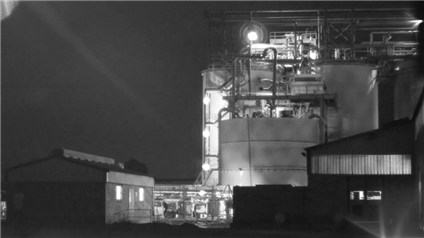
'After the Work Stopped' is a series of six static video portraits of work sites after-hours. The portraits are all filmed around City Deep, an industrial area located adjacent to the central business district. The videos capture the atmosphere of these deserted sites. Using a series of customised mirrors and filters, the headlights of cars passing unseen behind the camera are reflected back into the lens. The result is a choreographed movement of light that erases the image. One video will be shown each day of the working week.