'Museum of Contemporary African Art'
Meshac Gaba at Deutsche Bank KunstHalle'My museum has no walls,' says Meschac Gaba it is, 'not a model … it’s only a question'. His twelve-room installation, acquired in 2012, is the largest single work Tate has purchased to date. The Museum of Contemporary African Art 1997–2002 has no permanent place, but has been shown temporarily in different variations in museums all around the world. Now, seven rooms from this seminal work will be on view for the first time in Berlin to mark the beginning of a co-operation between the Deutsche Bank KunstHalle and Tate Modern. The artist has created a flag announcing the Museum of Contemporary African Art in Berlin especially for this presentation.
Gaba began working on this project between 1996 and 1997, when he first time in Europe on scholarship at the Rijksakademie in Amsterdam. The motivation for creating his own museum derived in part from the prevailing notion that contemporary African art simply did not exist. In the same spirit as artists associated with Relational Aesthetics, such as the American artist Felix Gonzalez-Torres and the Thai artist Rirkrit Tiravanija, Gaba was already using the exhibition context as an opportunity to create situations and places for social encounters here the meaning of an object is 'activated' through its interaction with the viewer. Gaba also expanded the borderline areas between art, architecture, and design. Despite this, he felt Western curators were hesitant to see his work in this con text. Moreover, Gaba was unable to imagine integrating his work into the canon of Western museums: 'I needed a place for my work, because it didn’t yet exist.'
The first room he made was the 'Draft Room,' which comes across as a preliminary sketch for his museum. A refrigerator containing discounted chicken parts, gilded loaves of bread, discarded food, a simple moneychanger’s table and decommissioned banknotes from Benin, cut into dots, are displayed as if for sale: Gaba alludes here to the overabundance of the Western economy, in which things are frozen and wastefully discarded, while even chicken-feet are consumed in his experience. Gaba uses money as a material to confront the structures which determine value, in the art and cultural world and beyond. Inspired by his own reality of living between Holland and his native Benin in West Africa, Gaba’s museum playfully questions a variety of relationships: between Africa and the West, local and global, art and the everyday. He translates themes such as globalization, ecology, religion, and power into a personal visual language that can be experienced in a multiplicity of ways in the various different spaces.
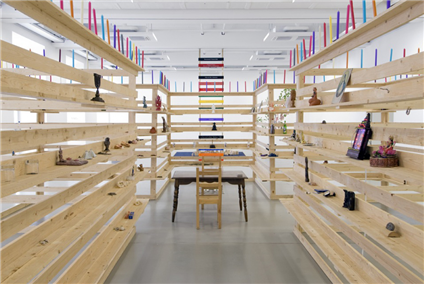
In the 'Architecture Room,' the visitor can design his or her own museum building using wooden building blocks. A stylized ladder indicates how this project developed toward its official conclusion in 2002. On each Plexiglas rung, the curators and institutions that housed the museum are recorded. Actual currency notes bearing the faces of personalities from art and architecture lie on a desk that serves as an 'Artist’s Bank,' while homemade bills featuring the portraits of famous artists who were inspired by African art hang on the 'Money Tree.'
Spaces customarily found in a museum, such as a shop and restaurant are here transformed to include artists who are invited to contribute objects and prepare and host dinners for members of the public. In the 'Art and Religion Room' objects and symbols of Christianity, Buddhism, Judaism, Islam, and Hinduism are brought together with various different African religions in a cross-shaped wooden structure, challenging their hierarchies and differences. Devotional objects are combined with ordinary objects such as plastic dolls and rear-view mirrors, suggesting that spirituality is rooted in everyday experience in the world, the market-stall display hinting at the relationship between religion and business. The space is further activated and the nature of belief explored through the occasional presence of a Tarot card reader.
In the 'Library', making knowledge freely accessible, visitors are encouraged to browse art related and children’s books displayed with their covers visible on simple shelves. The 'Curator’s Table' is covered with banknote dots includes books by curators who have worked with Gaba. The exhibition concludes with the 'Humanist Space' eight golden bicycles. Each of these bicycles, available for visitors to ride, carries the African logo of the museum and transports the museum’s aims and cultural message into the city space.
In the context of the exhibition, some rooms of the 'Museum of Contemporary African Art' can be activated for and by visitors.
20 September - 16 November