'Damascus Gate'
Ricky Burnett at Gallery 2'To the Palestinians it was the Bab al-Amud, the Gate of the Column, but Lucas rejoiced in the common English name, the suggestion of a route toward mystery, interior light, sudden transformation. He sat for a while over a Sprite, taking in the sensations of the gate, and then set out quixotically in search of something stronger.'
Robert Stone, 'Damascus Gate'.
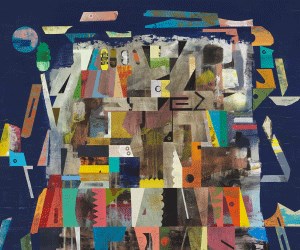
The paintings in Ricky Burnett’s latest solo exhibition are deceptively simple. Small objects, made up of bands and strips of monochromatic colour: the canvasses withhold any sense of narrative and avoid making statements. They are inward turned, self- absorbed carriers of nothing more than paint, the very materiality of which is the only subject matter.
The paintings are internally coherent, even or especially when the paint exceeds and coagulates at the edges of the canvas. Every part relates to every other part: composition is everything. Elegantly brittle, the paintings hold together like skin. Nothing is out of place: every mark, bruise, smear, stain and incision makes sense. You can feel it.
Clearly these are products of concentrated thinking and intentionality, but also of blind feeling in the dark. One can sense the painter’s painstaking consideration in every cut, furrow, groove, line, thickly loaded brushstroke and erasure, while every decision derives from doubt.
The materiality of the paint contributes to the physicality of the paintings. They may be small, but they have body. One can think of this in terms of the writer Don DeLillo’s observation that he uses a typewriter because he likes to watch the letters stamped into the paper. As if the words are material things, with generative substance. As if every letter matters.
Here there are no declarations about the politics of identity, which motivates so much contemporary South African art, ad nauseum. There is no tedious, superficial babbling about the role of art in society: the completely pretentious idea that art can make a difference to actual suffering. Burnett does not buy into the dubious notion that art must be an exercise in academic, sociological and psychological posturing. The paintings are nothing more than paintings, the remainders of hours of solitary labour and craft, and it is precisely this that gives them presentness: grace revealed in exile, absconding, loss and longing.
(Written by Dr Gerhard Schoeman, March 2014)
17 April - 07 June