international reviews
Faces and Phases
Zanele Muholi at FRED London Ltd
By Danielle de Kock24 June - 04 August. 0 Comment(s)
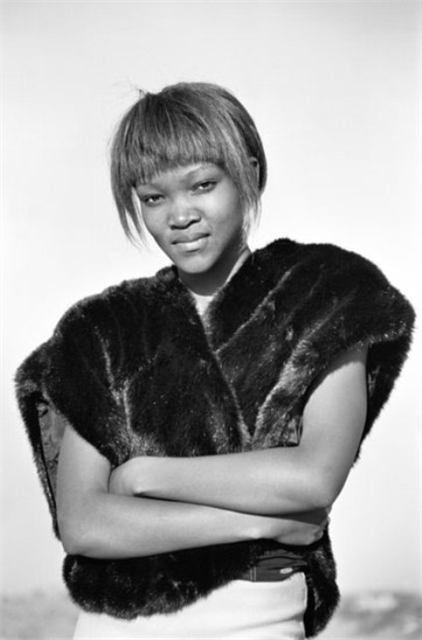
Zanele Muholi
Tumi Mokgosi,
2009.
silver gelatin print
76.5 x 50.5cm.
In August 2009, at the opening of the 'Innovative Women' exhibition in Johannesburg (which showcased photographs by Zanele Muholi as well as nine other black South African female artists), the Minister of Arts and Culture Lulama ‘Lulu’ Xingwana walked out before giving her proposed opening speech. The minister found certain images on the show offensive in their display of ‘naked bodies presumably involved in sexual acts’ (Xingwana, as quoted in Mail & Guardian March 04, 2010). According to reports at the time in the Mail & Guardian, the minister was particularly offended by Muholi’s images of black women affectionately holding each other in bed, deeming the images sexually explicit.
Considering the ubiquity of naked bodies in the media, and the similarly frequent suggestion of heterosexual sex, Muholi and many others saw the minister’s actions and subsequent statements as blatantly homophobic and potentially causing the perpetuation of hate crimes against black lesbians in South Africa. In the ensuing debate, various opinions surfaced which raise questions about art in post-apartheid South Africa: Do artists have a responsibility to fulfill a program of ‘nation building’, as the minister suggested? If so, what exactly is the collective vision for such a nation? And how does a delineation - if one is indeed needed - between art and pornography, fit into this vision?
These questions remain interesting in revealing the very particular climate of the art scene in South Africa, in contrast to the state of affairs in many Western countries where images and performances of a far more explicit nature are so pervasive as to be almost banal. In light of the apparent specificity of the South African scene; a country that accepts homosexuality in its democratic constitution while (as Muholi points out) many homosexual people are constantly subjected to violent hate crimes, one wonders about the significance of the location of Muholi’s current exhibition, 'Faces and Phases', in London. An English audience will inevitably read these portraits differently, and it is possible that the bravery evident in the sitters’ consent to being represented is somewhat diminished. While resisting the tendency to generalize, one must acknowledge the difference between being ‘queer’ in London and being ‘queer’ in Soweto. Muholi’s portraits emphasize the importance of the continuing struggle for the acceptance of sexual orientation and the need to acknowledge the vast differences in its acceptance in different contexts.
art events calendar
VIEW FULL CALENDAR
buy art prints

edition of 25: R3,500.00
About Editions for ArtThrob
Outstanding prints by top South African artists. Your chance to purchase SA art at affordable prices.
FIND OUT MORE Editions for artthrob


The images in Muholi’s current exhibition do not, at first glance, appear to be of the kind that offended Xingwana. Large-format, black and white photographic portraits of 24 people, each with a palpable individuality and a direct, confrontational gaze, populate two walls of Fred Gallery in London. The A4 paper document listing the titles of the works on display reads - with the detailed naming of the subjects including personal nicknames such as ‘Kalmplex’ or ‘Skipper’ - like the membership list for an exclusive club. The viewer who enters the space without having read Muholi’s thought-provoking and eloquent statement (published on the gallery’s website and in the accompanying catalogue), and without prior knowledge of the themes of Muholi’s artistic engagement, may be forgiven for wondering what the criteria for entry into this visual community might be.
Muholi's own words add clarity. These images seek to address the lack of positive visibility for Lesbian, Gay, Bisexual, Transgender and Intersex (LGBTI) people in South Africa (in particular, visibility for Muholi's own community of black lesbians). Through this knowledge, the viewer’s engagement with the portraits acquires a specific cognitive filter. The power of visibility becomes what the images communicate: much of Muholi’s work attempts to create a presence for black queerness. Her work operates as what she terms ‘visual activism’ and serves to ‘mark, map and preserve our [‘black lesbians’] mo(ve)ments through visual histories’. Yet even a cursory knowledge of South African sexual politics brings with it the awareness that such visibility constitutes much personal risk. Muholi explicates the frequent violence perpetrated against them, saying that ‘black lesbians are targeted with brutal oppression in the South African townships and surrounding areas. We experience rape from gangs, rape by so-called friends, neighbours and sometimes even family members.’
The sense that these portraits represent a community of people united through their fight for recognition in an environment where hate crimes (such as the harrowingly-termed ‘curative rape’) continue to afflict them is further emphasized in the exhibition by what initially appeared to be a rather strange curatorial choice. The decision to group the bulk of the portraits on one wall of a space which could easily have accommodated a more evenly-dispersed arrangement at first seemed to create an uncomfortable sense of ‘overcrowding’. In hindsight, however, the arrangement functioned to enhance Muholi’s call for visible unity. Yet she resists the impulse to homogenize. The individuals depicted are diverse in their choice of personal aesthetic, surroundings and occupation and Muholi’s question – is this a man or a woman? – remains, fittingly, unanswerable.
‘Is there a lesbian aesthetic or do we express our gendered, racialised and classed selves in rich and diverse ways?’ Muholi asks. An answer which one would assume to be in tune with the artist's thinking lies in the title F'aces and Phases'. Through the individual subjects’ appropriation and recasting of items of clothing and hairstyle stereotypically associated with either end of the male/female binary, these aesthetic symbols lose their inherent gender and become incapable of fixing identity for the individuals.
The verbal or textual symbol of an individual’s name is conventionally assumed to provide evidence of their gender, yet here, again, the subject’s names (which are also the titles) appear simply as caveats rather than facts. Names like Penny, Nosizwe, Nosipho, Thembi or Lebo, which are conventionally female names, belong to subjects whose gender cannot always be squeezed into such a box. Other names cause the viewer to wonder whether they have been chosen by the subject (rather than given) to provide protection from stigmatization and potential hate crimes. Gender ambiguity is of course only ‘ambiguous’ if we choose to believe in an absolute ‘feminine’ or ‘masculine’ identity as a starting point, and I would suggest that part of the success of 'Faces and Phases' is its refusal to adhere to any fixed notion of identity and to depict gender as performed rather than inherited. This idea is illustrated in the exhibition’s accompanying catalogue where Muholi has effectively chosen to allow some portraits to appear on their own while others are twinned and thus provoke dialogue across the page. The portraits of two people who share both the first name of ‘Tumi’ and the place of Yeoville, Johannesburg are placed side by side in the book and one cannot help but be struck by their divergent choice of aesthetic signifiers; a suit, shirt, tie, short hair and a stance stereotypically associated with the ‘masculine’ for Tumi Mkhuma and a fur shrug, long highlighted hair and a somewhat demure and stereotypically ‘feminine’ stance for Tumi Mokgosi.
In light of the current controversy surrounding Zanele Muholi’s work, this recent series of 'Face and Phases', with its confrontational portraits, provides an important counterpoint to the more overtly sexual images which sparked the debate. Here we are reminded that to fix identity is to exclude many who do not adhere to the constructed norm. Being lesbian or gay is about sex (as is being heterosexual), but it is also about ordinary individuals like those in the portraits, with ordinary lives and the ordinary need to define personal style.