cape reviews
Brice, Gratrix, Busuttil and the Principles of Painting: A review of three exhibitions
Lisa Brice at Goodman Gallery
By M Blackman10 March - 14 April. 0 Comment(s)
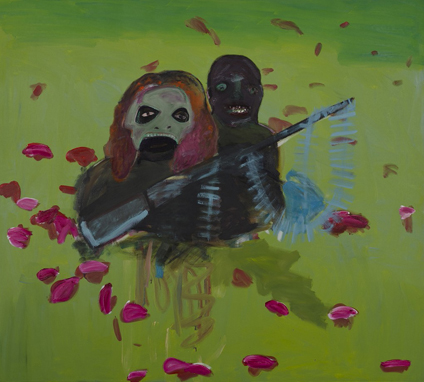
Carla Busuttil
Poppy Fields Forever,
2011.
Oil on canvas
170 x 200 cm.
The recent exhibitions of Carla Busuttil, Lisa Brice and Georgina Gratrix at various venues in Cape Town and Johannesburg have seemingly delivered some more hammer blows to the coffin lid of that incessant postmodern verbal tic, ‘painting is dead’. To add to this, Lisa Brice herself, perhaps unknowingly, delivered a few more nails to the undertakers at her walkabout at the Goodman Cape by sanctioning a liberal humanist theoretical stance.
Brice, in an off-the-cuff answer, said that she felt that painting is an investigative process, where one discovers how and what one is trying to communicate while painting. She added that her more conceptual works lacked that exploratory quality in that they were planned and constructed to a predetermined specification. The comment could have come straight out of that apotheosis of liberal humanist art theory, R.G. Collingwood’s The Principles of Art. This was, after all, precisely the distinction he made between what he called ‘art proper’ and ‘technical theory of art’, or craft.
Art, Collingwood claimed, is an investigation into an emotional state while craft, or technical art, is limited by its planned understanding of the final object. Certainly all three of the artists mentioned above seem to exemplify painting’s investigative underpinnings. To be sure, the strengths and weaknesses of each of their exhibitions rely on how intimately they seem to understand their subjects.
art events calendar
VIEW FULL CALENDAR
buy art prints

edition of 60: R8,000.00
About Editions for ArtThrob
Outstanding prints by top South African artists. Your chance to purchase SA art at affordable prices.
FIND OUT MORE Editions for artthrob


In Gratrix’s case, the fact that her exhibition at SMAC is titled ‘My Show’ is a clear indication of this assertion. Busuttil’s ‘Exit Mode’ similarly suggests something of her own position as émigré. It is, perhaps, only Brice’s title, ‘Throwing the Floor’, where a close personal association is not immediately intelligible.
Brice has come a long way - or perhaps it could be said she has come a long way back. From a Michaelis painting student, to conceptual artist, to a brief dalliance with painting on denim with bleach, she has now returned to painting with colour. In ‘Thowing the Floor’ one can clearly see the developing confidence of a painter reinvestigating a medium and finding its strengths. In fact, the show itself in some respects documents Brice working backwards to her beginnings, moving from monochromatic artworks right the way to the use of a full palette.
On first viewing the paintings, Brice’s subject is not immediately clear, and she offers no help in the way of titles, opting for the Untitled epithet throughout. As in Gratrix’s ‘My Show’, flowers recur several times. However, the matt tones and the dominance of tempera and inky reds and greens evoke a very different response to Gratrix’s overblown pseudo-romantic gestures. The vases are placed on dining-room tables accompanied by morning teacups, a milk jug and opened letters. On both occasions this dinning room setting is backgrounded with a shrunken and translucent figure of a child-like or aged apparition. In these paintings, solid objects are given an eerie, diaphanous quality, which fills the show with the disturbing feeling of ephemerality.
The idea of the transitory nature of life is heightened in her scenes of a bedroom. Three of these are painted from the perspective of a person lying in a bed, almost certainly convalescing. Here the ‘author’ is quite clearly not Brice. In Untitled (LBTTF002) she appears (one might almost say disappears) as one of the figures sitting on the bed in a pose of consolation. In Collingwood’s terms the ‘emotion’ that Brice is exploring seems not to be hers but rather the mental state of someone gravely ill. In a reversal of perspective, Brice literally seems to be investigating the patient’s state of mind rather than her own, but inherent in the conceit is that this dissolution is Brice’s too.
The ephemeral is expressed in a self-portrait, where she appears through the domestic objects and structures of the bedroom behind her. Through Brice’s body are revealed the structures of a domestic world of bedspreads and pictures frames – those very arrangements that create the world’s feeling of permanence. As in the other paintings, Brice creates a world where dissolution of identity is conveyed through her inky washing on the canvas.
The strength of ‘Throwing the Floor’ seems to come from an experience that has been lived, that is known and has been intently reflected upon. The only weakness in the show is perhaps where this contemplation of the evanescent nature of being becomes dramatic statement. This is when, in another painting, a Christ-like figure appears in mourning. Perhaps intimating a state of permanent devastation, the figure, unlike the others, is more solid and geometric in its rendering. This work demands an immediate, heightened emotional response from the viewer. In this instance the painting becomes a little too emotionally charged and it loses that preternatural passive reflectiveness contained in the others. But this is a rare moment and in no ways detracts from the honesty that Brice has always shown towards a complicated domestic environment, which is a pervasive theme in her work.
Gratrix’s paintings share, to a certain degree, Brice's domestic subject. For the most part the paintings of ‘My Show’ are portraits of people familial and familiar to the artist. Throughout the exhibition Gratrix’s discombobulated understandings of her own environment are explored, but unlike in Brice's work there is certainly nothing translucent in the paint application. Almost absurdly thick impasto is set onto the canvases in works that become more like low-relief sculpture than paintings.
Although jocular, Gratrix’s works display a disturbing seriousness through the frenzied paint application. The History of Dad, which sits at the top of the exhibition with its multiple eyes, comically skew teeth and a ribbon in its hair, displays a child-like affection for the grotesque. However, within the dark slashing shading of the neck and the slightly bruised eyes is the intimation that certain ideas, formulated in childhood, have been horribly distorted by the vision of the adult. Similarly, A More Famous Friend, BFF and The Baroness become, in the adult’s imagination, both humorous and disturbing.
The paintings of ‘My Show’ seem, at almost every turn, to adumbrate a feeling of acute disappointment, even revulsion, with the world and those falsely constructed images of what was once promised. As with many of her previous works, Gratrix plays with media and social constructs, recreating them as multi-eyed and snouted aberrations. Again in ‘My Show’ she displays a playful contempt for the contemporary world, cutting away at and exposing constructed images, while simultaneously creating and disfiguring her own.
There are only a few occasions where this frustrated uncovering of the image becomes a little forced. One example is in Please Call Me where the painted words on the image become a little overstated, forcing home what is already implied in the bunch of flowers painted under the scrawls. Another weakness in the exhibition as a whole lies, perhaps, with the gallerist’s demands. The gallery itself is immense and, in the paintings Lol Faces, Gratrix seems to be dabbing out embryonic ideas simply to fill a room. One, after all, only needs to go into the final room and view Jungle (a four-panelled immensity) to see how exquisite Gratrix’s finish can be. However, despite the few moments where her intensity seems to lapse, Gratrix consistently explicates, through her unique rendering, something that is intimately and intuitively understood.
Gatrix's intuitive approach is shared with her contemporary, Carla Busuttil. Busuttil’s work may not be familiar to a South African audience, for her Goodman show marks her first exhibition in South Africa since she left to study in London at the Royal Academy. And although a comparison to Gratrix’s work may be obvious, there are some significant distinctions between the two. One is that Busuttil’s canvases are far less worked than Gratrix’s and are, in a sense, painted sketches. As Busuttil stated in a recent interview, ‘I have my moment of reflection, down on canvas, then I can move onto the next thing.’
Also, unlike Gratrix, her subjects are often overtly political. In the past she has ‘sketched’ the likes of Eugene Terre’blanche and Winnie Mandela in an attempt to seek out and expose, as she says, ‘the essence of the thing being portrayed’. However in ‘Exit Mode’ these political references are surprisingly less recognisable. Rather than dealing with an obviously South African context, Busuttil seems to have moved towards a more globalised depiction of many of the world’s political ills.
In paintings such as Holy Tank Celebration and Poppy Fields Forever Busuttil explores the violence and hypocrisies which bombard us daily through the mass media. But there is something missing in these paintings – a deficiency that may be the result of an artistic distance from the subject. Particularly in Poppy Fields Forever there are some incidental and unresolved brushstrokes that seem, unintentionally, to express a certain lack of feeling and understanding of the subject she is engaging with. Of course Busuttil’s paintings rely on gesture and a calculated lack of finish, but one frequently questions just what is actually being contemplated in these works, and how close an understanding the artist has of the subject.
‘Exit Mode’ seems to gather strength with paintings like It’s Raining Sun, Bright Eyed and Pussy Tailed and Sell your House and Buy Gold. These paintings are more resolved, and seem to convey something of the feeling that is inherent in their titles. Here, like Gratrix, Busuttil begins to master a legitimate response to contemporary society in places that are not overtly political but are nevertheless just as serious.
If this criticism of Busutil’s (and indeed Gratrix’s and Brice’s) work is fair then perhaps it does confirm something further about the ideas of Collingwood. That is to say that artists, or at the very least painters, have a certain empirical underpinning to their work. A painter’s work, Collingwood suggests, is about an investigation into the emotional nuances of a subject and this relies on the artist’s own experience of that subject. Art is pursued ‘to bring us to know in a different way things which we already knew in some way.’