Gallery 1989, at the Market Photo Workshop
19.04 – 26.05.2017
Dedicated to the work of emerging international photographers, the upper gallery of the new Market Photo Workshop relocated building is showcasing Georges Senga Assani’s latest series ‘Cette maison n’est pas à vendre et à vendre’ which translates as ‘This house is not for sale, and for sale’. The Lubumbashi-based photographer has been wandering his surroundings, alert to the passage of time and history. Immutable concepts like history and time leave traces. Time enforces memory, history bequeaths and infuses collective memory.
 Always akin to capture those traces, Georges Senga Assani’s late visual enquiry addresses inheritance conflicts and disputes over material legacies. Houses here are bearers of an objectified memory that is complicit with intricate personal narratives. In this project, the traces that Assani is after are testimonies of those narratives. Offering his visual interpretation of a larger socio-cultural phenomenon, he made sure the actors of those conflicts are absent, reinforcing the presence of what is really at stake. Sadly, it is commonly assumed that value is found in materiality. What does occur when material value is subject to capitalists considerations or has simply deteriorated? The series elaborates on these questions, through a visual rhetoric that articulates around vacancy and omnipresence.
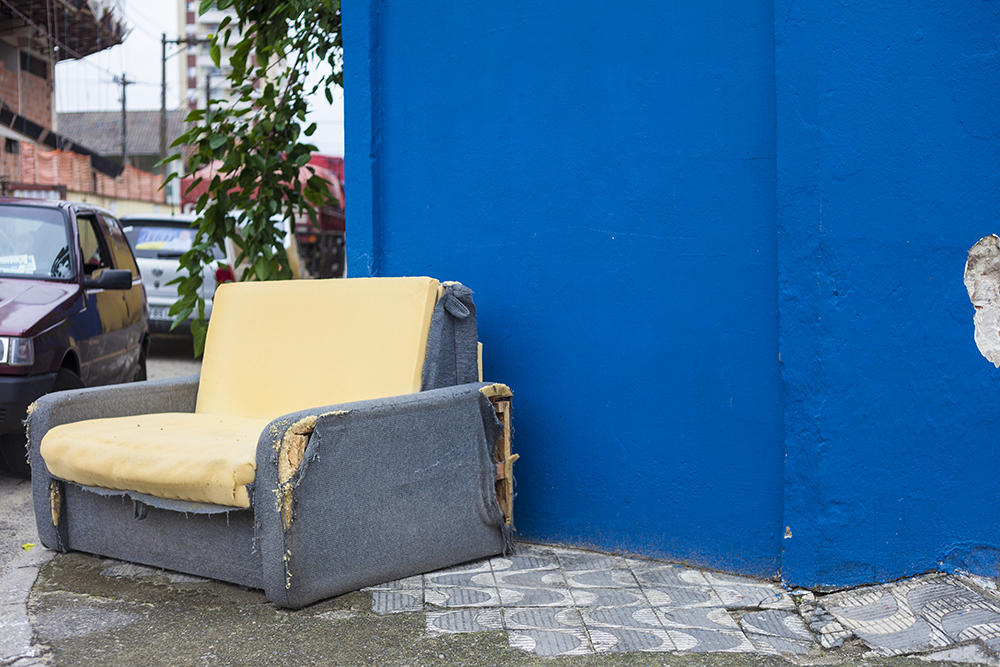
Opting for prints directly on the wall, the effects of merging with the existing architecture and of the proximity with the viewer accentuate the ordinary charge of Assani’s photographs. The two entry walls present the viewer with four large prints that set the tone of the series. An abandoned single couch and a cupboard on the streets of Praia Grande, São Paulo have never looked so inviting. Directing our gaze inside houses located in Katuba – one of Lubumbashi’s districts – Assani sets to reveal how their interior, stripped of human presence, is the vehicle of familial and individual narratives. There is a dialectic that runs through this series, many in fact.
 The triptychs clearly outlined read like peculiar compositions left to the viewer’s scrutiny, an ensemble that navigates between Katuba and Praia Grande. Even though the relative small size of most photographs invites for intimacy, it tends to partition the series, isolating the different glimpses of houses and objects in dialogue with each other. The whole becomes parts that the viewer will relate to one another under a common thread. Or, when does a personal and familial history become staged publicly? When do the constituents of intimate shared memory fall in social consideration or under the collective gaze? Whether a firmly stated hand-written gesture meant to keep at distance any potential buyer or a frontal billboard advertising the property for the same buyer, intimacy meets the public realm. This social statement might be frantic, flouting the embodying and almost spiritual quality of the ordinary. Assani’s project does justice to this violation.
Noticing large, bold inscriptions stating, ‘this house is not for sale’ on house façades in Lubumbashi – a phenomenon that can be extended to the Democratic Republic of Congo at large – Assani sought to look behind them, transcend the capital value that fuels inheritance conflicts and expose object’s familial vulnerability. Within our households, we often take an object’s presence for granted as if they had always been there. The series gives them an eye, staring back at the audience and testifying the familial histories, at times burden that they carry once in the midst of dispute or neglect.
 Staring at the seven triptychs that compose the exhibition, a dynamic of presence and absence is at play: the same dynamic that orchestrates inheritance conflicts. Inhabited or once inhabited, the absence of human presence in all photographs except one draws attention to the actual setting, allowing for contemplation and imagery. The photographs find their communicative strength in this respect. Presence and absence are old allies that play out in our urban and intimate surroundings the way nostalgia or perceptibility shape our experiences. Through this project, Assani’s intention is to open a window past the socio-economic nature of those conflicts in narrowing it, artistically, to phantom insights that reveal how value lies in familiarity, in the unintelligible passage of time. We are faced with a life-time decor, brought closer to the myriad of possible scenarios enclosed in the exhibited spaces. The images are timeless. Even though the setting gets fixed through Assani’s visual capture, the atmosphere of the inside photographs conveys movement, liveliness. The irresolvable question that heritage conflicts asks is addressed and becomes transparent in the series; have this house and its voiceless residents’ lifetime expire?
 Drawn into Assani’s carefully framed photographs, a subtle asymmetry makes the aesthetic pleasing. The photographic gesture somehow humanises the materiality of the objects portrayed. A mattress covered by crumpled sheets and cloths or a couch inclined horizontally on the pedestrian way, as visualised by Assani, are figures of resistance to potential acts of destitution. An object, a house is never only ‘standing there.’ It accumulates and carries a stack of vivid interactions, shared and personal moments that seem ungraspable at first sight. The series render them palpable.
‘Cette maison n’est pas à vendre et à vendre’ gives a very humanising account of inheritance conflicts despite dismissing individuals as photographic subjects. In doing so, it gets those disputes down to their paradox. The houses, interiors and objects pictured exist as atemporal entities that defy the capital value ascribed to them. Claiming a right or ownership over them is having the pretense to seize the many narratives imbricated in them, which are invisible but so diffused. The series photographs unveil that paradox. Recalling a copper ornament displaying a bible open at Joshua 24:15 and lurking above a television on one of the photograph, the attachment and personal bond that exist between a house and its resident takes on its profound meaning. It is a bond that cannot be translated into transaction value. Me and my household will serve nothing but the eternal, the almighty, the essence of our presence.
[calltoaction]