Nirox Foundation
09.12 - 24.12.2021
If we concur with Lao Tzu that substance requires nothingness, a vessel its hollow, then why do we also declare that nature abhors a vacuum? Because we cannot cope with nothingness, despite knowing that it defines us? Because we have replaced the void with God? Cynicism and fear underlie both Faith and Reason. We demand objective correlatives, things that fill a void, or mirror ourselves. What we term ‘Realism’ is as addled and hallucinatory as any other orthodoxy – deceptive, even criminal. It is no accident that Hellenic culture – which defines Western thought – valorised the bas-relief and abhorred sculpture in the round. The world must be wholly seen, understood, and absorbed.
Abstraction, a return to the void, is an inclination that defined art at the start, yet has been denied. Suppression is age-old. It is our fear of inarticulacy. We damn those who stutter and forms that resist an acculturated norm. Our craving for continuous surfaces, explicable hinges, graspable interfaces, explains our love of design. No matter that houses, par excellence, require a void. Houses – walls, windows, doors – are cut out. A transactional fluency requires holes, portals, thresholds. The continuous line is an illusion. Breakages occur at every instant. Rupture is the language of the void – its tongue.

Sibusiso Ngwazi, The Journey To My Son, 2021. Courtesy of the artist.
With this preamble, we can slowly turn to the paintings of Sibusiso Blessing Ngwazi, aka Sibusiso ArtIs3. A young abstract artist, Ngwazi has radically broken the contemporary mould of black portraiture, the defining cultural mode of the moment. Modern Western taste has persistently shackled black life to representation – the objectification and explication of the black body. This, despite the fact that African art understood abstraction as a portal to the divine long before the 500-year aberration of colonialism. By forcing black life – its mind, body, and soul – squarely into the Order of the Real, we subject it to a controlling gaze. Unable to slip the hold of white power, it remains forever visible, and thus, damned.
The taste for Black portraiture today is the metastasised variant of this chokehold. I can’t breathe, the definitive summation of the knee of power against the neck and chest of the black body. The black portrait, by rendering the body static, reducing it to a commodity performs a similar act of asphyxiation within a controlling white optic. Black artists know this all too well – some cynically and honestly so, in the case of a recent song by Snoop Dogg, Fabolous, and Dave East titled Make Some Money, shot in a gallery filled with black art. What we require in this revisionist moment is the representation of black power – the reclamation of its self-presence. And yet, despite this demand, one cannot ignore the creeping presence of the void. We see it in flattened neutral backdrops in Amy Sherald’s paintings, in the invasive colour blocking that cathects the bodies in Amoako Boafo’s paintings. A vacuum remains intrinsic to these artists’ works. Inversely, in the case of Kehinde Wiley’s paintings, it is the Rococo excesses of design, their ornamentality, which consumes the black bodies at their epicentre. The black subject remains either over- or under-articulated.
-

- Sibusiso Ngwazi, Self Portrati II, 2021.
-
- Sibusiso Ngwazi, Landscape, 2021.

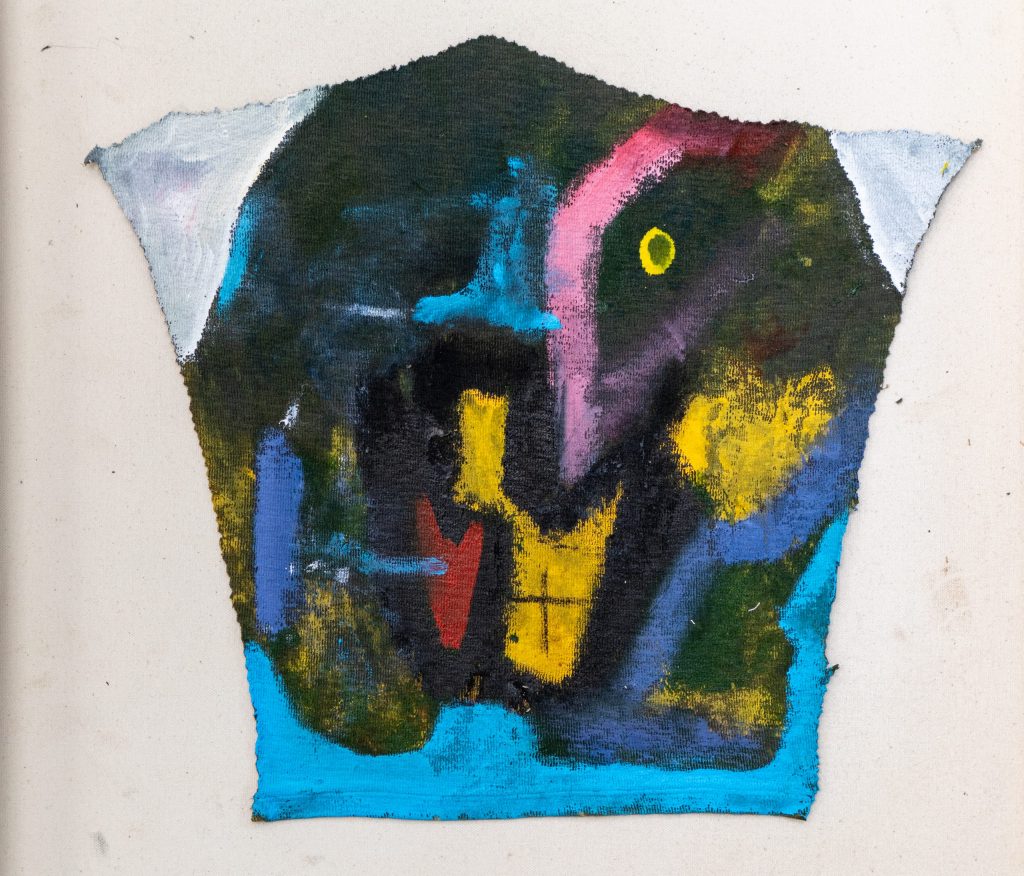
Sibusiso Ngwazi experiences none of this neurosis. Refusing the market for black portraiture – a latter-day variant of the slave trade; a legitimate way to install the black subject in one’s home or the secular temple that is the public museum – Ngwazi has decided to go ‘native,’ to become feral, to shatter the chains that bind. His paintings resist objectification; they allow for nothingness to consume the picture plane. Colour and movement replace the stately presence of the black body – painted impeccably in a greyscale by Sherald or fingered into impasto by Boafo. In some of Ngwazi’s paintings, the figure is discernible – unsurprising, given that all we make is anthropomorphic – however, in Ngwazi’s case, the figure is but a ghost, an apparition, an apparency. This artist’s decision is critical. He has chosen to disinvest himself in things – in the black body as a thing – and, thereby, liberate it from the Tyranny of the Real.
Counter-intuitive, Ngwazi’s paintings on canvas and paper appeal to our desire to breach the void, to sip from an abyssal cup. In them, we roam freely, uncensored. No power underpins the work, no knowing nous. Abstract art, of course, has its precedent too, but unlike Realism – or its calcified fallout, Pop Art – abstraction persistently strives for freedom. Its inchoate expression is a testimony to this. My own interest in abstraction in South Africa dates back a mere five years, when an art dealer asked me why Expressionism – German Expressionism in particular – had such a hold on South African artists. Frankly, I didn’t consider this the case, but then it clicked.
-
- Sibusiso Ngwazi, Make Food Not War, 2021.

-
- Sibusiso Ngwazi, Biological Mother, 2021.

All autocratic societies demand rebellion. In South Africa, a country strangled by imperatives – most notably, punitively, and exhaustively racial – it is unsurprising that monochromaticism is the dominant aesthetic. This is why colour is shunned by Protestantism, why Magical Realism is denied a right, and why Realism – the dull metronomic rule of fact – defines our literary output. Expressionism, perceived as an existential threat, must be routed out. But, it cannot and will not succumb. Instead, it finds ways to corrode the Reality Principle – a eugenic fake – and holds fast to an audience that desires the wondrous, strange, and inexplicable. That South African abstract art should have its last international outing at the Venice Biennale in the 1950s is telling. It is figuration which has since become the rule, primarily the black body as a sign of protest and liberation. Abstraction, it seems, had no place in a resistance aesthetic. This is ideological nonsense.
There is no greater creative expression of freedom than abstraction. If it terrifies most artists, it is because it destroys the quattrocento system – the illusion of a depth of field which affords the viewer a central point from which to absorb the world. Realism supposes the control of the eye; abstraction defies it. It either blinds or compels the eye to shift about erratically. At their best, Ngwazi’s paintings do both. He refuses a point, a control, surprises the eye with uncanny congregations of colour-line-energy. At the same time, they can still the mind, arrive at some inscrutable grace. Ngwazi’s paintings are pagan, animistic, wild, dystopian. One relishes, wonders. There is rarely a moment, I imagine, that the artist doubts himself. If he has freed himself and the viewer from over-assertion, he has also freed himself and the viewer of any latent anxiety. This is an astonishing achievement.

Sibusiso Ngwazi, Midday, 2021. Courtesy of the artist.
In the South African and global art firmament, Sibusiso Ngwazi is a radical anomaly. Unlike Stompie Selibi, a great contemporary South African expressionist, Ngwazi carries no pathology. His mark-making possesses zero despair. His colour palette, while wildly varied, possesses no patina of pain. If I am convinced of what will prove a stratospheric rise in the art world, it is because Ngwazi is the rare possessor of what we yearn for most – liberty, grace, wonder, surprise, delight. His is an uncanny realm – inviting, labyrinthine, stuttering, devoid of any guiding map. That we tumble into his world, as though into a rabbit hole, reveals our willingness to yield. This is because Ngwazi is fearlessly drawn to the void. His is a fathomless creative font. It is because Ngwazi refuses statement, because he will not be coded, that we trust him implicitly. In our current realm – policed, woke, righteous, and dull – he offers us well-being.
Far more can be gleaned from Ngwazi’s abstractions than from any Janus-faced black portrait. With Ngwazi, we can finally venture into what Frantz Fanon dubbed the zone of indistinction – a realm from which most have chosen to flee, opting instead to enshrine the suffering of the black body by turning it into a cause celeb, an ideological weapon, a site of resistance. While a powerful cause, it remains limited because the psyche and imagination that traverses this typology reveals a far more complex reality. For Fanon, that radically complex and liberatory realm is a zone of occult instability. It is there, he says, in this inscrutable realm, that the people dwell, where the revolution comes from. It is this realm that Sibusiso Ngwazi intuits. It is there that he beckons us. His is a call for communion – a deep that calls unto deep.