In 2017, Ernest Cole’s lost collection of 60,000 negatives and contact sheets was found in a Swedish bank vault. In 2023, Foam mounted this newly discovered archive to the public for the first time. Titled House of Bondage after his explosive publication in 1967, the extensive exhibition in the heart of Amsterdam offered a deep and dynamic perspective on Cole’s life’s work, surpassing previous in-person encounters visitors may have had with his fragmented oeuvre. Including images from Apartheid era South Africa in the 1950s/60s, as well as images from Cole’s subsequent exile in the USA, the exhibition featured display cases with negatives, contact sheets and news clippings, surrounded by large-scale reproductions of selected prints. Additionally, mounted tablets displayed excerpts from his research and field notes and, in an alcove, a rare video interview with Cole was screened, where he reflects on his exile from his home country.
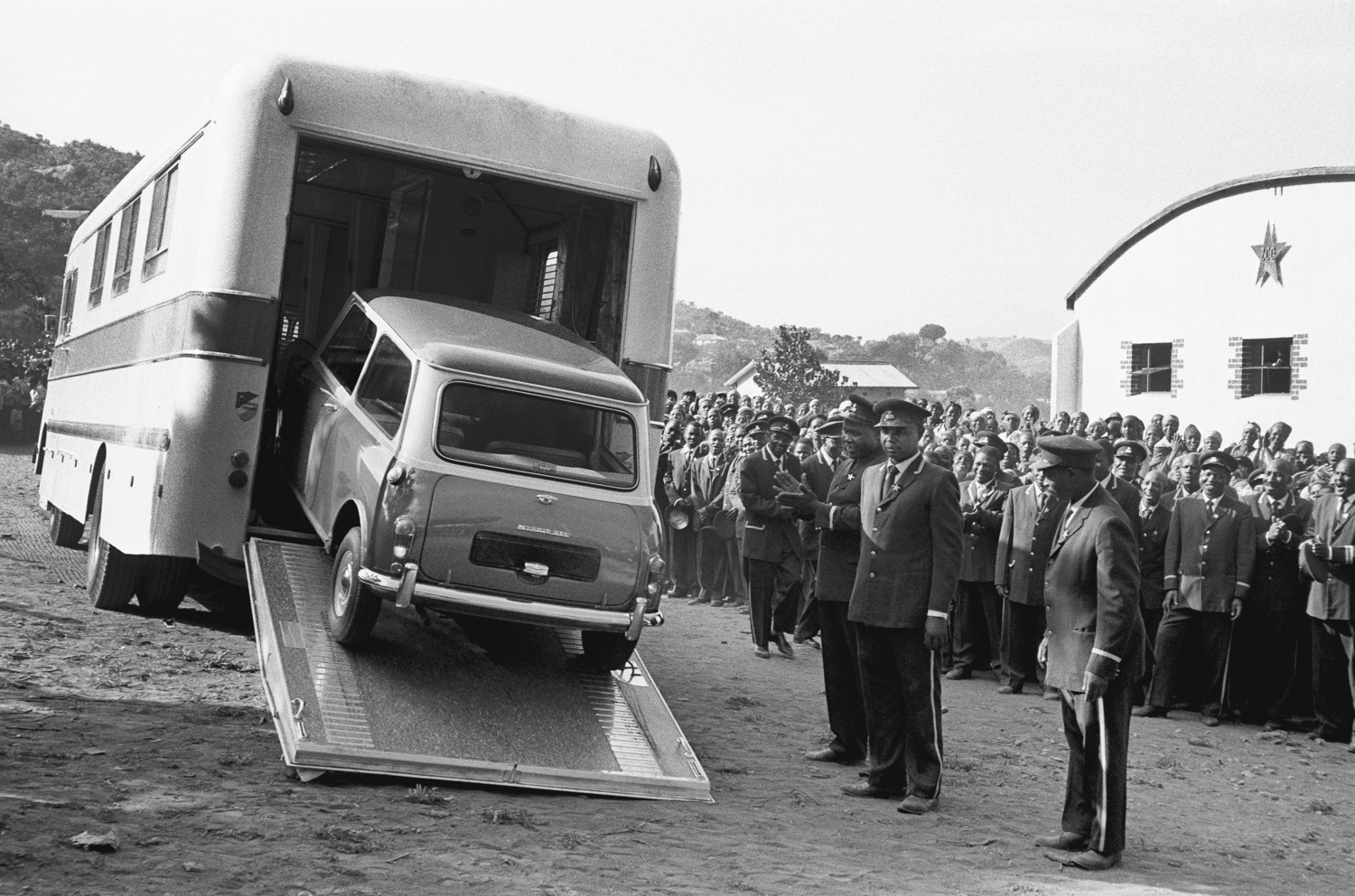
Ernest Cole, They inspect one result of their support: the bishop’s newly-acquired mobile home, n.d.
Courtesy of the Ernest Cole Family Trust/Magnum and The Photography Legacy Project. ©
Ernest Cole Family Trust.
Cole’s best-known photographs capture the harsh reality of South African townships, hospitals, schools, and segregated urban spaces during Apartheid. They reveal the challenges of cramped public transport, social issues like alcoholism, malnutrition, homelessness, drug abuse, and crime, as well as labour conditions in mines and domestic servitude. Lesser-known series published by Cole during his lifetime explore the lives of the Black middle class, and the customs of ancestor worship that endured in rural areas despite bullish interventions made by Christian colonialists. As part of the latter series, titled The Consolation of Religion, Cole briefly documented the flamboyant Zionist Bishop Edward Lekganyane, who emulated American evangelists with his fleet of luxury vehicles, diamond rings and personal fortune built on tithes from his rural congregation. Established in 1910, the African-led Zionist movement today represents the largest congregation across Southern Africa, a footprint that Cole could scarcely imagine at the time.
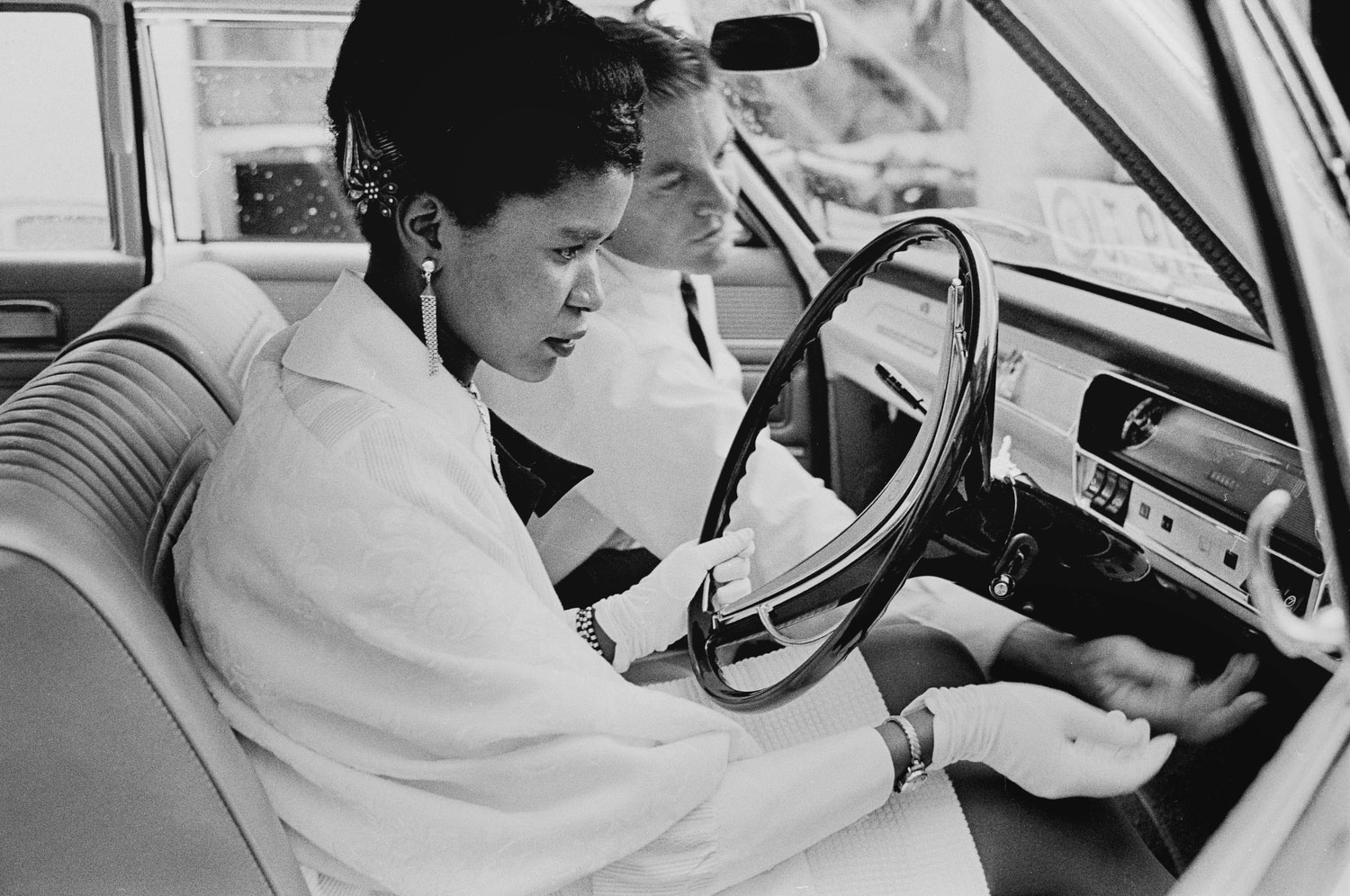
Ernest Cole, Learning to drive, n.d. Courtesy of the Ernest Cole Family Trust/Magnum and The Photography Legacy Project. © Ernest Cole Family Trust.
Beyond the scope of this exhibition, in recent years, it has become easier than ever before to examine and interpret Cole’s work through online repositories such as the Photography Legacy Project. A previously unpublished series (represented in the exhibition, online repository and the 2022 re-issue of House of Bondage by Aperture) focuses on “Black Ingenuity,”challenging any misperceptions that Black cultural production under Apartheid simply did not exist. Cole withheld this series at the time as he found it difficult to articulate these jubilant scenes to an international audience in combination with the more pressing themes of oppression in his work. Today, we are better equipped to celebrate the cultural richness and community that thrived under the oppressive Apartheid regime, without suggesting that the times were less severe than they appeared
Overlapping with the latter part of Cole’s retrospective exhibition and scheduled during Amsterdam Art Week, three contemporary South African artists opened solo shows in the Dutch capital in early June, namely Lungiswa Gqunta, Mawande Ka Zenzile and Simnikiwe Buhlungu. These artists depart from Cole’s explicit social documentary, tending towards the interior lives of contemporary South Africans.
The ground as you enter AKINCI gallery on Lijnbaansgracht has been transformed into an ancient landscape, covered in clay that slowly shifts and cracks as visitors step across it to enter Lungiswa Gqunta’s solo show, Sleep in Witness. The opening installation, titled Zinodaka, features hand blown glass boulders in aqua shades dotted across the landscape, representing inscrutable, mystic objects as place holders for forgotten knowledge. Plant Study II suspends one of the glass boulders in a nest of blue fabric covered barbed wire, a material ubiquitous across South Africa for keeping certain people in and keeping others out. Gqunta’s work engages with the historic criminalisation of spiritual practices, especially those centred around water, and acknowledges their loss, preservation, and evolution.

Installation view: Lungiswa Gqunta, Sleep in Witness, 2023, Photo by Peter Tijhuis. Courtesy of AKINCI.
Across all of Gqunta’s work, she creates a dreamscape that makes visible an interior font of wisdom, saluting the sanctuary of sleep to bathe in these essential sources. The video work Rolling Mountains Dreams inserts the artist’s body into a dreamspace of healing and remembering, as Gqunta embodies sacred rolling hills and water, simultaneously representing eternal movement and eternal stillness. The textile wall hangings Instigation in waiting I and II stem from a residency in Washington D.C. where Gqunta explored an abandoned greenhouse and reflected on the removal of indigenous plants from their home lands to be tamed and displayed in the heart of colonial empires. This limiting, curated mirage of a faraway land calls to mind Cole’s restrained portrayal of Apartheid South Africa, modified to suit the erroneous expectations of a foreign audience.
In 2015, Mawande Ka Zenzile remarked to Hansi Momodu-Gordon that his art practice centres on the “relationship between me and the making” of the work, insisting that the rationale of his oeuvre lives in others’ perception. His recent exhibition at STEVENSON titled Ayinethi iyadyudyuza! is inspired by the impetuous tokoloshe and an oft-repeated story where he rushes into a rural homestead from the rain. This chaotic imp wreaks havoc across the lives and imaginations of millions of South Africans, praying on the unprepared at their most vulnerable moments, usually in their sleep. It is curious that Ka Zenzile’s compositions betray none of this danger, alluding instead to balance and harmony. The work itself blends visual characteristics of land and water, prominently profiling the texture and colours of cow dung as an artistic medium. Personally, the colour transported me back to my youth in Gauteng, and the red iron-ore soil that creeps up walls and stains everything it touches.

Installation view: Mawande Ka Zenzile, Ayinethi Iyadyudyuza!, 2023. Courtesy of Stevenson.
Following the installation of the work in late May, Ka Zenzile added a barrier of salt across the floor, demarcating a space in front of the canvases that the viewer may not cross. Salt is a cleansing mineral across many parts of the world and is used to ward off negative or malevolent spirits, such as the tokoloshe. Much like Gqunta’s protective barrier around Plant Study II, I wondered whether Ka Zenzile’s ritual protects the viewer from the art, or if it protects the conceptual, physical and psychic link between artist and terroir from the reductive gaze of the Global North art market.
Simnikiwe Buhlungu’s solo show suggestures among us (Interlude) at Ellen de Bruijne Projects tugs at the ephemera of South Africa. A pared-down exhibition space leaves ample room for perambulation and interpretation, in the mode of Ka Zenzile. Her address to us (a collective) is felt across her notes to self and others in the works Theory Sketches (wallet) I and Theory Sketches (wallet) II. Here, she muses on the presence/ absence of misplaced things, questions whether intuition is individualistic or collective and laments the loss of a Pick n Pay SmartShopper card.
A reel-to-reel tape (Same-ing the Same Sames) runs across the length of the exhibition space through wall-mounted tape carriers, issuing forth a looped piano recording and snippets from a conversation with Makhulu Victoria Jabavu, last born daughter of Davidson Don Tengo Jabavu (politician, educator and writer). Buhlungu plays a piano that came to South Africa about a century ago as a souvenir of Jabavu’s travels in the UK, creating a spiritual portal that connects players of the past, present and future. The activities and rituals portrayed across all of the exhibitions are the ties that bind across generations, and constitute ways of knowing not wholly reliant on words.
A banner towards the end of the room, emblazoned with the moniker don’t I know you from somewhere?, beseeches connection with the viewer, implying, you seem familiar to me. The Khuaya modular stands invite visitors to reconfigure the space as desired, to sit or stand, stomp out a beat, speak or remain silent, or view the works from multiple angles. Viewing the banner from atop the stand closest to it, with a simultaneous view out of the window onto the Singel in central Amsterdam, brings forth a longing for homespun connection in this foreign setting.

Simnikiwe Buhlungu, Don’t I Know You From Somewhere? 2023. Courtesy of Ellen de Bruijne PROJECTS.
Marie-Louise Rouget is a South African archivist currently based in Galway, Ireland.
Featured Exhibitions
Ernest Cole, House of Bondage, Foam, from 27 January until 14 June 2023
Lungiswa Gqunta, Sleep in Witness, AKINCI, from 2 June – 15 July 2023
Mawande Ka Zenzile, Ayinethi iyadyudyuza!, STEVENSON (Amsterdam), from 2 June – 15 July 2023
Simnikiwe Buhlungu, suggestures among us (Interlude), Ellen de Bruijne Projects, from 2 June – 29 July 2023