Lawrie Shabibi
16.11 - 06.01.2026
Hamzeh Alfarahneh is curator of the group exhibition, ‘By the Movement of All Things’ staged at Lawrie Shabibi gallery in Dubai. The exhibition traces affinities and resonances between South African and Middle Eastern non-figurative practices, foregrounding lines of contact that complicate established regional and disciplinary narratives.
Featuring works by Igshaan Adams, Hamra Abbas, Diana Al-Hadid, James Webb, Bronwyn Katz, Timo Nasseri and Moshekwa Langa, the exhibition borrows its title from Aimé Césaire’s ‘Notebook of a Return to My Native Land’ and sets a tone of active participation, calling the audience to engage with the works by reflecting on their own lived experiences.

Installation view of ‘By The Movement of All Things’, 16 November 2025 – 6 January 2026, Lawrie Shabibi, Dubai
What drew your interest in the dialogue between South African and Middle Eastern abstract artists. How did you come about being interested in these intersections?
I’ve always been drawn to building cultural bridges across the Global Majority and its diaspora. Bringing practices from South Africa and the Middle East into conversation feels natural to me because these regions share layered histories, deep traditions, and ongoing struggles with how they are seen—or not seen—within the dominant art canon.
There is a real urgency in placing these practices side by side. Not to flatten them, but to highlight their realities, similarities, and differences. I believe this is a moment for the so-called “South” to expand the conversation, to rethink and revise whose knowledge and whose aesthetics are centered.
This exhibition is simply one way of contributing to that ongoing shift.

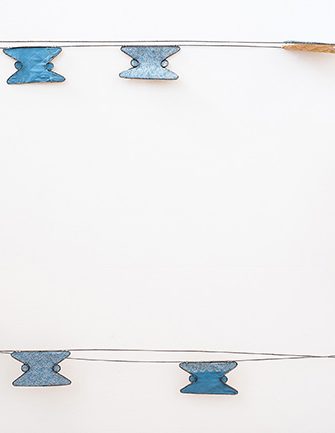
James Webb, ‘I do not live in this world alone, but in a thousand worlds (There is a light that never goes out)’, 2023, Water, ink, paper and glass medicine bottle, 14.5 x 7 cm
Can you speak to how you are thinking about knowledge production and knowledge sharing through this exhibition? How does this exhibition, in particular, propose new ways of approaching knowledge and meaning-making?
At first, I thought this exhibition would offer clear alternatives to dominant ideas of knowledge. But as I spent more time with the artists and revisited thinkers like Paulo Freire, Frantz Fanon, Edward Said, and Aimé Césaire, I realised that my role isn’t to provide answers—it’s to open questions.
The exhibition encourages viewers to slow down, look closely, and take their time. We intentionally chose not to use wall labels (except in Timo Nasseri’s case, where text is part of the work). In a fast-paced city like Dubai, I wanted the exhibition to resist instant gratification and ask people to engage more deeply.
The only wall text is Césaire’s poem, which sets the tone for the show. It’s the first thing the viewer encounters—a kind of invitation to be present, patient, and curious.
If there is one “proposed method” in the exhibition, it is complication. The world is complex, and knowledge cannot be simplified or reduced. Working on this show reminded me that no matter how much I learn or know, I will never know everything—and oddly, that realisation brings me comfort.

Installation view of ‘By The Movement of All Things’, 16 November 2025 – 6 January 2026, Lawrie Shabibi, Dubai
How would you describe your curatorial approach?
Curious and process-led.
That feels most true to me. By the Movement of All Things was shaped completely by the practices of the artists; their work guided the narrative far more than any preconceived idea I had.
My aim as a curator is to give artworks the space to do what they naturally do, without forcing a single narrative onto them. Especially with abstraction and non-figurative work, opacity is essential. The viewer needs space to feel, think, and interpret.
I’m also enjoying the challenge of questioning familiar “art world” definitions—like what abstraction can mean. In this show, abstraction stretches far beyond the European tradition; it includes practices rooted in Islamic geometric thought and the fluid, multi-layered nature of the Arabic language.
All of this has expanded my own understanding of abstraction as something much older, broader, and more alive than I previously imagined.

Timo Nasseri, ‘Babel V’, 2025, Steel, magnets, 73.5 x 19 x 19 cm. Courtesy of the artist and Lawrie Shabibi
Are there any moments of surprise that you encountered while working on this exhibition, not just from an organisational aspect, but rather in relation to the artworks themselves and relationships between them in the space?
Absolutely. This exhibition kept shaping itself in unexpected ways.
As the works came together in the space, I started to see new connections and new readings emerging—sometimes subtle, sometimes very clear. The show continues to reveal itself to me.
At this stage, I see three main themes forming: embodied movement, remnants of performance, and gestures.
These themes weren’t planned; they surfaced naturally through the works and their conversations with one another.
What does abstraction offer us in this moment?
For me, abstraction offers opacity. It gives us a way to understand ourselves and the world without needing everything to be explained.
‘By the Movement of All Things’ is on view at Lawrie Shabibi until 6 January 2026.