Two recent developments should concern South Africa’s contemporary art community. They matter because they reveal how easily governance can unravel when institutions hesitate. The handling of South Africa’s national pavilion at the Venice Biennale 2026 and the late-stage intervention in the Steven Cohen retrospective at the Iziko South African National Gallery (Iziko) are not isolated controversies. Together, they reflect a system struggling to act with clarity and resolve, exposing a deeper unease about how public institutions respond when their mandates are tested.
These developments are unfolding against a backdrop of uncertainty in South Africa’s contemporary art sector. Confidence has cooled, institutions move cautiously, and decisions are increasingly deferred. What is at stake here is not taste or trend, but the capacity of public institutions to act decisively when confidence thins and support can no longer be assumed.
In South Africa’s cultural sphere, the consequences of this hesitation have become impossible to ignore.
South Africa’s participation in the Venice Biennale 2026 is not an informal cultural exchange. It is a public function. The Venice Biennale remains one of the most significant platforms for contemporary art globally, where national pavilions operate as both cultural statements and exercises of public representation. It is a site of national ambition and symbolic power, underwritten by very real obligations. The pavilion is leased by the state and administered under the authority of the Department of Sports, Arts and Culture (DSAC). As an organ of state, DSAC is bound by the Constitution and by the Public Finance Management Act (PFMA). Section 217 of the Constitution is clear: when the state contracts for goods or services, or delegates a public mandate, it must do so through a system that is fair, equitable, transparent, competitive and cost-effective.
In this context, Art Periodic South Africa (a not-for-profit company established in 2025) emerged as a proposed partner in relation to South Africa’s participation in Venice. Any such partnership, however, operates within the framework of a public mandate. This obligation does not dissolve because an external entity offers to raise private funds or proposes an alternative operational model. Once a public mandate is delegated, procurement law applies. From a legal standpoint, the question turns on the nature of the function itself, rather than the source of funding. However benevolent the intention, compliance with constitutional and statutory obligations remains non-negotiable. To suggest otherwise is to treat governance as optional rather than foundational.
In practice, DSAC was constrained by an existing lease agreement and hesitant to commit public funding – a combination that allowed an unconventional proposal to emerge outside open, fair, and transparent procurement processes. This edition of the Biennale was widely anticipated to be a definitive moment for Africa and its diasporas, a discourse shaped significantly by the vision and legacy of the late Koyo Kouoh. Her influence on the global stage further underscores the visibility and heightened responsibility attached to South Africa’s national participation. To falter now is to fail a moment of profound continental significance.
It is tempting, in moments like this, to accept an irregular solution on the grounds that something is better than nothing, but that reasoning mistakes urgency for justification and treats the erosion of process as a tolerable price for visibility.
Subsequent to these events, in a recent social media statement (6 January 2026), Art Periodic announced that DSAC had terminated the partnership with immediate effect. No formal termination notice has been made public. While this clarification brings practical closure to Art Periodic’s role, it also draws attention to what did not occur at the beginning. Where a public mandate is unclear or improperly constituted, the obligation lies with the government to act within its mandate, and with any prospective partner to insist on that compliance at the outset, rather than proceed on an improvised basis. The absence of such insistence has contributed to a situation in which South Africa now appears to have no confirmed pavilion, at a point when time has effectively run out. What is the reputational cost to South Africa? What does an empty pavilion say about South Africa’s standing in the global cultural landscape?
What is at stake in Venice, then, is not a disagreement about curatorial vision. It is the integrity of public administration. When a process can be set aside because an arrangement appears more efficient or more appealing, governance itself becomes exposed. That exposure carries consequences well beyond a single exhibition.
A similar pattern of hesitation emerges in the handling of the Steven Cohen retrospective.

Steven Cohen, Golgotha, 2007-2009, Single-channel HD, video, Duration 20 min 8 sec
A retrospective, in its most exact sense, is a comprehensive view of an artist’s practice over time. It traces work from its earliest gestures to its most recent expressions, allowing the viewer to encounter the practice in an intimate register. It reveals not only development and refinement, but also rupture, contradiction, and failure. A true retrospective does not smooth over discomfort. It makes visible the blank spaces, the politically incorrect moments, the repetitions, the grief, the emotional risk, and the invisible line that runs through the work as it changes across years and contexts. It is not an exercise in endorsement or moral agreement, but an act of historical accounting that holds the work, and its tensions, intact.
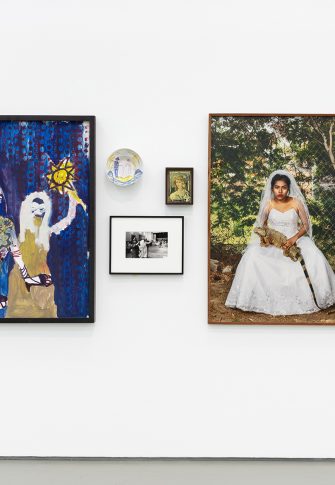
Steven Cohen is a well-known provocateur whose work has long occupied contested ethical and political terrain. In the context of this retrospective, public debate centred on specific groupings of work, particularly those referencing Cohen’s childhood family home domestic helper (who he considered a ‘second mother’) and longtime collaborator, Nomsa Dhlamini, in the ‘Cradle of Humankind’ series, as well as the ‘Golgotha’ series incorporating skull imagery. These works were not newly produced, nor newly encountered. They have formed part of Cohen’s practice for many years and have been publicly exhibited and debated across different contexts. Their inclusion in a retrospective was neither incidental nor unforeseen, but integral to presenting the practice in full.
The ethical tensions surrounding these works have long been understood. In ‘Cradle of Humankind’, Cohen’s work places the Black body at the centre of visibility, vulnerability and spectacle, inevitably invoking histories of exploitation, extraction, and racialised display. Such readings are neither incidental nor misplaced; they form part of a broader and necessary critique of how Black bodies have historically been rendered available to power, art and consumption. At the same time, these works resist a singular moral frame. Nomsa Dhlamini’s repeated presence across these works suggests not only representation but participation over time, raising difficult questions about agency, collaboration and consent that cannot be resolved by casting her solely as a passive figure. To deny that possibility is also to risk erasing her involvement and subjectivity.
The Golgotha series operates in a similarly unstable register. While they inevitably evoke histories of violence, dispossession and the anonymous dead produced by colonial economies, they can also be read as confronting mortality, anonymity and the persistence of human remains within systems that commodify even death itself. The skulls sit uneasily between memorial and provocation, refusing closure or comfort. None of these tensions is new, and none of them is accidental. A retrospective is precisely the space in which such contradictions must be held together, not resolved through late-stage concealment once the exhibition is already underway.
It is precisely this form of artistic inquiry that finds protection under Section 16 of the Constitution, which safeguards artistic creativity against reactionary interference, particularly where discomfort or controversy arises. When intervention arrives late, after curatorial approval and institutional preparation, it ceases to read as judgment and begins to look like censorship. By shrouding certain works in black fabric, the institution rendered that intervention materially visible, transforming institutional hesitation into a physical act within the exhibition space.
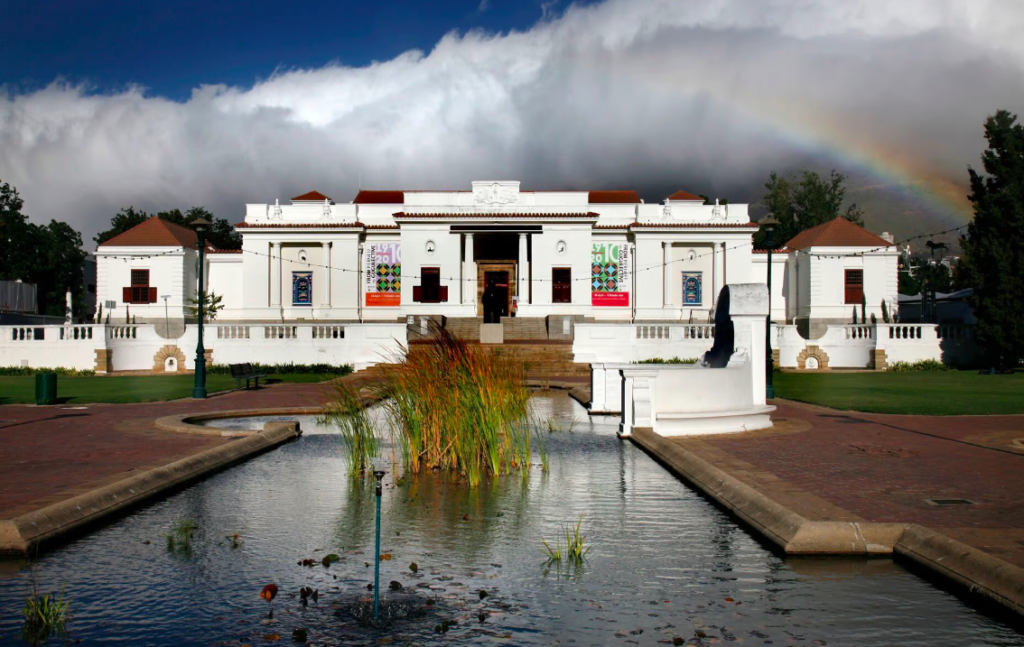
Iziko, as a publicly funded institution and a Schedule 3A public entity operating with institutional autonomy, is bound by constitutional obligations. When a public institution intervenes at the eleventh hour, the focus inevitably shifts away from the work itself and toward the institution’s understanding of its public responsibility.
In both Venice and the Cohen retrospective, the problem is not controversy. It is hesitation. In one case, a deliberate failure to follow the procurement process left governance exposed. In the other, institutional mismanagement was compounded by fear of consequence, resulting in censorship. These are not failures of intention so much as failures of institutional resolve. They suggest organisations unsure of their mandates, reluctant to stand by their procedures and reactive when steadiness is required.
For South Africa’s contemporary art community, this should be unsettling. These moments are not isolated missteps. They point to a gradual weakening of the frameworks that allow cultural institutions to operate with credibility and trust. When governance falters, artists, curators and audiences are left navigating inconsistency, unsure of where authority rests.
The question, then, is not whether these decisions were made in good faith. It is whether they were lawful, principled and grounded in responsibility. Institutions are tested not when circumstances are calm, but when they are pressured. In those moments, hesitation is not neutrality. It is a choice.
If hesitation becomes policy, the cost is not abstract. It is carried quietly and collectively.
Notes: This text was edited on 8th Jan at 12.26pm to rectify that Nomsa Dhlamini was employed in Steven Cohen’s family home – and not employed by Steven Cohen.
Hoosein Mahomed is a Cape Town–based attorney and director of CHURCH Projects, an independent contemporary art space. His work sits at the intersection of law, governance, and contemporary art practice.