

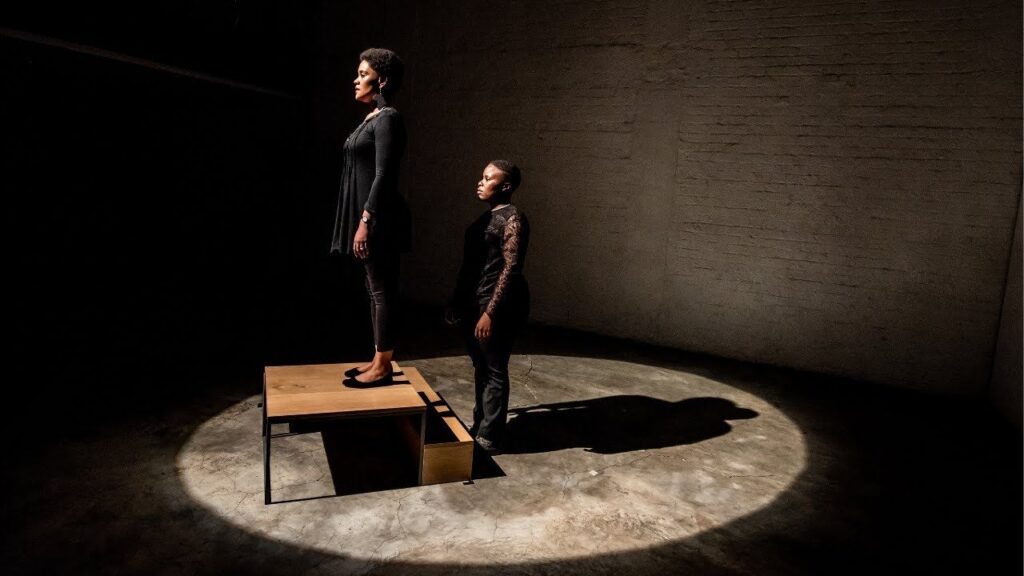
Gabrielle Goliath’s Elegy (2015- ) has an expansive, evolving capacity to enact solidarity that spans geography and time. Following the news of the cancelled proposed exhibition of Elegy selected for the 61st Venice Biennale, in the spirit of Elegy, I extend my solidarity to Goliath, curator Ingrid Masondo, team member James Macdonald, and the selection committee of the South African pavilion (Greer Valley, Molemo Moiloa, Nomusa Makhubu, Sean O’Toole and Tumelo Mosaka). Through this text, I offer my support as a concerned – and angered – member of the South African contemporary art community, a colleague and a friend. To this end, I want to address the significance of Elegy in the context of Goliath’s ongoing artistic and intellectual practice. In her oeuvre, Goliath draws our attention to present and historical losses, and her work challenges us by refusing the calcifying spectacle that conflates the deceased with violence.
Elegy needs to be seen, experienced and grappled with – as much now, as ever.
Elegy is an iterative, ongoing artwork staged numerous times since 2015, and has been shown in the United States, Germany, Brazil, Switzerland and across South Africa. The series commemorates women (contemporary and historical) and LGBTQ+ individuals who have lost their lives to the “normative crisis of rape culture and femicide in South Africa and globally”. In the text marking the 10th anniversary of Elegy, it stated:
“Refusing the objectification of bodies deemed rapeable and killable, Elegy asserts conditions of hope and avowal: of black, brown, femme and queer life as loveable and grievable.”
The work is realised through a repeated set of physical and performed elements: in a dark room, a dais is lit by a spotlight. Over the course of an hour, a group of seven opera singers hold a single, unbroken note between them. One at a time, a performer steps onto the dais and into the light, as the note is passed on from one singer to another, like a vocal baton. Every iteration of Elegy is accompanied by a written eulogy, either by a loved one or another invested individual, such as the commemoration of historical individuals.

Gabrielle Goliath, Elegy, 2015-. Courtesy of the artist.
I had the privilege of first seeing Elegy in August 2018, at the Centre for the Less Good Idea, Johannesburg, an iteration that commemorated the life of Eunice Ntombifuthi Dube. In Goliath’s words, I was drawn into the “absent presence” of Dube. It was one of the only occasions in my life that an artwork had me entirely overcome with emotion, noting too, the contemporaneous backdrop of the global #MeToo movement, and, at the time, the beginning of the Lesser Violence Reading Group (a collaboration between the Visual Identities in Art and Design Research Centre (VIAD) and GALA Queer Archive, which ran annually from 2018-2020) the first session of which was hosted by Goliath and Nondumiso Msimanga in Goliath’s Johannesburg studio.
In the years that followed, Elegy stayed with me. The “sung cry” continued to ring in my ears and in my mind. Seeing Elegy had such an enduring and profound effect that it formed a key part of my PhD thesis, which drew from the commemorations of Louisa van de Caab (shown in 2018) and Cornelia van Piloane (shown in 2019), two enslaved women who lived in the Western Cape in the 18th century. These iterations are significant as they are among the few contemporary artworks that engage with the history of enslaved women in South Africa.
For the work’s duration, Elegy asks us to “be there” for another; a task that requires a sustained commitment – even if symbolic. Experiencing Elegy, I felt personally tested in the act of listening and being present. As described by historian Saarah Jappie in her essay “Sitting as a Lesser Violence” (2022):
“Elegy also requires a level of endurance from its audience: to be present, to hold space, to remember. And mostly, to sit with discomfort: that of the commemorated individual’s story and the violence that ended their life (which audience members learn about from the written eulogy circulated in advance), and of bearing witness to this kind of mourning.” (Jappie, 2022, p. 31)
Seeing the work again in 2025 at the Institute for Creative Arts (ICA) in Cape Town (in a staging that marked Elegy‘s 10th anniversary), I realised each of us in that room collectively engaged in an inevitable confrontation of self. For some, of course, the call to be present did not land. But for others, Elegy spurred a pointed, directed kind of meditation; sending one on an internal odyssey of deep reflection, and leading one to ask: “What does it mean to mourn someone whom one doesn’t know, or could never have met?” Or, “What does it mean for the performers to mourn another physically, publicly, audibly?” I began to pay close attention to the idiosyncrasies of each singer’s resonance, timbre and force; the increasingly obvious strain on their voices, their laboured breathing as the hour came to a close. Each sung note insisted upon life. The work moved and marked me.
As demonstrated by 2025’s National Shutdown to declare femicide in South Africa a National Disaster, feminists so frequently bear the burden of the uncomfortable, structurally inconvenient work of reminding us – again and again – that we experience emergency daily under white heteropatriarchy. The Department of Sport, Arts and Culture minister Gayton McKenzie’s assertion that the proposed Venice Biennale iteration of Elegy does not “showcase South African artistic expression rooted in South African experience” is not only wholly inaccurate, but demonstrates a deeply uncritical conception of nationhood and artistic expression. The suggestion that Goliath or the exhibition could be used as a mouthpiece for another nation’s interests is offensive and undermines the integrity of the SA pavilion proposal review process, its panellists, and Art Periodic (which was established to introduce more effective organising for the Biennale).

Gabrielle Goliath. Personal Accounts. 2024–ongoing. Installation view of ‘Gabrielle Goliath: Personal Accounts’, on view at MoMA PS1 from November 6, 2025, through March 16, 2026
At its core, Elegy speaks directly to the reality of millions of South Africans. The proposed Venice iteration was planned to connect this South African reality of femicide to the Ovaherero and Nama Genocide in Namibia, and to the genocide in Palestine. As described by the pavilion selection committee in a statement published on ArtThrob, the femicide in South Africa was to serve as the central concern of the work, with the inclusion of the genocides in Namibia and Palestine. As seen in her works “Berenice” (2010-), “This Song is For…” (2019), “Beloved” (2023-), and “Personal Accounts” (2024-), among others, Goliath’s works frequently operate in relation to others, their stories. She asks us to listen sensitively and deliberately, and to consider the ethics and implications of hearing them.
Over the last 10 years, in its multiple stagings in different countries in commemoration of multiple people, Elegy has created its own lexicon. The work’s formal elements, repeated performed elements and the inclusion of eulogistic texts form a distinctive set of motifs. The recurring nature of the work powerfully binds together the performers, the people commemorated and the audience members. As a collection of iterations, Elegy has formed its own chorus and, through its written eulogies, a corpus of devotions. The work operates across multiple temporal scales, drawing direct links between historical and contemporary conditions of rape culture that render people marginalised. Minister McKenzie, knowingly or unknowingly, reinscribes this violence through his dismissal of the work and ultimately, the suggestion that no one would find any necessity or value in solidarity with those outside one’s immediate context.
The Minister’s inconsistent arguments against Elegy and its address of the genocide in Gaza lay bare the fault lines operating in SA’s art funding systems and aggravate instability in the entire arts and culture milieu. The abrupt revocation of support for the project suggests a disregard for the art sector, and it is gravely concerning that the minister appears to fundamentally misunderstand the nature of exhibitions at Venice, reducing the event to a tourism trade show to “sell [South Africa] to the world”. At its worst, the minister’s act of sabotage likely affirms local private capital’s raison d’être and has the potential to drive the art industry further into the arms of privatisation.
The precedent set by the unjust termination of the proposed South African pavilion exhibition signals more to come. Under these conditions, what do we owe each other when our work is beset by insecurity and precarity? As Goliath stated in her reflection on the 10th anniversary of Elegy: “The work is not over.” I support Goliath, Masondo and the curatorial team on the challenging road ahead. In doing so, I urge all of us to work towards a sector of mutual support, generosity, and accountability. I am honoured to follow Goliath’s principled example.


