It’s a tropical, sticky-air-Durban day, and we have settled into the air-conditioned room of the Africa South Art Initiative (ASAI) resource centre. Along with fellow practitioners and artists, we attended a panel discussion, ‘Curating Durban1The panel was moderated by Sumayya Menezes, with guest curators and creative consultants Zinhle Khumalo (curator), Lindah Majola (Hue Cafe), Rachel Baasch (Arts Historian), Azola Kwerqe (Independent curator and arts administrator at the KZNSA Gallery). ’. Framed to “bring together artists, curators and cultural producers for a roundtable discussion on what it means to curate in and from Durban today…”
What emerged from the talk revealed a need for curatorial practice to be better understood by the local practitioners, as well as to be challenged by new trends and decolonial thinking on what curating is.
The idea of “meeting in the middle” is a potential way of thinking about curatorial practice in Durban as a space of negotiation, between institutional and independent practice, between care and critique, and between visibility and marginality. It reflects a condition where curators work within constraints while simultaneously attempting to expand the possibilities of what exhibitions can do.
As the first question is opened up to the panellists, reflection on this morphs between the role of artists and curators in a city with its particular challenges and benefits.
Rachel Baasch responded that curatorial practice in Durban is often context-specific and that resources influence the final result. Zinhle Khumalo, an independent curator, sees the role of curators as storytellers on journeys with artists, expressing that art in Durban is often more raw, thus her curatorial practice is shaped by a need to employ modes of care in her process of exhibition building.
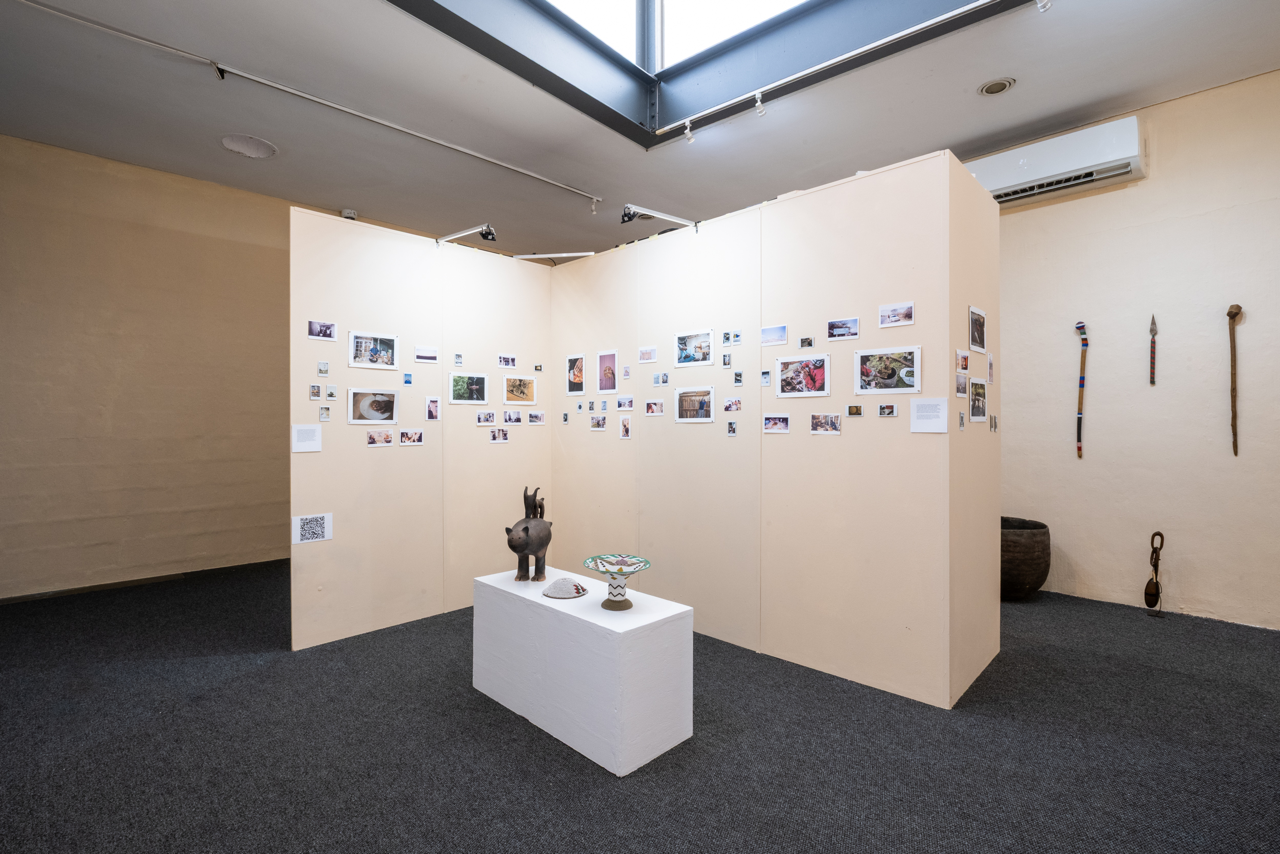
Installation View, ‘Okwethu Okwezandla’, 2025 curated by ArtsResearchLab (Russel Hlongwane and Dr Rachel Baasch). Image:
KZNSA Gallery/Paulo Menezes
In her research, ‘Curatorial practice as reflexive inquiry: A case study of an art museum exhibition’, Jenny Stretton writes that the term has since broadened beyond museums into a wider cultural phenomenon, where ‘curating’ now describes various forms of selection and organisation across fields such as retail, media and conferences. Despite this expansion, the core function remains grounded in care and the shaping of cultural narratives, with curators playing an active role in constructing meaning, experimenting with exhibition formats and redefining how audiences engage with art and culture. Ivan Muñiz-Reed argues in ‘Thoughts on curatorial practices in the decolonial turn’ that curatorial practice must also be understood within the ongoing structures of coloniality, where curators and institutions act as powerful gatekeepers of knowledge and cultural meaning. In this context, a decolonial curatorial practice becomes an ethico-political project that seeks to challenge Eurocentric frameworks, re-centre marginalised perspectives, and return agency to those historically excluded. In Durban and as discussed within the panel, the understanding of curatorial practice often lies within narratives that criticise institutional frameworks (as within this context institutions are predominant, such as the Durban Art Gallery, the KZNSA Gallery, Tamasa Gallery, Durban University of Technology). Although coloniality is not an agenda of these spaces’ outputs, audience perception still has a disconnect and clings to an ethos that these spaces embody hangovers of colonial structures, which intimidate and exclude practitioners and audiences.
Discussion on the positionality of curators and their practices shifted from the specific role of curators in Durban to broader questions of language, colonial barriers and the historical formation of exhibition sites shaped through European epistemologies. In the post-apartheid period, these structures often remain mediated through institutional frameworks historically dominated by white practitioners and academic authority. While these reflections bring forward important structural critiques, the discussion did not fully engage the depth of locally embedded knowledge required to meaningfully address whether Durban has developed a distinct curatorial practice. This gap revealed the extent to which curatorial discourse continues to operate within inherited frameworks, highlighting the ongoing tension between globalised curatorial models and the articulation of locally grounded, context-specific practices.
Durban’s curatorial practice is therefore distinct because of this absence in permanent curatorial posts, which complicates the individual curator to become, as Sylvester Okwunodu Ogbechie writes on Okwui Enwezor in ‘In the kingdoms of ruin: Okwui Enwezor, contemporary art, and the Global South, a ‘cultural broker2A cultural broker bridges African art with the Western-dominated global art scene.’’. Smaller, non-profit arts organisations such as the KZNSA Gallery, the Contemporary Archive Project and Amasosha Art Movement assume curatorial responsibility out of necessity, shifting curatorship from a fixed professional role to a distributed organisational function to meet project outcomes. Kodwo Eshun states in ‘Public Assets: Small-scale arts organisations and the production of value’, that there is a distinction between “smallness” and “scale.” Eshun argues that small organisations should not be defined by limited material resources, but by their capacity to act as platforms that nurture ideas, sustain discourse and build “interpretive communities3Coined by Stanley Fish an “interpretive community” is a group that collectively interprets media texts (like books, newspapers, broadcasts, and online sources) based on the ir social experiences and identities.”. The significance of smaller organisations lies in their ability to make public forms of thinking and artistic practice that may not otherwise enter formal museum structures. Institutions often function precisely in this way: as connective platforms that support experimental, provisional or process-based work and that create space for artists and archives to develop over time. Here, curatorial practice becomes less about the authority of an individual curator and more about the organisational capacity to care for, platform and sustain cultural production.

Installation view of the “dummy room” an exhibition within the Field Notes [an exhibition], curated by Contemporary Archive
Project, at The Chairman, Durban, 2024. Photograph by Paulo Menezes
Curating is provisional and responsive to project-based funding rather than sustained institutional support. Sumayya Menezes described the city as “reactionary,” a condition that reflects how exhibitions are often organised in response to available opportunities rather than long-term programming frameworks. This results in a curatorial ecology shaped by improvisation, where exhibitions emerge in adaptive forms. While this flexibility can enable experimentation, it also reflects structural precarity, where curatorial practice becomes something added onto projects when resources allow.
Recent exhibitions illustrate a tension between radical intention and conventional display that presents a ‘classical white cube’ frame. For example, ‘Izihlahla Ziyokhuluma’ at the KZNSA Gallery in 2025 by Amasosha Art Movement presented a body of portrait-based work addressing memory and resilience. The collective’s ethos positions itself as disruptive and revolutionary. The exhibition curation employed conventional portrait hanging styles. This created an interesting dissonance between the political urgency of the work and the conservatism of its presentation. Although this does not mean radical modes of presenting work have to be ‘alternative’ or unexpected to be radical in nature. The placement of works and what spoke to each other (or not) brings up questions of power and which artist in the collective is seen at the fore, and those who might be placed on the periphery. The decisions by one curator in a collective setting become pertinent in how a show is read, and perhaps the radicalism exists in taking up space in historically white institutions.
Similarly, also at The KZNSA Gallery in 2025, ‘Transformative Journeys in Mentorship’, exhibited by Unlearn to Learn, wrote in their curatorial statement, “[the exhibition] challenges traditional educational paradigms by promoting personal and communal growth through mentorship.” However, the exhibition itself primarily presented resolved artworks within conventional display frameworks. Perhaps a framework of experimenting with ways to exhibit mentorship as an unfolding process could have strengthened the show. Greater emphasis on process, documentation, or spatial experimentation may have more fully embodied the exhibition’s stated curatorial intention. These examples highlight how curatorial form does not merely present meaning but actively shapes it, and how the persistence of conventional modes of display can limit the transformative potential of exhibitions.
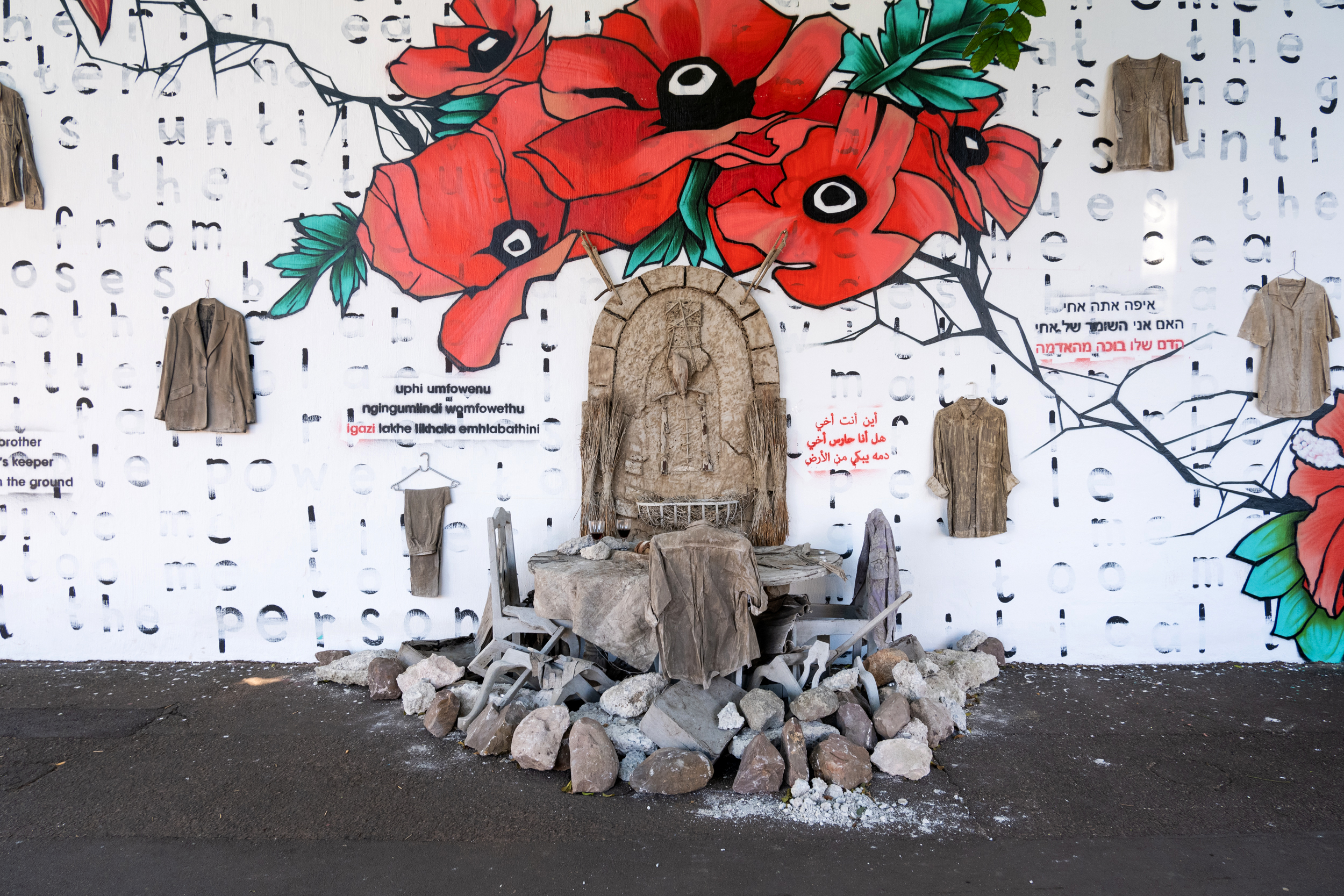
EWOK (Iain Robinson) Mural (The Cracks Are Showing) and Installation (Am I Brothers Keeper) by Robin Moodley for the
exhibition A House is Not a Home…, 2024 with sponsorship from Artbank South Africa. Image: KZNSA gallery/Paulo Menezes
Lindah Majola, owner of Hue Cafe, an events space whose ethos revolves around community and creativity, works toward intersecting fine art, mural practice and music to be regular events in their space. His method is informed by community-led practice. “Durban DNA”, as coined by Majola in the discussion, is something which makes the artists from here stand out. They noted how it is ‘easy’ to identify an artist from Durban. As much as this coincidence might be attributed to the lineage and energy of eThekwini, educational and important artistic spaces such as The BAT Centre and Durban University of Technology have shaped the foundations of many artists from KwaZulu-Natal. Menezes reinforced the notion that the stable foundation for artists results in these similar, authentic styles, which are not yet consumed by the more gallery-condensed cities of Cape Town and Johannesburg. Thus, this foundation of art-making may be the same which influences the curatorial outcomes of exhibitions within the city.
The question is then asked, what makes a successful exhibition? In Durban, the answer might be: people showing up and a sale or two as the final cherry. For others, it is the prompting of critical inquiry with audiences. Menezes references ‘Ubudlelwane (propinquity)’, which was exhibited at The KZNSA Gallery in 2022. Curated by Greer Valley and Sibonelo Gumede, Menezes recalled the limited audience engagement and the uncertainty expressed by viewers, some of whom asked: “Where is the art?” The exhibition presented sound boxes for people to walk up to the walls and wear headphones. The space remained silent while a video of artist Zawadi Yamungu performing with an umakhweyana looped, projected on a wall. The exhibition employed encounter and relationality as its primary methods, relying on “contact, confrontation, deliberation and negotiation … and acts of deep listening”. Yet this moment raises a critical question within the Durban context: to what degree did the institution employ curatorial engagement or educational programming to connect highly experimental work with local audiences who may not regularly encounter these modes of exhibition-making?
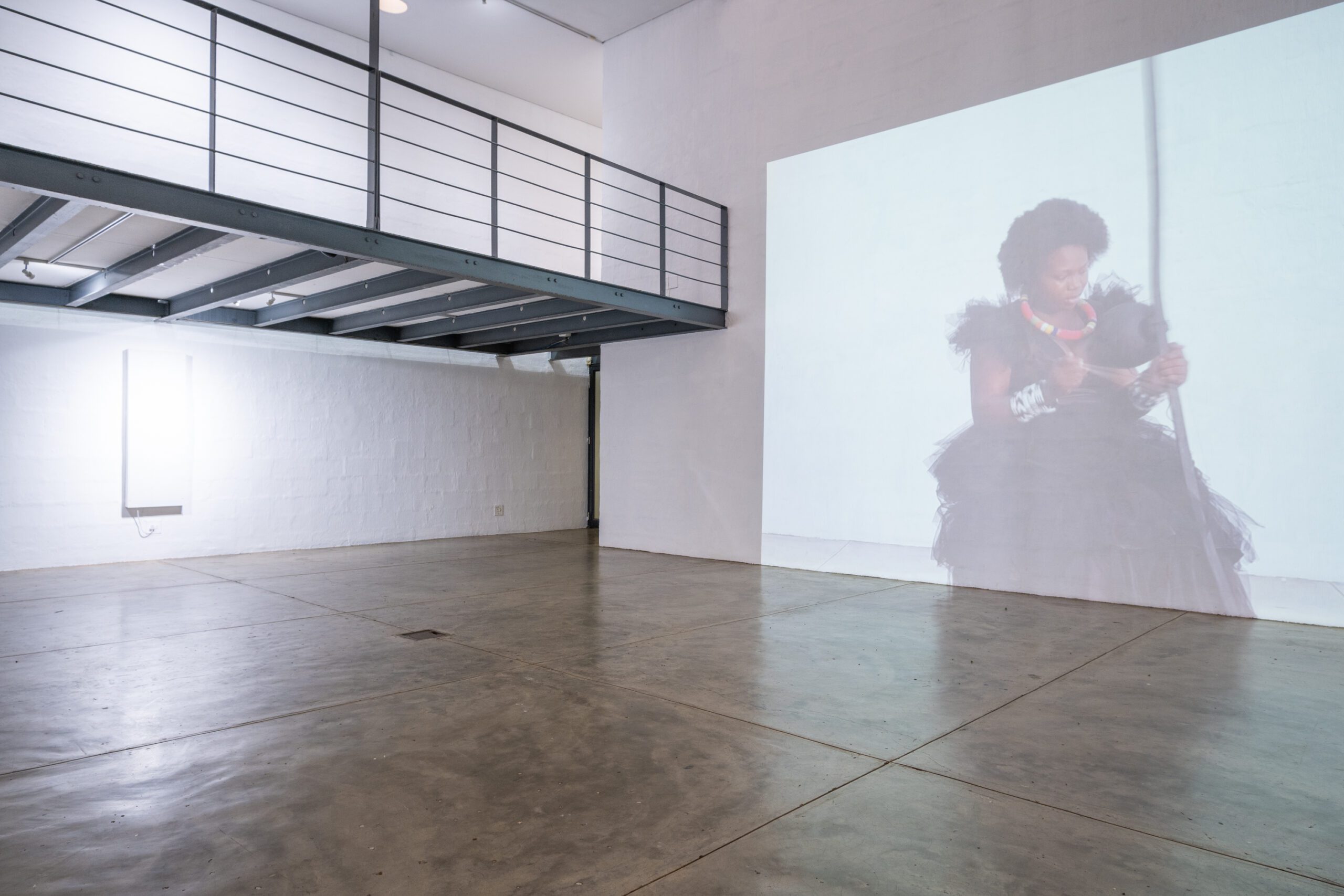
Installation View, ‘Ubudlelwane (propinquity)’, 2022. Video of artist Zawadi Yamungu projected on the gallery wall. Image:
KZNSA Gallery/Paulo Menezes
When experimental practices are presented without accessible interpretive frameworks, curatorial mediation or public programming, galleries and curators risk reproducing the perception of art as something distant or inaccessible. The issue of audience engagement was touched on in the panel discussion, although never sufficiently unpacked. Audience development is particularly significant in Durban, where opportunities for exposure to experimental curatorial forms remain limited due to socio-economic constraints. In such cases, the responsibility of a gallery extends beyond presentation: creating points of entry through public programmes, walkthroughs or discursive platforms that enable audiences to locate themselves within the work. This also raises the question of how audiences are supported in understanding how to engage, without feeling intimidated by participatory expectations. I encountered this challenge in CAP’s ‘Field Notes’ exhibition at The Chairman in 2024, where the ‘dummy room’ invited viewers to sit, look and write responses to the exhibited images. Despite this clear invitation, engagement remained minimal, suggesting that participation cannot be assumed without adequate mediation or framing.
This is not to suggest that experimental practices should be diluted to ensure legibility, but rather that curatorial and institutional practice must remain attentive to the conditions of reception. If curating is understood, as Muñiz-Reed (2017) argues, as an ethico-political act of shaping knowledge and meaning, then mediation and meeting in the middle become central to that responsibility. Within Durban’s ecosystem, where institutions often take on curatorial roles out of necessity rather than mandate, the success of an exhibition may only be so due to its ability to create opportunities for meaningful encounters between artworks and the publics they seek to engage, beyond aesthetics and sales.
While exhibitions are put on, there is still a need for reviews and written critiques. The last review of an exhibition in Durban seems to have been published in October 20254Zama Cebsile Mwandla’s ‘Disgust, Fear and Hell’, and considering there have been a plethora of shows in between, after and before this, it is safe to say Durban’s efforts in exhibition making go largely unseen in art publications. This is not to say there are no writers and people are not writing. I have submitted articles and pitches which have received no reply, or colleagues who have been rejected due to editorial preferences. With limited platforms, we find ourselves in a place where we self-publish. This leaves a gap in editorial guidance to strengthen arguments, as well as continuing cycles of being read in our small circles, reinforcing the silo effect with which the art ecosystem currently operates. Thus, in a city screaming for support, and our curators wearing multiple hats, it becomes a losing battle.
We need arts writers to bring a critical eye to how works are hung and to offer unpackings that draw on critical theory and curatorial intention. Considering Tina Campt’s method of writing to artworks, instead of writing about them, offers a useful proposition not only for criticism but also for curatorial practice itself. In ‘A Black Gaze: Artists Changing How We See’, Campt develops this method as a writing strategy; it can be extended to exhibition-making as a way of constructing curatorial statements and exhibition frameworks that emerge in dialogue with artworks rather than positioning them as static objects to be explained. Campt argues that this practice “minimises a viewer and maximises the work”, allowing the artwork to assert its own presence and address us on its own terms. In curatorial terms, this suggests a shift away from explanatory authority toward a relational approach in which the curator listens, responds and builds structures that allow works to speak back. Applied to curatorial practice, this becomes a strategy of creating conditions where meaning is not fixed in advance but unfolds through encounter.
Arts criticism plays a crucial role in interpreting exhibitions as well as shaping the historical and political conditions through which art becomes visible and meaningful. As Thulile Gamedze demonstrates in her critique, ‘No end, no fairytale: On the farce of a revolutionary ‘hey day’ in contemporary South African art’, of Adilson De Oliveira’s review of FNB Art Joburg, criticism that lacks historical grounding and reflexive care risks reproducing the very hierarchies it seeks to challenge. Gamedze argues that critique must move beyond emotional reaction or personal taste and instead “locate and identify the synthesis of the trouble,” grounding its arguments in sustained engagement with the cultural, political and historical conditions of artistic production. Gamedze further shows how writing itself has historically functioned as a mechanism of exclusion, noting that white art criticism in South Africa has “effectively carried anti-black racism into the ‘new’ South Africa, sustaining the relevance and centring of white bodies in the visual arts world.” Gamedze’s analysis reveals that criticism is not neutral commentary but an active site of knowledge production that shapes artistic value, historical memory and institutional power. In this sense, the absence of sustained critical writing in Durban does not merely reflect a lack of visibility but represents a structural gap in the production of discourse itself. Without rigorous critical engagement, exhibitions risk disappearing from the historical record, and the potential for locally grounded curatorial and artistic practices to articulate their own meanings remains limited.
Personally, I left the discussion with questions. Perhaps the question of “what makes an exhibition successful” is where we meet in the middle. Success is subjective. I recall one exhibition where I was completely absorbed in the work, an experience shaped by the artist, the curator, or both. Hosted at the KZNSA Gallery in 2019, ‘Making Meaning: The Art of Albert Adams (1929–2006)’, curated by Marilyn Martin, remains an example of a show which lingered in my mind. Martin has spoken of her fascination with artists “who have been left behind or forgotten.” Mary Corrigall writes of Martin’s commitment to artists in ‘Overlooked late artist Albert Adams remembered’, remarking on her curatorial practice as one which places figures like Albert Adams back onto the art historical map. This curatorial position was evident in the exhibition, where her extensive research and accompanying publication brought depth and care to an artist I had not previously encountered, and who had long remained marginal within dominant narratives.
It is not that the exhibition design itself was particularly extraordinary; rather, it was her ability to translate Adams’ life and work with clarity and sensitivity that left a lasting impression. Through careful framing, she did not simply present artworks but facilitated an encounter that reshaped my understanding. This experience reinforced how curatorial practice can operate as a form of mediation and recovery, one that makes artists visible, situates their work within broader histories and shapes how audiences come to know them.
References
Campt, T. M. 2023. A Black Gaze: Artists Changing How We See.
Eshun. K (2015, March 5). Kodwo Eshun – (Goldsmiths / The Otolith Group) Public Assets Conference, Common Practice. Public Assets: Small-scale arts organisations and the production of value [Video]. YouTube. https://www.youtube.com/watch?v=Zfs-yQqvlA4
Fish, S. E. 1976. Interpreting the “Variorum.” Critical Inquiry, 2(3), 465–485.
Corrigall, M. (2016, May 9). Overlooked late artist Albert Adams remembered. Mail & Guardian. https://mg.co.za/article/2016-05-09-albert-adams-retrospective-lest-we-forget/
Gamedze, T. (2025). No end, no fairytale: On the farce of a revolutionary ‘hey day’ in contemporary South African art. Retrieved 2026, from https://www.thulilegamedze.net/text/no-end-no-fairytale
KZNSA Gallery. (2025). Izihlahla Ziyokhuluma. KZNSA Gallery. Retrieved 21 February 2026 from https://kznsagallery.co.za/exhibitions/izihlahla-ziyokhuluma/
Quijano, A. (2000). Coloniality of power, eurocentrism, and Latin America. decolonialtranslation.com. https://www.decolonialtranslation.com/english/quijano-coloniality-of-power.pdf
Muñiz-Reed, I. (2017). Thoughts on curatorial practices in the decolonial turn. In Decolonizing art institutions (On Curating, Issue 35, pp. 99–105). On Curating. https://www.on-curating.org/issue-35-reader/thoughts-on-curatorial-practices-in-the-decolonial-turn.html
Mzolo, M. (2025, October 28). Ewww: Zama Cebsile Mwandla’s ‘Disgust, Fear and Hell’ at the KZNSA Gallery. ArtThrob. https://artthrob.co.za/2025/10/28/ewww-zama-cebsile-mwandlas-disgust-fear-and-hell-at-the-kznsa-gallery/
Ogbechie, S. O. (2025, November). In the kingdoms of ruin: Okwui Enwezor, contemporary art, and the Global South. e-flux Journal, (158). Retrieved 21 February 2026, from https://www.e-flux.com/journal/158/6776797/in-the-kingdoms-of-ruin-okwui-enwezor-contemporary-art-and-the-global-south/
Schwartz, J., & Cook, T. 2002. Archives, records, and power: The making of modern memory. Archival Science, 2(1–2), 1–19. https://doi.org/10.1023/A:1020826710510
Stretton, J. A. R. (2018). Curatorial practice as reflexive inquiry: A case study of an art museum exhibition (Master’s dissertation, Durban University of Technology). Durban University of Technology Institutional Repository. https://openscholar.dut.ac.za/server/api/core/bitstreams/3477ef8f-5bda-4a2f-8e16-1491cb0fe55c/content