We reached out to Iranian artists based in South Africa and asked them to share their experiences and reflections on the current war in Iran.
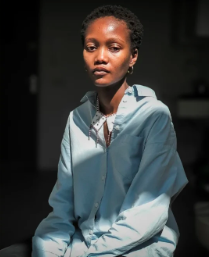
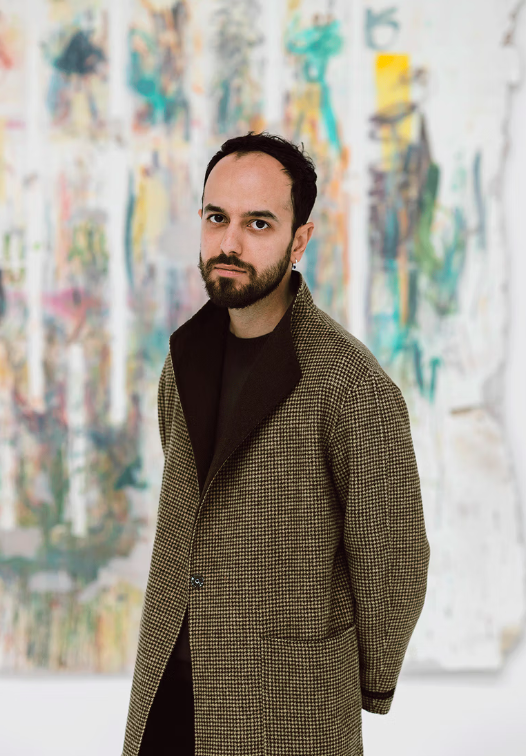
Kamyar Bineshtarigh details his dread, anxiety and fear through journal entries that reflect his experiences between Monday, 16 March and Sunday, 22 March. We at ArtThrob are eternally grateful for this act of generosity, which words cannot fully describe.
Bineshtarigh was born in Semnan, Iran and is now based in Cape Town, where he graduated from Cape Town Creative Academy with a Bachelor of Arts (Honours) in contemporary art in 2024 and a Diploma in Fine Art from Ruth Prowse School of Art in 2019. There, he received the Ruth Prowse Award for his series ‘An Exhaustive Catalogue of Texts Dealing with the Orient’. In 2021, he was awarded the Simon Gerson Prize for his graduate exhibition at the University of Cape Town’s Michaelis School of Fine Art, as well as a Creative Knowledge Resources Fellowship from the National Research Foundation and UCT.
Bineshtarigh’s conceptual inquiries range from language and communication in all its forms to migration and the displacement of humankind. His interest in text, particularly Arabic script and calligraphy, has become an explorative means to study the nature of mark-making and the cultural complexities that often arise through translation.
Often, his work is a meditation on how script carries our collectively imposed meaning but also a multitude of intuitive translations, as well as an innate aesthetic of form and shape. This is embodied through the additive act of layering, with the artist utilising canvas, ink, pencil, shards of glass, glue, or layers of paint extracted from the very walls of his studio and other artists within his community. He frequently works on an immersive scale, creating site-specific installations that are arresting and affecting.
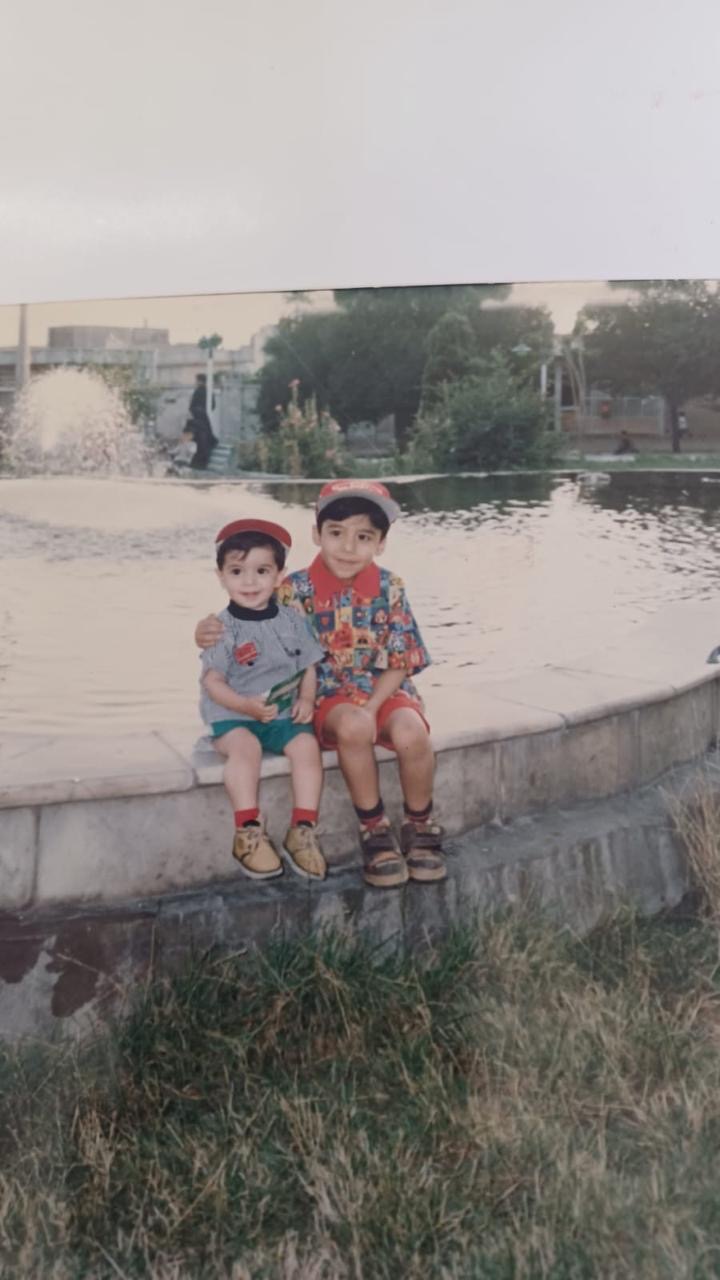
Kamyar with his brother in his hometown.
How are you? You have family and loved ones back home. Have you been able to keep in touch?
I find myself hoping no one asks how I am. And when they do, I say “I’m okay”; the kind of okay that really means I’m not, but it saves me from having to explain.
Of your second question – I answered this on Monday, 16th March, and this was my answer -Right now, as I’m answering this, there has been a total internet blackout. The last time I spoke to my mom was four days ago, when she managed to call from a landline, and that can only happen from that side. She also used to send me an SMS every morning just saying “they are all fine, don’t worry,” but I haven’t even received any in the past few days. At least I’m hoping that’s the case — that the Islamic Republic responsible for the internet blackout now has also closed the landlines. I know it is wrong for me to feel this way, but better censorship than something even worse happening.
I will probably know about the locations of the bombings before they do, since I have internet access in Cape Town, and I haven’t heard anything about my hometown, where my family is being bombed. Generally, since the beginning of the war, no attack has happened directly on my hometown, which feels like a privilege but makes me feel morally uneasy as well, to feel relieved as I see how much has been happening in other cities.
Updated the answer on Tuesday, 17th March: There is still a total internet blackout: the Chaharshanbe Suri day. Chaharshanbe Suri is an Iranian festival held on the last Tuesday evening before Nowruz (Persian New Year). People jump over small fires and celebrate to let go of bad luck and welcome health and energy for the new year.
My mom called me in the morning of that day — it was a relief. She said they are all fine and preparing for Nowruz. She even said that she and my grandmother went to buy fish from their local market for the Sabzi Polo Mahi dish, a dish that’s made for Nowruz. But she also said that it has been banned for people to gather for the celebration, which is usually when people are all out, with lots of bonfires in each neighbourhood and lots of fireworks (fireworks are banned as well).
I was thinking about all the “fireworks” that the US/Israel would light up that night… instead of the people lighting them up. But when I talk to them and hear that they continue with their lives — still doing simple things like going to the market and getting ready for Nowruz — it gives me moments of comfort. Knowing that life goes on despite everything reminds me of Abbas Kiarostami’s films (perhaps the biggest inspiration to get into art for me). He is someone who was criticised a lot for making films about ordinary people and ordinary life during the Iran/Iraq war, but I’m particularly talking about ‘And Life Goes On…’(1992), part of his Koker trilogy. The film is about one of his crew members travelling through a region after an earthquake to find two boys who acted in his previous film, ‘Where Is the Friend’s House?’ (1987), witnessing how people continue living despite loss and destruction. Or as Mahmoud Darwish says, “We love life whenever we can.”
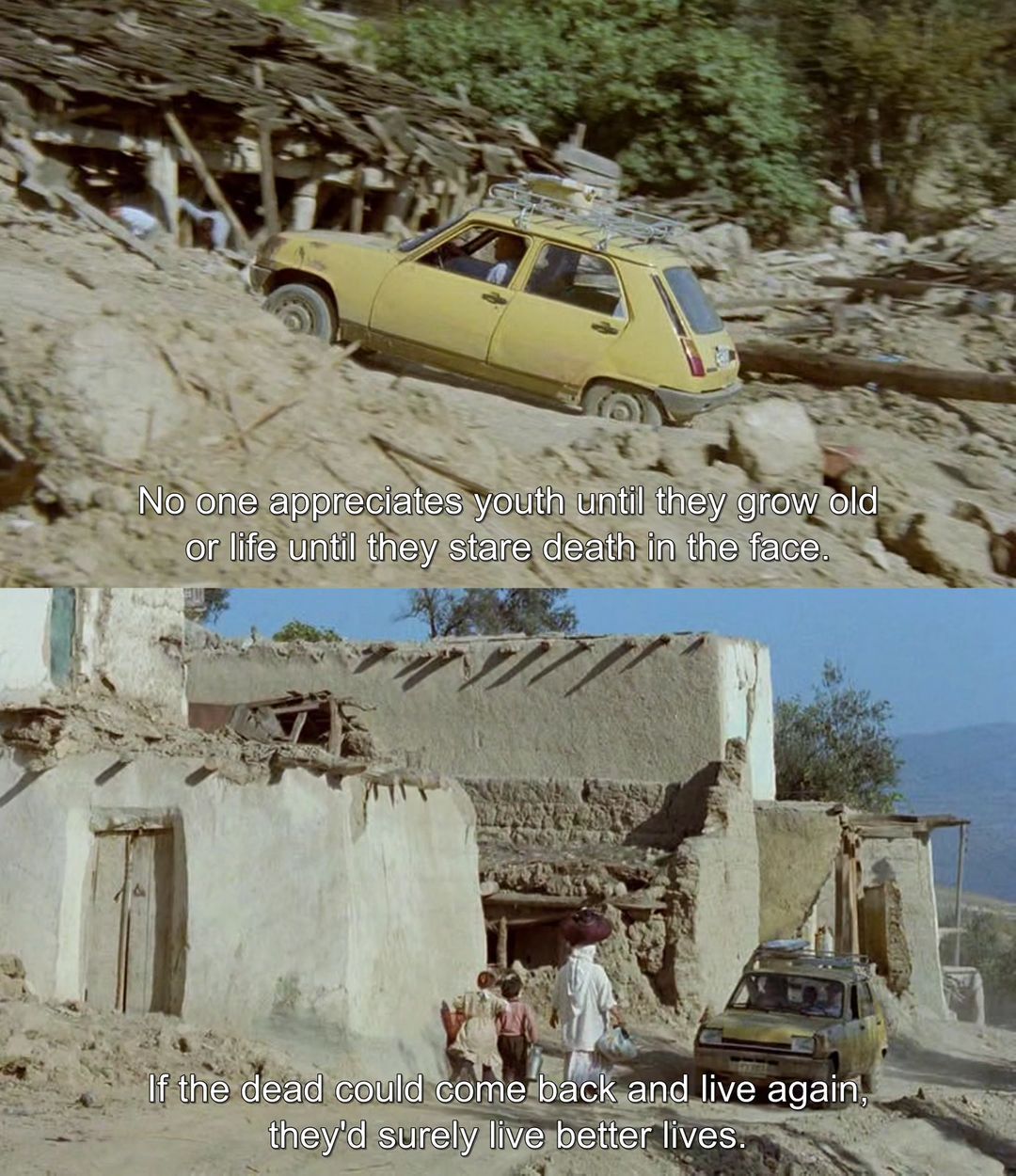
Stills from Abbas Kiarostami’s And Life Goes On…’(1992)
Update 24th March: Missile Strike on Tehran Hits House of Iranian Director Abbas Kiarostami.
In a land shattered by disaster, the act of living, something like buying fish from the local market and continuing to celebrate our culture and New Year (Nowruz), is itself a quiet, everyday art and resistance.
And yet, perhaps my mom is very good at comforting me, even if she doesn’t show the full extent of what she is going through… The truth is, I don’t know. We don’t know. And that uncertainty is what worries me. Every time she says they are more worried about me here, that I’m worrying too much, and they think I won’t be able to handle it, I’m like — what are you even talking about? There aren’t any Israeli/American bombs here, nor is there the IRI [Islamic Republic of Iran] ruling this country.
Friday 20th March, Nowruz day: I get a call from an unknown number — that’s usually my mom, as the line somehow diverts to a South African number. I pick up, and I hear a lot of noise, multiple people talking at the same time. I couldn’t hear anything anyone was saying; it was many lines over each other. At that point, I was sure it was them from Iran, but we couldn’t connect. I kept saying “alo, alo,” but nothing, and the line cuts. I quickly got worried. I knew they would call me on Nowruz, but also knew they would rather call after the New Year, which was supposed to be at 4:46 pm SA time. So immediately after that, I went on the Telegram channels where they update the bombings almost immediately, and I saw there were multiple explosions in my town just before the phone call. I checked the locations with my brother in Germany on Google Maps. One of them was so close to where they live.
Shortly after, a message got through from my cousin from Iran saying, “If you have heard any news about Semnan being attacked, don’t worry, we are all fine.” Later that night, they finally managed to call, and it went through. I spoke to everyone, and we said happy New Year, trying to keep happy and hopeful and not to cry and wishing all the best for the coming year. I asked about the bombing earlier that day, they said they were all fine, and my dad even made a joke and said that the bomb today was an Eidi (new year gift) from Israel— but not a Nowruz like any other, of course.
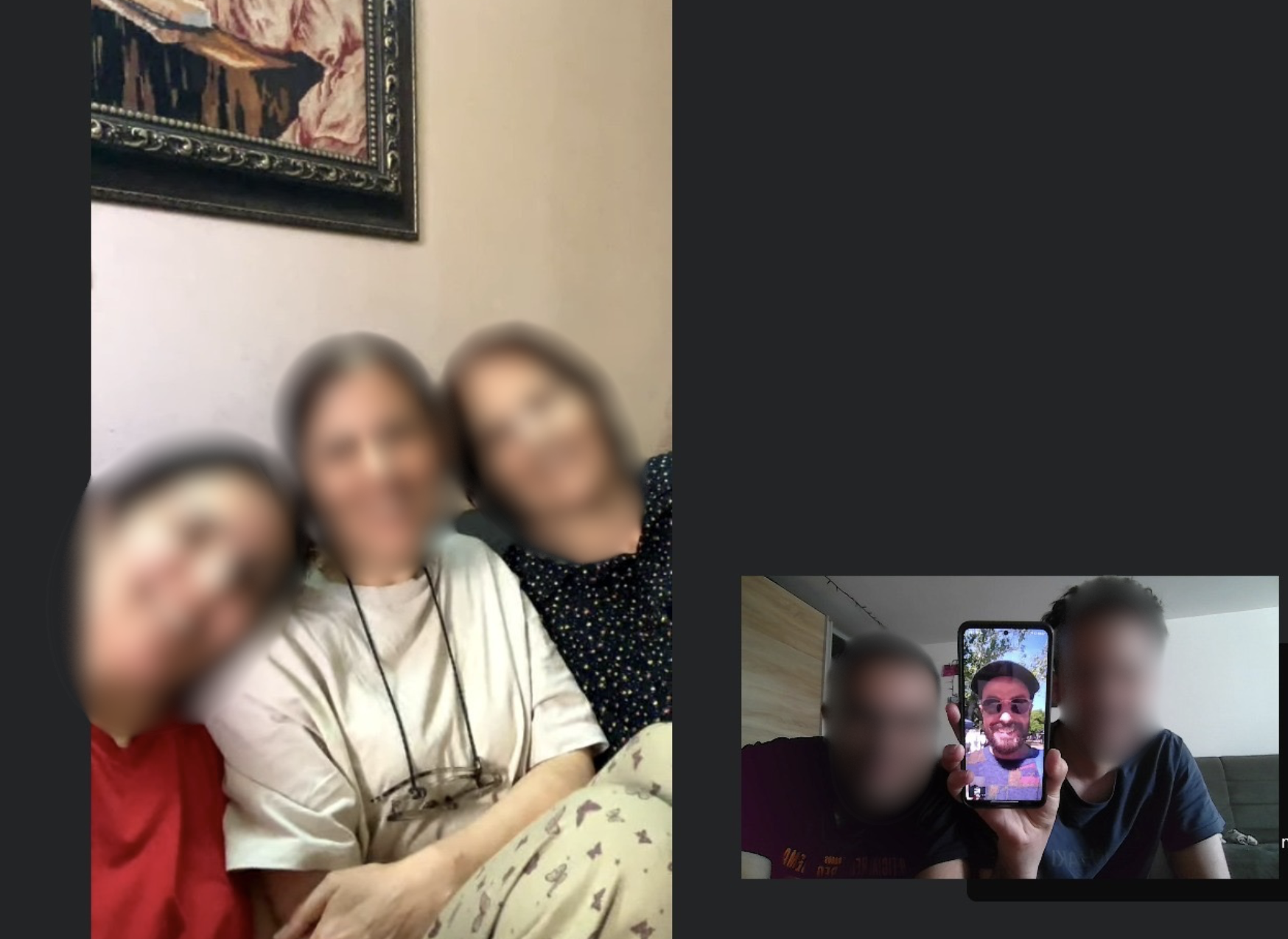
Kamyar on video call with his family.
Sunday 22 March: I hadn’t heard from them since. Then I got a video call from my cousin in Germany, who was with my brother. When I picked up, I saw that the camera on his phone was showing his laptop screen, and my entire family was live on the screen. He had miraculously managed to use a certain VPN and an app to get through, and for the first time, we managed to speak on a video call.
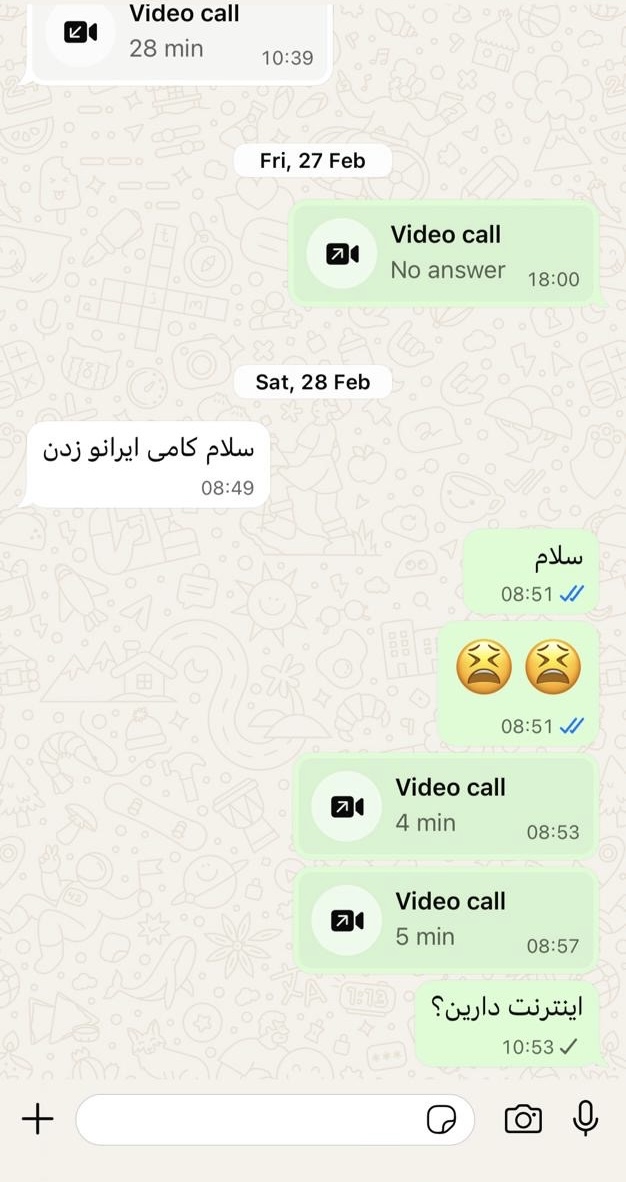
Screenshot of Kamyar’s latest WhatsApp Messages with his mom. This is the translation:
“First message from my mom Saturday 28 Feb:
‘Hi Kami they attacked Iran’
I said: “Hi” then the emojis.
Then managed to video call for a bit, and that was when the internet was being cut, and the call was cut, and then the last message I sent was, which is still 1 tick:
“Do you have Internet”
At such distressing times, have you been able to work?
Well, for the first week or so, it felt impossible to continue working as if everything was okay. I mean, it still isn’t. The war last year, which lasted only 12 days, was at a very crucial moment with a very tight schedule in the production of my last solo show, ‘group show’ at Southern Guild. I remember it was very difficult to continue doing such intense work while dealing with everything happening in the background back home. It feels surreal and almost irrelevant.
When I was in Joburg, peeling off Joburg artists’ walls, there was a huge contradiction between what I was doing physically and what was happening back home — this sense of doing something irrelevant as an artist, as a human. But I have to constantly remind myself that maybe there is a reason I’m here in South Africa, and that it is relevant. I think I always struggle to understand that, especially since I didn’t move from Iran, a theocratic country (where the act of even being an artist comes with so many risks, obstacles and censorship) and a country now also in war, to the global North, but to South Africa. I think now, more than ever, the importance of that is becoming apparent. It was for a reason, and I am continuing to build, to connect, to speak a language that is relevant, even when it doesn’t directly address Iran.
When I spoke to my dad when the war started, he asked me to promise him to continue working and doing what I do. He said that I have been gaining this success with hard work, and I can’t lose it just like that because war is happening, and I should not let this consume me. A lot of people here have either met my dad or know how involved he was in my practice while he was still here in Cape Town. I’m trying to do what he asked me, even if it’s so hard to do so. Recently, I decided to start painting my largest painting to date, which I have not yet started, but I am going to soon. I think that will give me a reason to go to the studio every day— to focus on one large work, to be proactive instead of constantly following the news. It’s really hard not to.
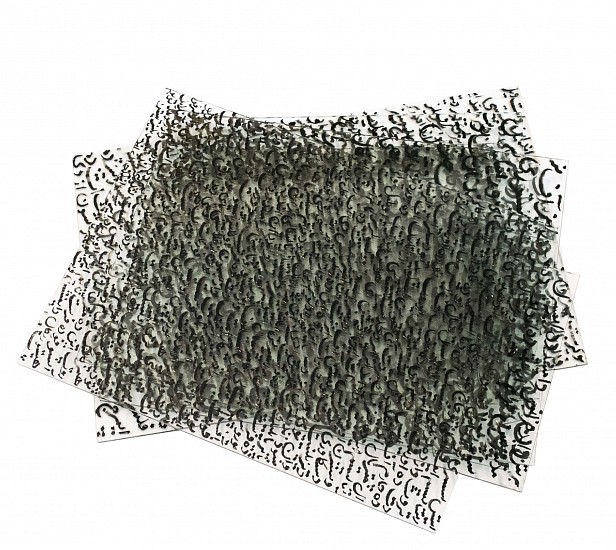
Kamyar Bineshtarigh, ‘An Exhaustive Catalogue of Texts Dealing With The Orient (Sheets)’, 2019
Right now, as Iran is in the news, text (headlines, social media posts, etc.) becomes propaganda,
caption, slogan or an attempt to urge close to the truth. How does your relationship to script and
language, which are so central to your work, sit against that noise?
My final project in my final year at Ruth Prowse School of Art was on Edward Said’s concept of Orientalism. It was titled ‘An Exhaustive Catalogue of Texts Dealing with the Orient’. I was 20/21 years old, and perhaps at the time the text didn’t fully make sense to me — maybe that’s why I was abstracting it through material: layering text, writing on sheets of glass, then breaking them, reassembling them, transliteration, and so on.
Now I feel like I’m living it… not abstractly. The power of language, who holds that power? How it shifts, and what consequences it has. And now AI?! It’s madness out there. There is a whole other war that is not abstract, nor physical, that we are all involved in. I feel far too many people get trapped in propaganda, even people close to me, even me.
There is so much power in language, as much as there is in missiles, if not more. As Edward Said said:
“Despite the variety and the differences, and however much we proclaim the contrary, what the media produce is neither spontaneous nor completely ‘free’: ‘news’ does not just happen… truth is not directly available… we do not have unrestrained variety at our disposal. For like all modes of communication, television, radio, and newspapers observe certain rules and conventions… and it is these, often more than the reality being conveyed, that shape the material delivered by the media.”
More than anything, I’m interested in creating space for reflection on the current war. Outside of the questions that I have asked above (which might perhaps feel lacking or even irrelevant because they cannot possibly hold the weight of the moment). With that in mind, can you share your reflections more broadly – in terms of what is on your mind at the moment?
Freedom is what has been on my mind the most. Certainly, my reflection or my point of view (especially given that I am not in Iran right now) cannot be a measure of understanding the entirety of the situation. I only want to share my experience.
We have too many people with too many things on their minds, too many analysts, too much intellectualism, and also too much fascism. There lies the problem: we lack acceptance of our differences, of how we think, who we support, and how we feel. Instead, we attack, we divide. That has very much been happening, especially among Iranians in the diaspora, who often have loud and powerful voices. Why? We can refer back to your last question — the power of language. But how we move forward towards freedom is what has really been on my mind.
I think here comes another perspective, perhaps shaped by me living in South Africa; going to high school here, studying art at three different universities in Cape Town, engaging with postcolonial studies but also living and working as an artist in an artworld in a country that has just come out of apartheid – living here for half of my life as an “outsider”. With all its troubles, there is something really beautiful here; a sense of appreciation for freedom that doesn’t just arrive with freedom, but something deeper.
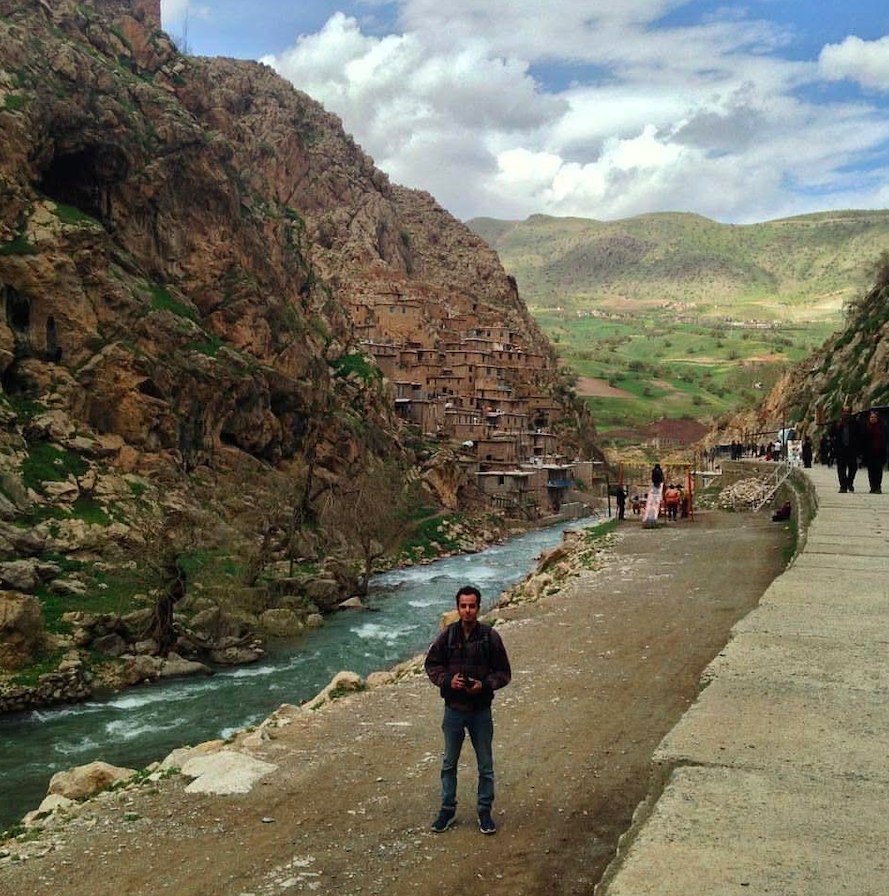
Kamyar – “This is the last time I travelled to Iran, 10 years ago, through all the Kurdish provinces’.
For me, it has been a very personal process of learning what freedom even means. Leaving Iran as a teenager, I was already preconditioned by the lack of it. It takes time to adjust, to learn how to be free — especially when freedom has always been taken away from you by the state, by authority, by an oppressor. You become used to that condition, even comfortable within it, and often scared to break away from it, especially when you are born into it. As Steve Biko said, “the most potent weapon of the oppressor is the mind of the oppressed.”
My experience in South Africa, in many ways, has been a process of unlearning that. Of understanding that freedom is not just external, but something that has to be realised internally as well. That shift, that recognition, is not necessarily comfortable. The idea that no one is inherently superior or inferior, that both must come to see themselves simply as human…I think that, for me, is where the meaning of freedom begins.
And perhaps that is what I am trying to understand: that freedom is not only something granted or taken away, but something that has to be formed within oneself first.
I think the way South Africa is trying to move forward, with all its troubles, can offer something to reflect on, certainly not an answer and not an immediate justice, but an active act of fighting and resisting, resistance as a living matter. Not necessarily an absolute resolution or result. I think it is a kind of miracle. That might be a naive or problematic thing to say — maybe I will regret saying it later when I read this again in a few years or sooner, maybe it sounds very “Rainbow Nation” or too “liberal”, which certainly I do not identify myself as.
Iranians have been resisting daily not only in the past 47 years but for much longer. For example, one of the latest movements is the resistance by Iranian women through ‘Women Life Freedom’ as well as Iranian ethnic minorities. But looking at Iran right now, people are being crushed between American/Israeli bombs, their own regime that brings violence and death to the absolute majority opposition, and at the same time another loud fascist opposition is growing faster than ever, often outside of Iran, with a fascist monarchist ideology, rooted in Persian supremacy and the myth of Aryanism, chanting “death to this” and “death to that,” while proudly carrying Israeli flags – where everything becomes about who must be erased and attacking anyone that says otherwise to the chant they want to hear. Haven’t we learnt from our past?
For me, this shows not only a lack of understanding of freedom but that perhaps we can still not be free even in a free country, because freedom is, in fact, scary and often comes with responsibilities. It is easier to give that responsibility to someone else. To allow a system to decide for us; to make decisions, to control. Essentially, someone who is not allowed to be criticised eventually becomes a dictator.
So what stays in my mind is this: how do we break free from the cycle of violence? How do we forgive? How do we move on? How do we learn freedom after we are free? Certainly, there are so many different opposition groups in Iran, too. Still, wherever you stand as an Iranian, it doesn’t matter what you believe or where you are— right now you are trapped between powers, none of which truly want to protect or save or free us. I would also go as far as saying that this is, unfortunately, the truth for Palestine too. The IRI has no intention of freeing Palestine either; they are on their own accord imperialists, theocratic fascists, and they are certainly not freedom fighters. They are great at taking away the freedom and not bringing any. I’m sorry to disappoint any South African who supports them and believe that IRI is standing against imperialism and for Palestine.
And finally, I cannot speak for 90 million people, or claim to represent them. But I would like to quote Edward Said again: “Every single empire in its official discourse has said that it is not like all the others… that it has a mission to enlighten, civilize, bring order and democracy… And, sadder still, there always is a chorus of willing intellectuals… as if one shouldn’t trust the evidence of one’s eyes watching the destruction…”