Amongst Johannesburg’s many contemporary art strands, is its own approach to work that connects deep research to creative processes. In this, a very preliminary sketch, I propose that Joburg’s formulation of research-informed art practice is highly driven by and rooted in site, and often concerned with understanding, producing, making visible or subverting systems. This turn to systems is largely non-commercial, and is inextricably linked to the city as a jumping off point in explorations of political identity, histories of resistance and the production of space. Kept alive by certain networks of people and institutions, and influenced by lineages of practice with similar investments, this turn is emblematic of both the limits of the market as a site for liberated knowledge production and, more poignantly, the complex matter that is Joburg.
Part I of this text looks to some Joburg histories of representation in relation to projects of recent years (or recent decades) — by Kaelo Molefe, MADEYOULOOK, Santu Mofokeng, Kudzanai Chiruai, room19isaFactory — to consider “Systems of Black Making and Unmaking,” as well as “Extra-Archival Systems.”
“The Black Lithosphere”: Systems of Black Unmaking and Making
Johannesburg’s growth is traceable to the discovery of gold on the farm Langlaagte in 1886. The decades that followed saw accelerated extraction of the land’s mineral wealth, booming commerce, industry and urban expansion, made possible by the work of migrant labourers. The commercial establishment of the city, at a time when South Africa was a British colony, was accompanied by a robust project of cultural imperialism.
The Johannesburg Art Gallery, which opened at its final site in Joubert Park in 1915, was central to this project, brought into being by Lady Florence Philips, wife of Randlord Lionel Philips. As a collection and a site, JAG exists because of the wealth of Philips and other mining magnates, indelibly connecting the establishment of Joburg’s formal arts sector to processes of colonial bodily and spatial extraction.

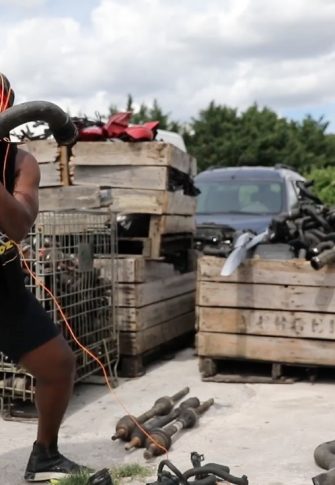
Kaelo Molefe, Mineral Maladies: Anatomical Pathologies of the Black Lithosphere, 2022. Courtesy of Ellipses […] Journal of Creative Research.
In 1936 — fifty years after the Langlaagte gold discovery — the South African Empire Exhibition was held in Joburg as an occasion to celebrate “the rapidly growing metropolis.”1Jennifer Robinson, “Johannesburg’s 1936 Empire Exhibition: Interaction, Segregation and Modernity in a South African City,” Journal of Southern African Studies 29, no. 3 (2003): 759–789. Much in keeping with the European colonial exhibitions of the time, the Johannesburg Empire Exhibition seamlessly blended presentations of early Joburg industrial innovation with (the utter violence of) human exhibitions, including a group of Khoi people from the Kalahari, Venda ironsmiths and Swazis.2Robinson, “Johannesburg’s 1936 Empire Exhibition,” 759–789. At Joburg’s Empire Exhibition though, the viewership was decidedly mixed, a large Black contingent making up a significant part of the audience.3Robinson, “Johannesburg’s 1936 Empire Exhibition,” 782–788. Of course, Black viewing presence would not have fundamentally changed the overarching nature of the dynamics at play in the conception of the exhibition. But such a compromised (or alienated, or violated) Black viewing and viewed presence — a kind of absent presence — makes the violence of Joburg’s iteration strange. What did these contradictory modes of Black urban participation and negation do? What do they continue to do in a city like Joburg, in which witnessing mutual abjection and violence may be said to be unexceptional?4You may want to check out Vuyokazi Ngemntu’s phenomenal text “S’vaya!” published recently by wherewithall.
Molefe’s project presses for modes of knowing that recognise moments of slippage, “faulty delineations,” amongst the flattening forces of the colonial project.5Kaelo Molefe, “Mineral Maladies: Anatomical Pathologies of the Black Lithosphere,” Ellipses, 4 (2023). Available here. Such slippage surely exists in any “all-encompassing” attempt, and contemporary Joburg, even in the time of ‘Mo Dollars,’ is surely no exception. “The Black Lithosphere” is both the recognition of an unyielding, inelegant extractive project and the unfortunate place from which other possibilities must be imagined.
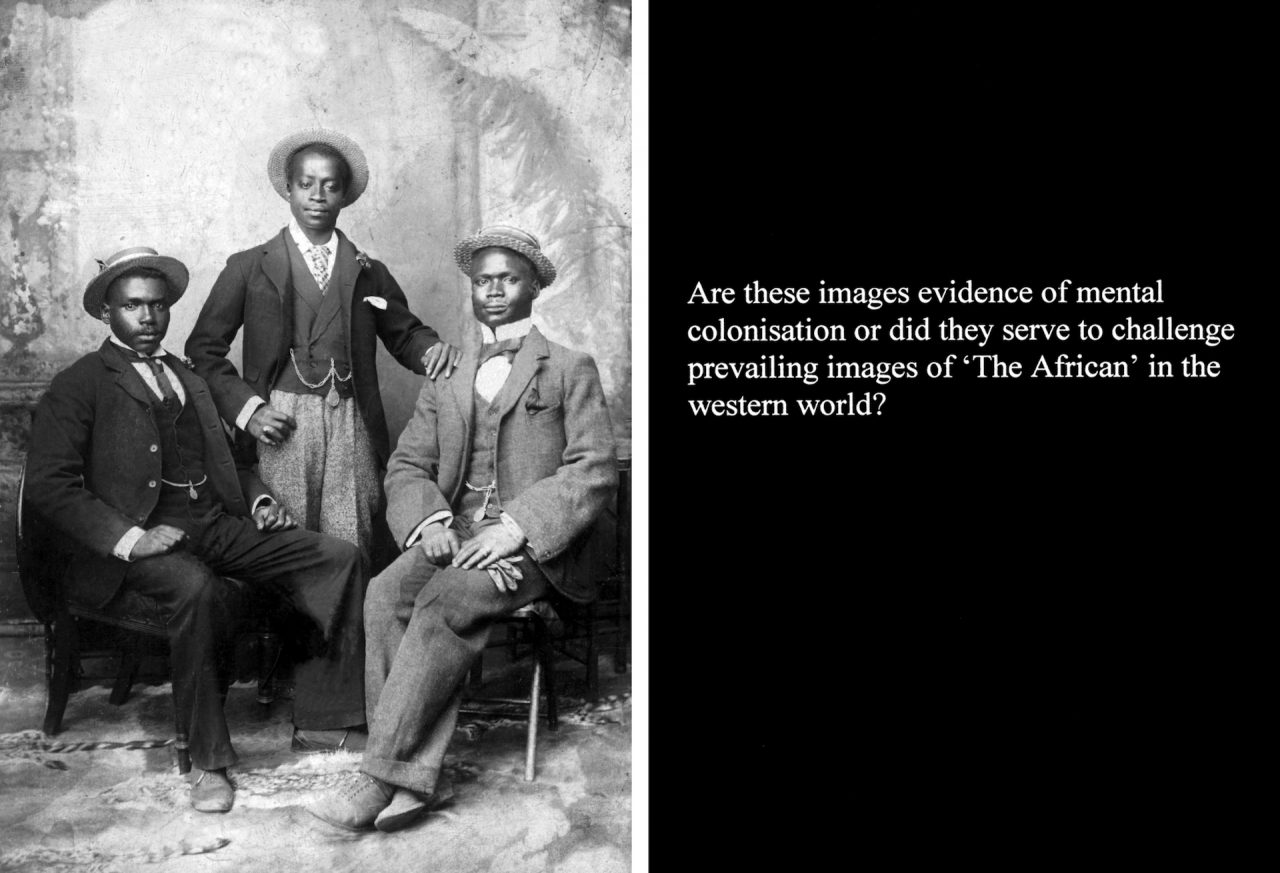
Santu Mofokeng, The Black Photo Album / Look at Me: 1890–1950, 1997. Courtesy of the Walther Collection.
The work of Santu Mofokeng — a key figure, inspiration and influence on the “System Turn” — takes on this complex landscape. Mofokeng’s preoccupation with the details of Black social and spiritual life in a place and time/s attempting to deny or kill any meaningful Black existence, has positioned his work “out of time” — an engagement, in many ways, with impossibility. The Black Photo Album: Look at me (1997) is an archival project that saw Mofokeng digging up photographs of Black South African working and middle class families from 1890 to 1950. The work reminds us that systems of self-making and representation are always happening simultaneously to larger historical attempts at Black unmaking.
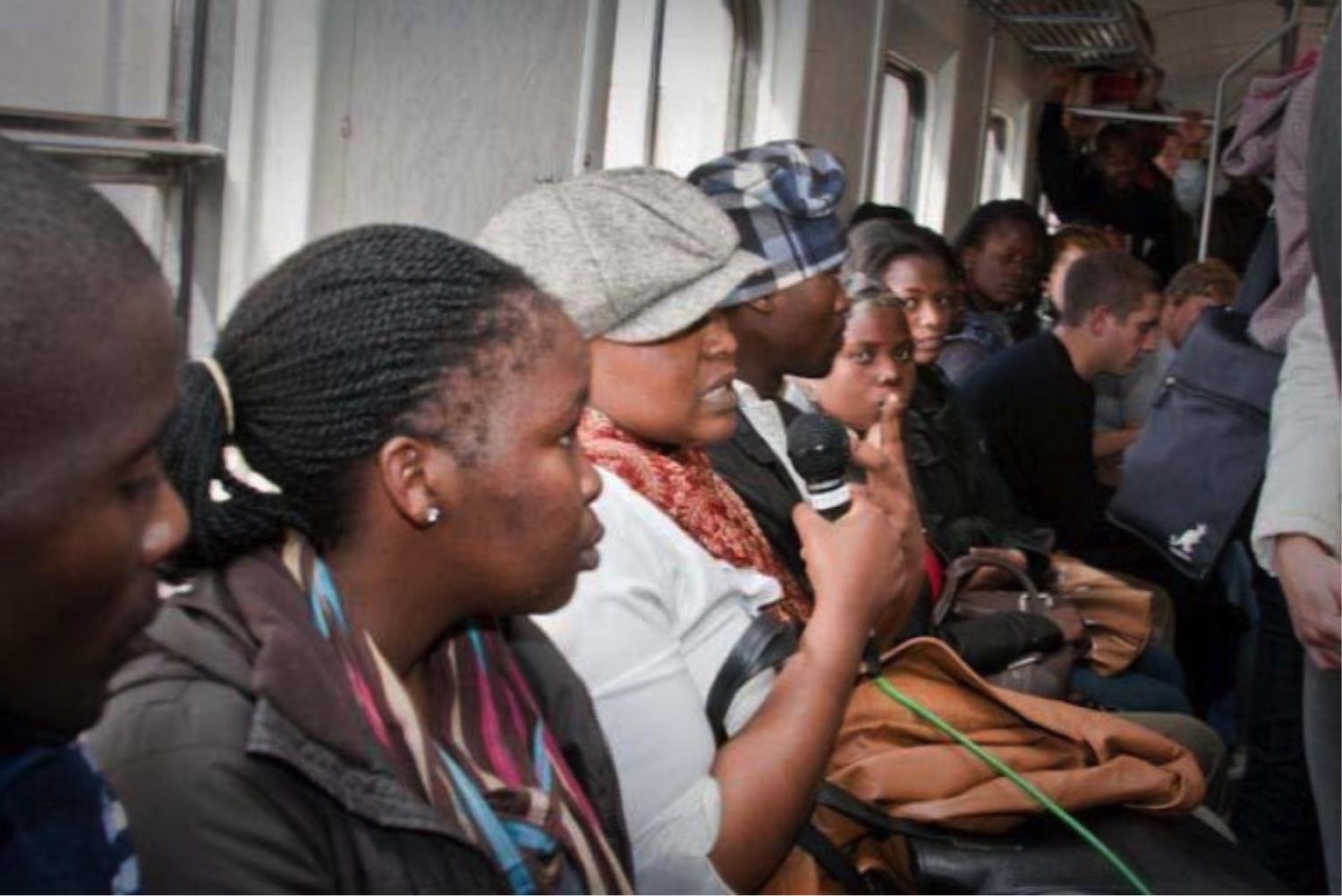
MADEYOULOOK, Sermon on the Train, 2009–2011. Courtesy of MADEYOULOOK.
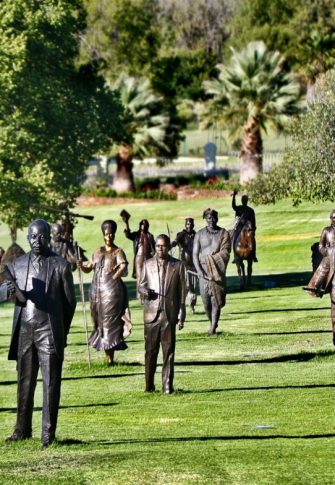
“It is this nature of ordinariness that Mofokeng sought to capture and that we were inspired by.”6MADEYOULOOK, “Tracks,” African Cities Reader II: Mobilities and Fixtures (2011): 68. Available here. Interdisciplinary artist duo MADEYOULOOK (Molemo Moiloa and Nare Mokgotho) wrote about Mofokeng’s Train Church in 2010. The duo began their collaboration in 2009 with a project inspired by Train Church (which saw Mofokeng photograph the enraptured and noisy happenings surrounding train sermons on his commutes between Soweto and Joburg.) In Sermon on the Train, a series of public lectures, MADEYOULOOK convinced four academics to give lectures along the same commute. As university students at the time, Moiloa and Mokgotho were inspired by Mofokeng’s photographic approach that reflected on the material of his own life: the production of a kind of “fictional biography,” in his words.7Mofokeng quoted in MADEYOULOOK, “Tracks,” 68. Taking their experience to the train, the Metrorail became a locus for the dissemination of academia. The provocation challenged the university and the way it positions itself as the centre of all important knowledge. The lecture scenes would have played out amongst traders, train preachers and commuters, melting into the general atmosphere of the commute. The train’s relentless primary role — the delivery and return of labour (rather than people) — remains ignorant of its many subversions, details, and energies… But yet, they do exist.
A central concern of some Joburg systems-oriented work is the unmaking of both the Black body and Black relations with land through colonial (and post-democracy era) processes. Molefe’s Black Lithosphere considers the violent formation and planning of colonial cities and subjects. Of equal potency is the understanding that colonial town planning can never account for improvisation, and the social architectures created through mundane, repeated processes of Black self-making, articulated throughout Mofokeng’s career, and brought forward by the work of MADEYOULOOK.
“Liberated Zones:” Extra-Archival Systems
“Ultimately, I am of the view that attempts at translating the conceptual expressions of Blackness and Black personhood shouldn’t be limited to one perspective. It should be a continuous redefinition ‘in actu.’ The crevices that exist in the unknown and misunderstood spaces should be recognised and utilised as prompts towards further probing of the human condition.”
Phumzile Twala, 20228Phumzile Twala, “Ngiyabonga belungu bami,” The Thinker 91 (2022): 31–37. Available here.
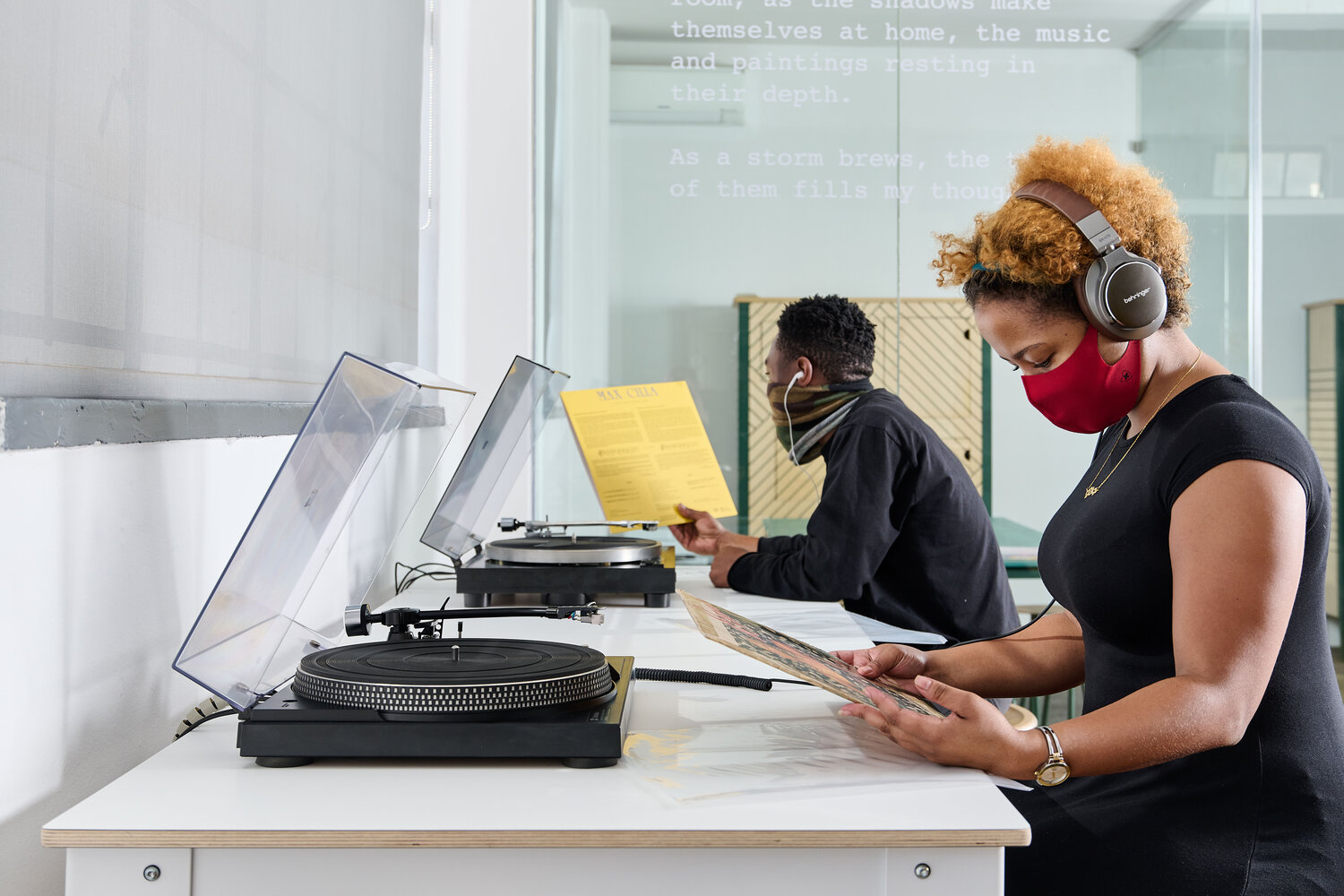
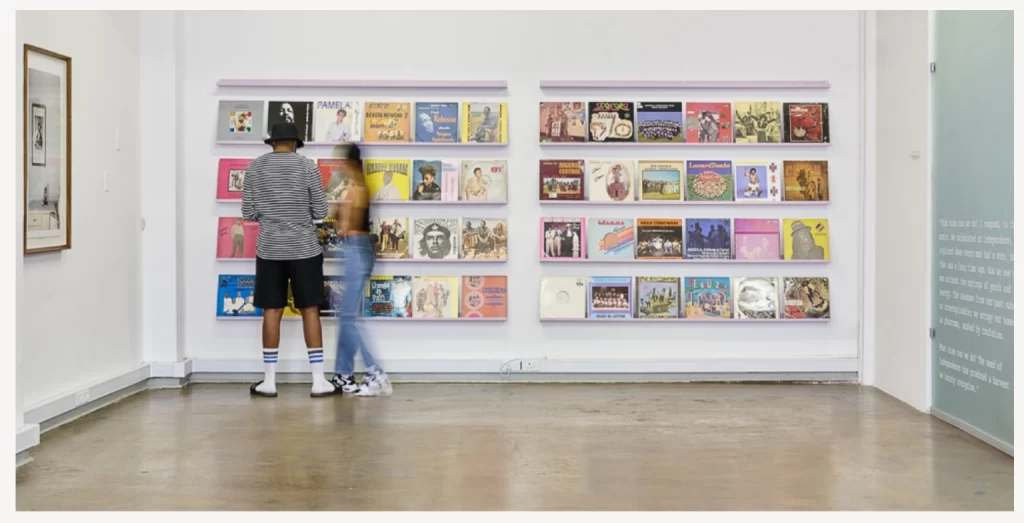
Kudzanai Chiurai, The Library of Things We Forgot To Remember, 2021–ongoing. Photo by Anthea Pokroy. Courtesy of 44 Stanley.
Kudzanai Chiurai’s Library of Things we Forgot to Remember is a shifting and vast collection of African and African diasporic records (and other things) that are otherwise rarely housed together and, often, cannot even be found or purchased on the African continent.9Also posters and paintings. The energy of the 44 Stanley space is easy and unpretentious, and visitors are trusted in their encounters with these rare offerings, spanning Independence era political speeches, various liberation movement material from Southern Africa, music, interviews, plays and more. Each vinyl grows closer to its natural death with each listening, but it is also only through this direct material interaction that these objects may pass on whatever life they possess. This is unheard of in standard archival thinking! Chiurai considers the library a “liberated zone,” a kind of autonomous space that, unlike typical archives, is open to the public, and is also open to re-ordering, reconstitution, and direct use — thus, eventual degradation.
The library also extends outward to facilitate artistic and talk programming by other practitioners. A wallpaper by Nolan Oswald Dennis — No Conciliation is Possible (Of Things We Forgot Except) — has been the backdrop for interventions from the Umhlabati photography collective and the cross-disciplinary architecture collective room19isaFactory. Room19 formed in 2022 and consists of former colleagues from the University of Johannesburg’s (UJ) Graduate School of Architecture (GSA). The members worked together at GSA as part of “Unit 19,” led by Tuliza Sindi, and include Sindi as well as Tuki Mbalo, Thandeka Mnguni and Miliswa Ndziba. Much in parallel with Molefe’s Black Lithospheric thinking, room19isaFactory is occupied in engaging strategies that seek to free “grounds” (spaces, architectures, land) that have been subject to the ruthless forces of Western domination.
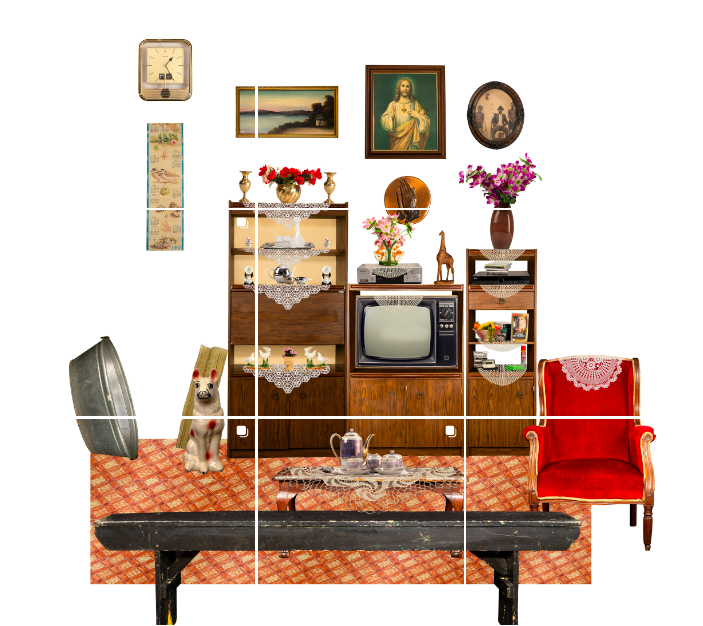
room19isaFactory, Lounge, 2023. Courtesy of The Library of Things We Forgot To Remember.
Room19’s project Lounge (in its verbal iteration, i.e.: “to lounge”), considers the historical subversion of apartheid era township housing by residents, which saw — and sees — the N51 house model shifted internally through a series of domestic symbols, decorations, and spatial features. “Where lounge as a noun was denied, lounge as a verb was orchestrated.” Proposing that a system of Black “Quiet Architecture” rubs against the limits of apartheid planning, room19 speculates shared strategies found in many township homes, which combine domestic “anchor” and “evergreen” artifacts to make possible hosting, lounging, and being together. The intervention is accompanied by the production of soundscapes through the Library’s collection.
The impulse of both the Library and room19’s interventions is something that I would like to characterise as ‘extra-archival’: that which moves beyond the typical logic of the archive. Both propositions, which centre Black social life and memory, refuse the stacicity and ‘untouchedness’ that is most often the primary attempt of the archival. What is most crucial in the archive is activated through the life happening around and with it. The extra-archival acceptance of flux and disorder encourages the production of histories that are people-centred and, thus, complex.
Conclusions, for now…
Thinking beyond strict conceptions of ‘archivalness’ is important for any project attempting to work with histories that have been erased, misapprehended, or intentionally skewed. Of equal importance is the consideration of alternative mechanisms for the independent publishing and dissemination of knowledge beyond those strictures.
Amongst newer Joburg collectives are the trio known as INVADE, with members Queenzela Mokoena, Omphemetse Ramatlhatse and Nyakallo Phamuli. The group is engaged with risograph publishing collaborations and education work, underwritten by their fundamental aim “to democratise, decolonise and deconstruct ways of creating and ways of being.” INVADE has run workshops and participated in events at a number of spaces including JAG, Goethe’s LAPA, and Latitudes. Last year, they riso-printed a major publication Lesser Violence, a book by the Gala Queer Archive — “a catalyst for the production, preservation and dissemination of information about the history, culture and contemporary experiences of LGBTIQ (Lesbian, Gay, Bisexual, Transgender, Intersex, Queer) people in South Africa” — edited by Amie Soudien. The book is the outcome of a reading group which began in 2018, attempting to think together about strategies for existence within the context of South Africa, defined by deep racial, class and gender inequality, and normalised violence, including sexual and gendered violence. In INVADES’s hands, the artistic labour of the book’s production is synchronous with its content, carrying its many careful and often painful articulations.
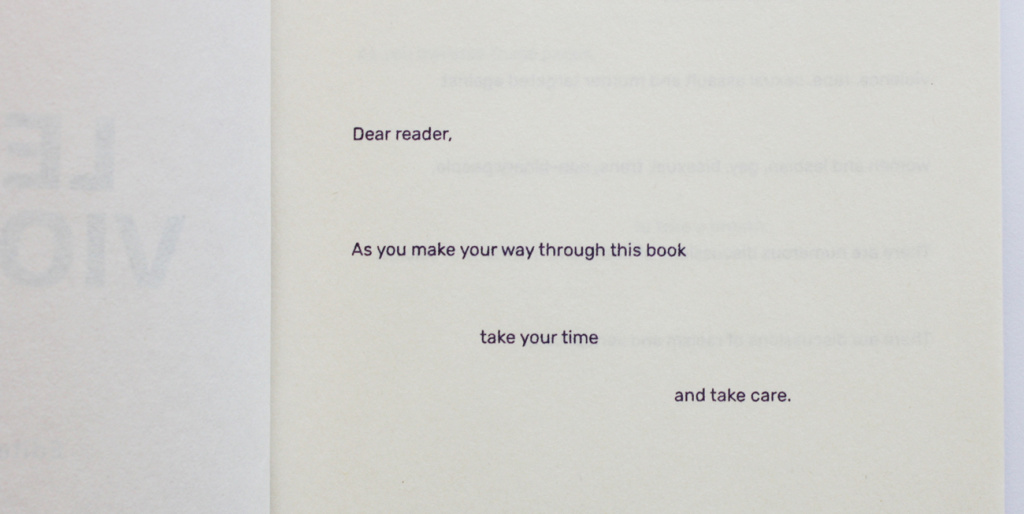
Amie Soudien (ed.), Lesser Violence: Volume 1, 2022. Courtesy of GALA.
Recent critiques of research art’s relentless onslaught in contemporary art production may have their place in other contexts.10See articles by Claire Bishop and Kavior Moon. But Joburg’s particular approaches to research in, as, and around art, including this turn towards site-specific system making, re-making and un-making, represents one of our more crucial and outwardly-faced moments of production since democracy, elucidated with most clarity, perhaps, by its broad exclusion from (or avoidance of) the commercial scene.
Part II of this series will pick up on the concluding thoughts, looking in more depth at Alternate Publishing and Printing Systems, as well as Ecological Systems, thinking through their role in the broader speculative category of the “Joburg System Turn.”