Green Point Park
21.10 - 20.11.2023
In a white building on the eastern entrance of the Green Point Park in Cape Town, Amy Watson of POOL and Sinethemba Twalo of NGO-Nothing Gets Organised have presented Nina Barnett and Jeremy Bolen’s research based practices, which cohere around matter and our systems of configuring its significance. Theirs is a conceptual offering that moves us beyond the audio-visual appeal of artistic and curatorial praxis towards a deeper affective and sensorial engagement.
This iteration is the first instalment of an extended programme that beckons us to sharpen our arsenal of perceptual tools. Each installation serves as a node; as a whole, or a series of interconnected sites, the installation beckons the viewer, recipient, observer to wrestle with the fragmented, illusory and indeterminate, from which the meaning of matter, nature and colonialism must be constructed and extracted.
Herein, Barnett and Bolen are informed by the quantum physicists Niels Bohr and Werner Heisenberg’s theory of Complementarity: the belief that ontic constituents of light and matter are not mutually exclusive, but equally necessary for a comprehensive description of quantum processes. Complementarity is a tale of relations, a recognition that perception is not simply the reflection of the micro-object’s properties or the nature of the experience in question, but contingent on the context in which the object is perceived.
To understand what Bohr and Heisenberg offer us with regards to the aesthetic, ecological and affective, we must turn to Karen Barad’s metaphysics. It begins simply by relaying that matter and meaning are not separate elements.1Karen Barad (2007) Meeting the Universe Halfway: Quantum Physics and the Entanglement of Making Meaning, Duke University Press, Durham and London. Matter cannot be perceived outside of the tools available to construct meaning. This imbrication of matter and meaning results in what Barad terms a metaphysics of phenomena, “wherein the primary [metaphysical] unit is not the independent object with independently determinate boundaries, but rather…phenomena.”2Ibid.

Installation view: Nina Barnett and Jeremy Bolen, Between the Ballast and the Pine, 2023. Photo by Paris Brummer. Courtesy of POOL.
Between the Ballast and the Pine makes clear that matter matters and that it does so as a consequence of how meaning is encapsulated, or how it reaches out for the discursive, the symbolic, the representational and the speculative. It beckons us to think through the multiple trade-offs that result in our particular and peculiar set of political and ecological realities.
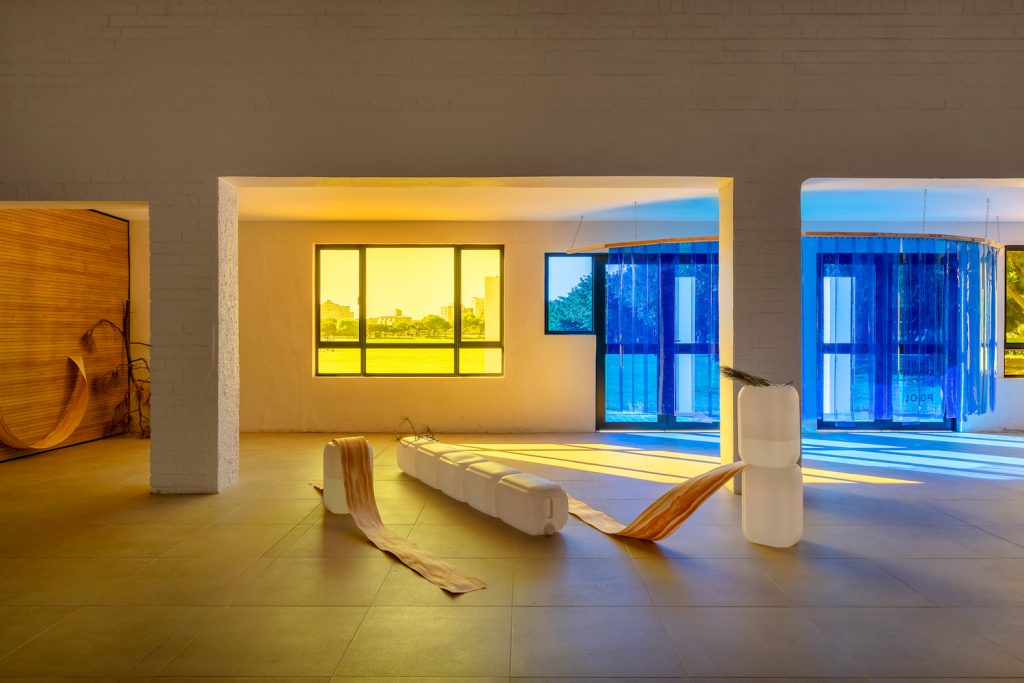
In the centre of the dimly lit space, the floor is littered with transparent twenty litre water containers that hold variable quantities of water, all of them at levels close to depletion. Ballasts are suspended from the ceiling, lest we forget that the Cape is the part of a naval imagination whose ecologies are reflections of oceanic mercantile economy. The transparency of the containers offer a framework through which we might contend with the material and draw deeper inferences about ecologies and the extraction of natural resources. Here, water is finite, containable and, if one considers the broader neoliberal structure, commodified. The containers simultaneously act as screens. The interplay of light and material determines what is sensorially perceived, but what can be known about both matter and light eludes us.
The ubiquity of matter and what Barad has termed ontological inseparability of intra-con phenomena is made apparent in Barnett and Bolen’s audio-video installation, where the narrator walk the listener through the journey of the mine dust particle. As the narrator explains, dust particles in Australia have been identified as emerging from the gold mines in Johannesburg. The earth is not so much a unified system, but a series of systems mediated and mitigated by ecological, economic and political flows.

Installation view: Nina Barnett and Jeremy Bolen, Between the Ballast and the Pine, 2023. Photo by Paris Brummer. Courtesy of POOL.
About the rest of the room are installations that figure the pine tree as a historical symbol worthy of interrogation. There is a scaffold of (what I perceive to be) pine that plays a projected image, and an installation of pine cones laid within car rims. These are all artistic gestures that pose important critiques of colonial terraforming, which is the altering of one environment so that it appears as a copy of another, imploring us to think about the ways that discourses of nature are imbricated with those of indigeneity and to question the apparatuses that obscure how such realities are constructed.
Pine is an evocative material because it is intimately bound to colonialism. Perhaps desirous of a landscape that mirrored that of the metropole3Zahn, G.A. (1929) “The Cluster Pine (Pinus Pinaster) at the Cape,” South African Journal of Science, Vol. XX VI, pp.195-210. or even a material with which the European artisan was familiar but more practically to supplement the expanding fuel needs of the settlers,4Showers. K. B. (2010) Prehistory of Southern African Forestry: From the Vegetable Garden to Tree Plantation. Jan Van Riebeeck ordered multiple species of pine trees to be imported from Europe and grown in the Western Cape. A century later, the first commercial pine plantation was established in Gadendal in the Western Cape. The ecological consequences of this planned invasion were particularly heightened during the Western Cape’s water crises. Pines are unsuited for regions with limited water resources, given that they need forty to fifty litres of water a day. Thus, the pine tree is a bearer of this uncanny history, it is a prism through which colonial materialities and sensibilities are reflected. Yet our view and knowledge of this history is determined by the mechanisms that determine our modes of contemplation.
The exhibition constructs a scene where the colonial and ecological are not just discrete discursive arenas, but continuous processes that birth complex phenomena. The relationship between pine trees and water is made stark. The dangers of terraforming revealed. Colonialism is thus a totalising force that constructs and constricts what we consider natural and further dictates the mechanisms through which we perceive and articulate our experiences of these phenomena.

Nina Barnett and Jeremy Bolen, And so we may feel echoes, 2021. Courtesy of POOL.x