Guns & Rain
24.06 - 04.08.2023
In 1972, Anansi published the Trinidadian author Harold Sonny Ladoo’s1Harold Sonny Ladoo, No Pain Like This Body (Toronto: Anansi Press, 1972). gut wrenching debut novel, No Pain Like This Body. The bold narrative, tinged with the violent mundanities of life on a rice plantation, secured Ladoo’s place within a tradition of Indian Diasporic writing such as V.S Naipaul’s similarly brilliant A House for Mr Biswas. Like Ladoo, Naipaul’s piercing tale sought to grapple with the psychic and social consequences wrought by usurpation, migration, coerced labour, colonial violence, life and death. Ladoo died strangely and suddenly in 1973. His body was found in the cane fields outside the village in which he grew up in Trinidad and Tobago, pointing towards the Caribbean as both the progenitor of the plantation system and a zone of metaphysical instability. That is to say, the Caribbean is where social relations – between masters and slave, free and unfree labour, object and subject – are configured. Ladoo’s fictive escarpments, his providential demise and contribution to a Caribbean consciousness find resonance in Zenaéca Singh’s practice.
Currently shown as part of the group exhibition US at Guns and Rain, Singh’s work is an intricate and instructive reflection on the artist’s indentured heritage. She compellingly interrogates how monstrosities become embedded in the ubiquitous. Within the ambit of Singh’s burgeoning career, sugar serves as a mechanism for historical retrieval. The artist’s methodical treatment of sugar – heating it at various temperatures to achieve a range of hues – is most evident in her sculptural figures of ships. She then casts these figures in resin – a slow and exacting practice.
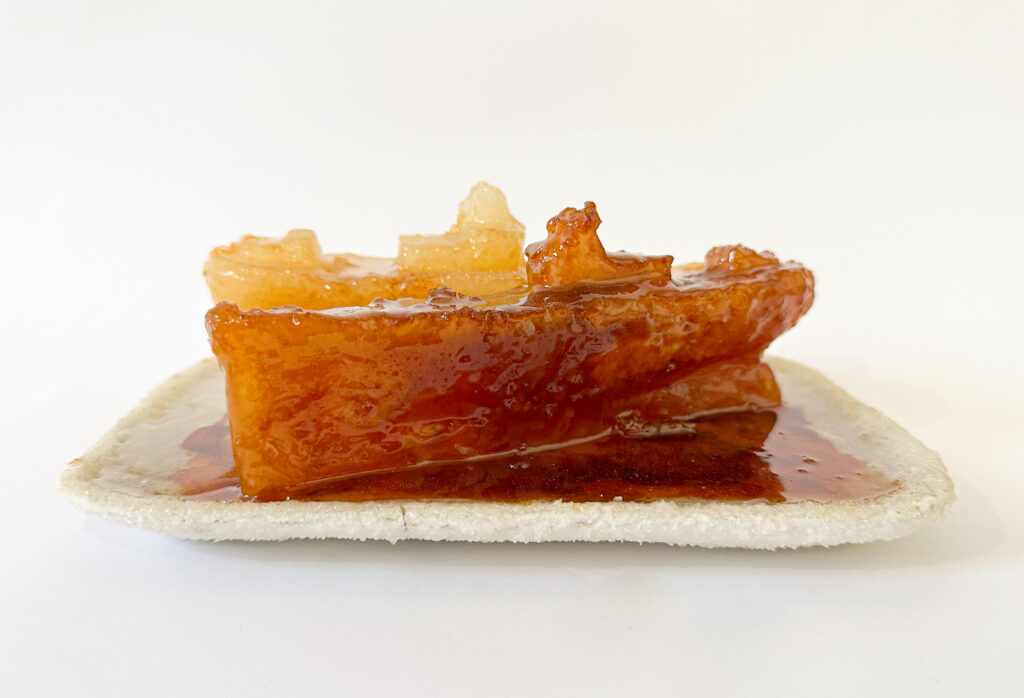
Zenaéca Singh, The Beginning, 2022. Courtesy of Guns & Rain.
The artist’s detailed paintings, achieved through molasses, utilise another painstaking method, one that evinces Singh’s dedication to thinking through and with her material. This careful exploration inadvertently links to the sugar plantation and its history of slave labour. A model perfected in the Caribbean, most notably in Jamaica and Saint Domingue (now Haiti), the sugar plantation was a site of a methodical labour management, in which the slave’s body was yielded as an industrial machine. It operated in service of an agricultural project that was particularly sensitive and exacting: sugar cane had to be tended to throughout the year, and the time between harvesting and milling was kept to a minimum, as harvested cane is quick to spoil. This above the fact that slave labour already existed for the purpose of driving profits, a feature that insisted that such a body never be idle. Thus, according to Trevor Burnard and George Garrigus2Trevor Burnard and John Garrigus, The Plantation Machine: Atlantic Capitalism In French Saint Domingue and British Jamaica (Philadelphia: University of Pennsylvania University Press, 2016). the sugar plantation must be thought of as a proto-industry without which the European industrial complex, which is erringly conceived of as the driver of modernity, would not have been achieved. Nicholas Fiori3Nicholas Fiori, “Plantation Energy: From Slave Labor to Machine Discipline,” American Quarterly (2020), 559- 579. offers an even deeper account of these capitalist relations, averring that what was at stake was not simply the conversion of the slave body into an inanimate object, but the configuration of the plantation as the site where the slave body becomes coessential with the machine. Yet this narrative is glaringly absent from the artist’s purview.
Perhaps this obfuscation of the slave is a consequence of the artist’s use of identity to engage with the fraught space of the plantation. Here, sugar is the ubiquitous product that inserts the Indian into the world of bonded labour. The sugar ships cast in resin are an ode to the passage across the Indian Ocean, and perhaps an allusion to indentured servitude’s wide net – a net that saw Indians contracted to regions as far flung as Mauritius, Cuba, Trinidad and British Guiana. The resined ships, placed carefully on tea stands, drip with decadence, centering the gastronomic desires of the metropole, but they ignore the figure of the slave and the journey through the middle passage. This, despite the fact that, as historian Stanley Engerman4 Stanley Engerman, “Contract Labour, Sugar, and Technology in the Nineteenth Century,” The Journal of Economic History (1983), 635 -659. has observed: “Nineteenth century forms of contract labour which the Asian was drawn into were most important in the sugar plantations where slavery had recently existed or which later began the production of sugar.”
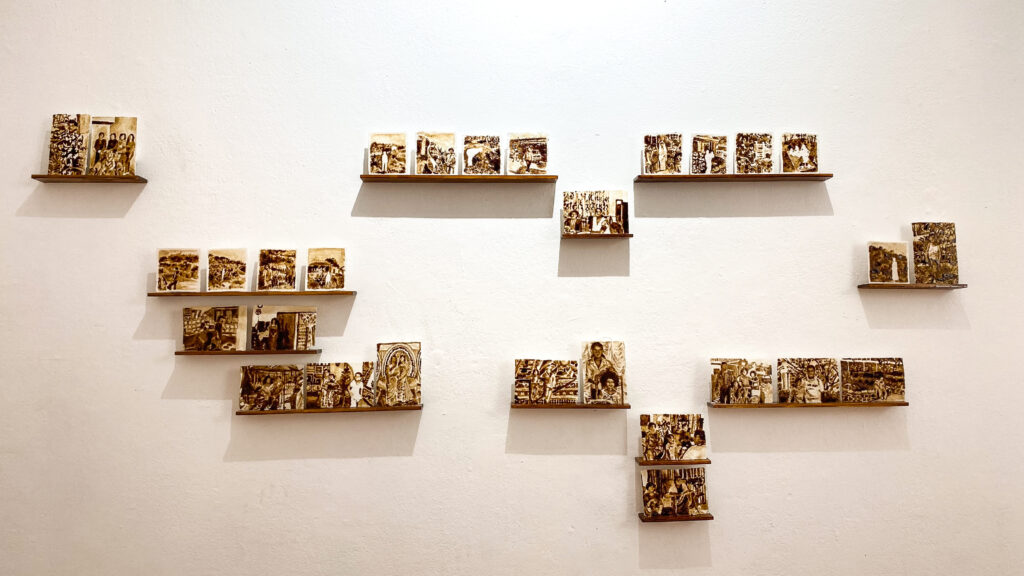
Zenaéca Singh, Bittersweet Impressions, 2022. Courtesy of Guns & Rain.
Identity – what often emerges as a politics of recognition that centres the individual I – is by design, unable to contend with the multiple political, historical, metaphysical and psychic vectors that create subjects and objects. Whilst identity might serve as an accessible modality for situating oneself in a constantly vacillating global configuration, it easily lends itself to essentialist articulations of self and subjectivity. Identity precipitates forms of political engagement that undermine the compound inheritances of imperialism and other forms of Western hegemony. Thus, the carefully crafted table settings and the sacks of sugar moulded from plaster of Paris that line the corners of the gallery work less as an ominous allusion to the global capitalist networks cemented through centuries of imperial terror and more as a singular genealogical quest.
The quandary is that the artist has a responsibility both to her past – her particular experience of the world – and her material, sugar, which encodes a hitherto unrecognised historical complexity. As Professor Bhekizizwe Peterson5Bhekizizwe Peterson, “Spectrality and Inter-generational Black Narratives in South Africa,” Social Dynamics (2019), 345-364. reminds us, “The arts and historical experience are inextricably interlinked, but also that there are occasions when art exercises an influential role in setting the limits and possibilities of political and socio-economic imaginaries and interventions.” The task, then, is to think through the multiple historical and political crevices, to create an expansive imaginative terrain that transgresses psychic and geographic thresholds and thinks through the history of the world. This is my challenge to Singh.
Ladoo’s life and literature beckons us to envision the diasporic Indian as increasingly unmoored from a singular cultural narrative and thrown into a multivariate crisis. Singh’s evocative sculptures and intimate family portraits, where molasses conspires with canvas, situate the South African Indian within the bounded South African imaginary as the recipient of a singular inheritance. Even so, embedded within the sensuous sculptures and the grainy textures of the sugar coated cups and saucers is an artistic eye that has the capacity to delve through history’s labyrinthine folds, revealing how the subaltern is born in slavery’s wake.
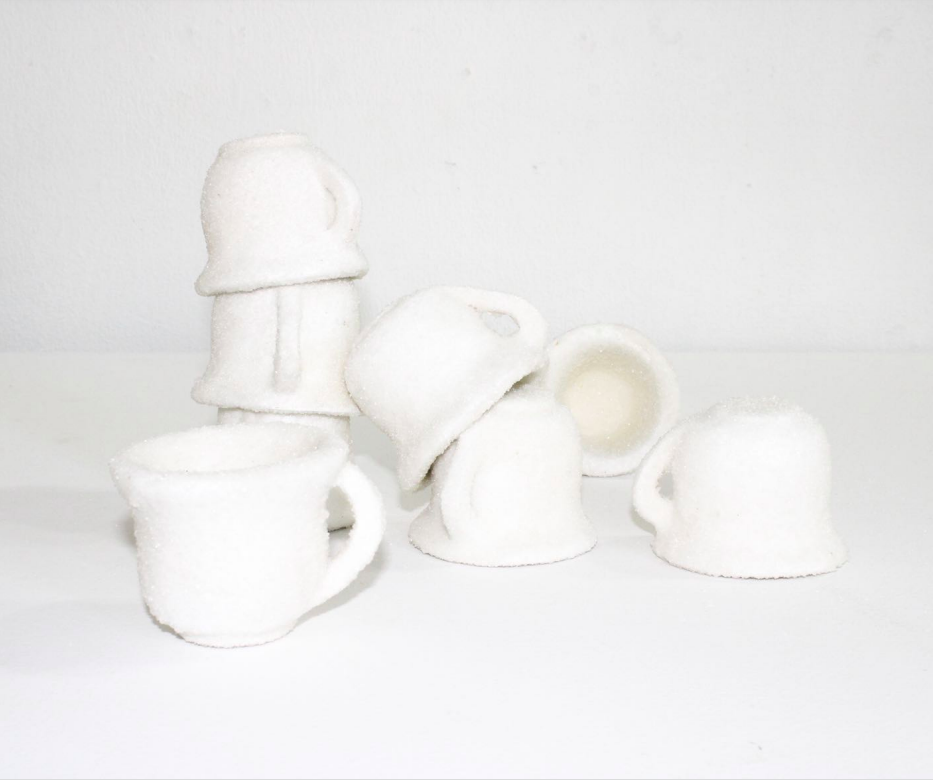
Zenaéca Singh, Why is There Hope Where There is Tea? 2022. Courtesy of Guns & Rain.