RMB Latitudes Art Fair
23.05 - 25.05.2025
RMB Latitudes Art Fair, located at its Shepstone Gardens venue on Hope Road, has been making its way into the hearts and art calendars of Joburgers for the last three years. The location for the fair holds as much ambience and agency as the booths and bodies that occupy it. Stone and marbled walls and staircases lead one up and around the garden and buildings that make up this layered setting. The fair and its participants mould themselves around the pillars, hidden rooms, glamorous walkways and water features. This gloriously imposing infrastructure helps visitors get their daily steps in while treasure hunting and art gathering, with an Aperol spritz in hand.
As a human living on the same street as the fair, I’m hyper-aware of how the area has transformed over the years, shaped by evolving events, rhythms, and occupants. Hope Road, in particular, is notable for forming a border between Orange Grove and Mountain View. Just two streets down lies Louis Botha Avenue, a central artery in the area that stretches from Hillbrow to Wynberg, lined with corner stores, bars and bottle stores, apartment buildings, makeshift churches, and takeaway spots. A stone’s throw away is the Houghton Hotel and golf course, often graced by the latest models from Mercedes-Benz, Land Rover, and GWM. The Radium Beerhall, the oldest bar in Johannesburg, dates its beginnings to the late 1920s. A dilapidated architectural residue of what used to be the Doll House roadhouse.
And of course, there’s Shepstone itself, which has slowly reshaped the first half of Hope Road over the years. A recent addition was used as a parking space for exhibitors, along with a new walkway connecting it to the main entrance. The walkway was a blessing this year, easing the need to dodge moving vehicles and squeeze past the stationary ones that line the road.
Walking to the fair, and with this context in mind, I couldn’t help but be drawn to particular works that leaned towards nostalgic, sentimental and historic reflections on urban and suburban life in Johannesburg, and city life more broadly.
The gallery section is always a pleasure, allowing one to see newer, larger, smaller, brighter, heavier (and often more affordable) work by familiar names. It is also a great introduction to newbies, with galleries testing the waters by showcasing artists they are courting or have just signed, giving audiences a taste of possible additions to their programme. Gallery-adjacent initiatives like that of Untitled and Peffers Fine Art stole the show.

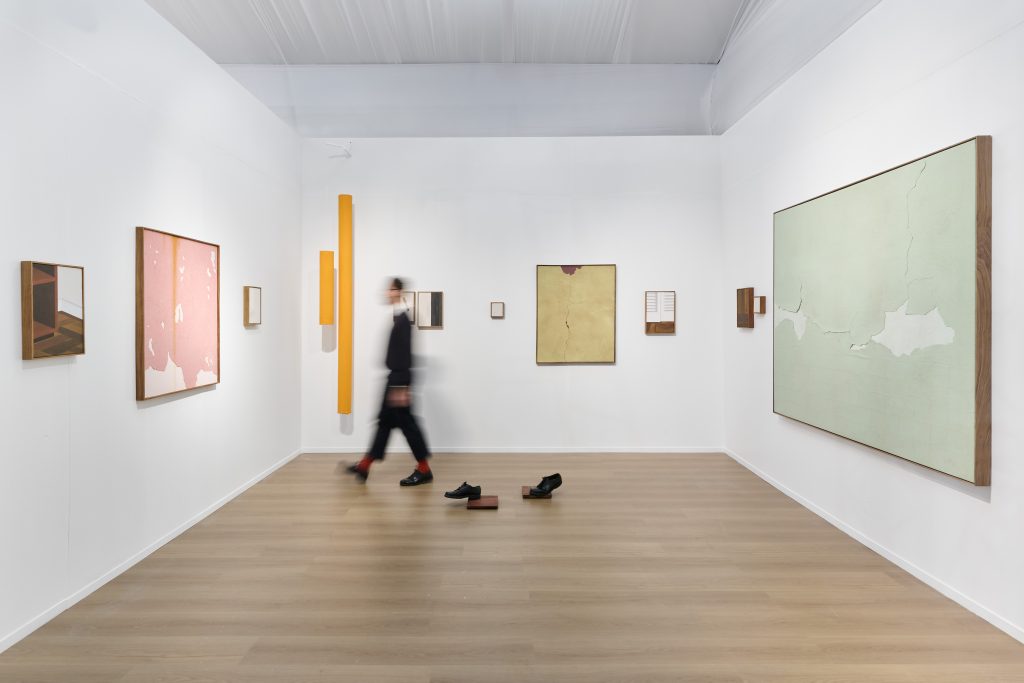
Guy Simpson, ‘Running Parallel‘, 2025. RMB Latitudes Art Fair. Image Credit: Anthea Pokroy.
Guy Simpson’s presentation ‘Running Parallel’ with Untitled is closest to my heart and was voted the Lexus Best Stand Winner. His first solo in Johannesburg draws direct inspiration from Louis Botha and Orange Grove, the area in which he grew up. Each work operates as a viewfinder, hyperfixated on the details of interior and exterior existence. His small-scale paintings, with their smooth brushstrokes and repressed articulation of space, mimic the experience of remembering, with memories sometimes coming back in pieces or offering oddly specific references to a cupboard, a curtain or a doorway. These depictions of interiors are of his childhood home. In conversation with the artist, it becomes apparent that they also reflect the intimacy of living and the residue of those who had lived in the house before. The blinds, the nail in the wall, the door handles, the mezuzah, all physical manifestations of acts and gestures of homemaking. They allow the viewer to fill in the unpainted surrounds of each work. This spills out onto the floor, with the installation Coming and going. By taking secondhand school shoes and salvaged Parquet flooring from his old home, the artist invokes a ghostly younger version of himself running through the corridors of his old house.
These are juxtaposed with larger, textured works that replicate cracks and peeling paint as seen on walls along Louis Botha. Working closely with Google Street View images, Simpson layers, cuts and paints canvas to produce strikingly realistic imprints of exterior details.
Speaking about his process and inspiration for these works, Simpson states: “What I’m trying to do is look at where the area came from. I’m looking at the cracks, the rust, and the chipping, and how this can reflect how I rust, crack, and chip as a person—how I make mistakes. It’s about trying to make something beautiful, not something that looks neglected.”
An additional experiment is what he referred to as “hanging paintings” that match the colour and dimensions of traffic lights. Their suspension disorients their reference point, with traffic lights solid, authoritative structures transformed into mobile pieces that resemble wind chimes.

Adele van Heerden, ‘Signal‘, 2025. RMB Latitudes Art Fair. Image Credit: Anthea Pokroy.
A neighbour to Simpson’s presentation was that of fellow Cape Town-based artist Adele Van Heerden with Lizamore & Associates, titled ‘Signal’. Here, she offered varied vantage points on swimming pools and other bodies of water across multiple cities. Existing as transcriptions of her memories and encounters with water, portraying feelings of buoyancy and fluidity. Her use of light and colour produces frozen moments and cinematic spatial compositions.
Van Heerden has developed a technique that involves translating photographs she has taken into detailed line drawings on the front of translucent drafting film, often used by architects, then flipping the sheet to apply gouache on the reverse. This dual-sided approach uses the film’s transparency, allowing the pastel and paint to interact visually, creating a layered piece that unites both sides into a cohesive image.
Two paintings in particular depict a visit to the pool at Zoo Lake from the last time she was in Johannesburg for Latitudes. Reflecting on this memory, Van Heerden shares that she “tried to go swimming, but unfortunately the pool was closed. But I managed to sneak in and take some pictures. The water was very low, and so I was just obsessed with these willow leaves and the kind of slime at the bottom of the swimming pool. But I think my work is very feelings-based, so it’s definitely about the calmness that the water gives you, and thinking about bodies of water in terms of my own identity.”
With her depicting open waters and architectural forms that house swimming pools across multiple cities, the body of work is a cartography of the artist’s own movements, the energy states of water, and how this is a reflection of herself.
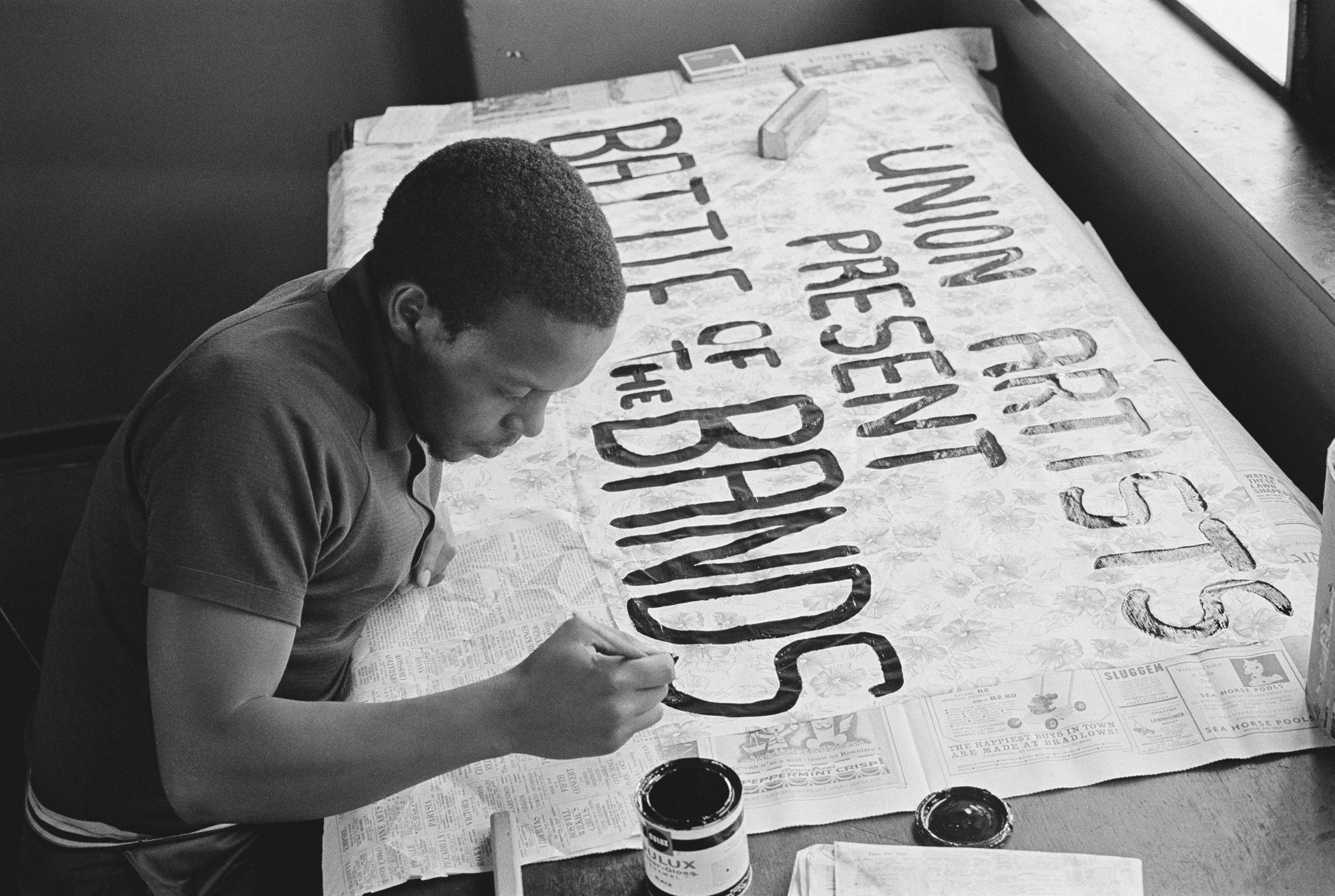
Ernest Cole, Untitled (Union Artists Present Battle of the Bands), c.1965, printed 2025
embossed with the Ernest Cole Estate stamp; signed by Leslie Matlaisane (Ernest Cole Family Trust) and Dennis da Silva (Alternative Print Workshop), numbered and inscribed with the medium in pencil on the reverse
hand printed silver gelatin print on Ilford fibre-based paper.
The final highlight is art consultancy Peffers Fine Art’s presentation of ‘Back o’ the Moon’, winner of the Lexus Best Stand Audience Award, featuring photographs by Ernest Cole, Bob Gosani, Alf Kumalo, GR Naidoo, Jürgen Schadeberg, and Paul Weinberg. The title is drawn from the famous Sophiatown shebeen, with the presentation showcasing the intimate connection between South African musicians and photographers, whose work shaped and captured the country’s history and cultural present.
The selection of images featured here originates from the exhibition of the same title, showcased earlier in May at the Journey to Jazz Festival in Prince Albert. The artworks presented here vividly articulate the socio-political landscape of Johannesburg during the 1950s and 1960s, capturing moments of joy, release, resistance, identity formation, and the complexities of urban life in a city shaped by segregation and racial injustice.

Ernest Cole, Untitled (A young Banza Kgasoane with double bass), c.1960, printed 2025
embossed with the Ernest Cole Estate stamp; signed by Leslie Matlaisane (Ernest Cole Family Trust) and Dennis da Silva (Alternative Print Workshop), numbered and inscribed with the medium in pencil on the reverse
hand printed silver gelatin print on Ilford fibre-based paper
On view were iconic images, such as that of Schadeberg’s photograph of Miriam Makeba, Cole’s Untitled (A young Banza Kgasoane with double bass), and Kumalo’s Hugh Masekela leaps into the air with delight after receiving a trumpet from American jazz legend, Louis Armstrong as well as covers from DRUM magazine.
“The photographers featured in Back o’ the Moon — many of whom were associated with Drum magazine — played a vital role in documenting the spirit, struggle, and vibrancy of urban Black life under apartheid. Their work captured moments of beauty, defiance, and everyday joy, often in the face of deep systemic injustice. Sharing these images now is not just an act of remembrance; it’s a way of restoring visibility to artists and communities whose stories have too often been marginalised. Their lens offers us a visual archive of cultural resilience and historical truth.” – Ruarc Peffers, Peffers Fine Art.
The artworks presented here explore Johannesburg’s physical and emotional landscapes, reflecting on the city’s past and present through diverse artistic expressions. Unpacking themes such as identity and memory, they explore visual vocabularies for contemplating iterations of city life, as well as the making and remaking of urban existence through the self, the familial, and the larger collective.