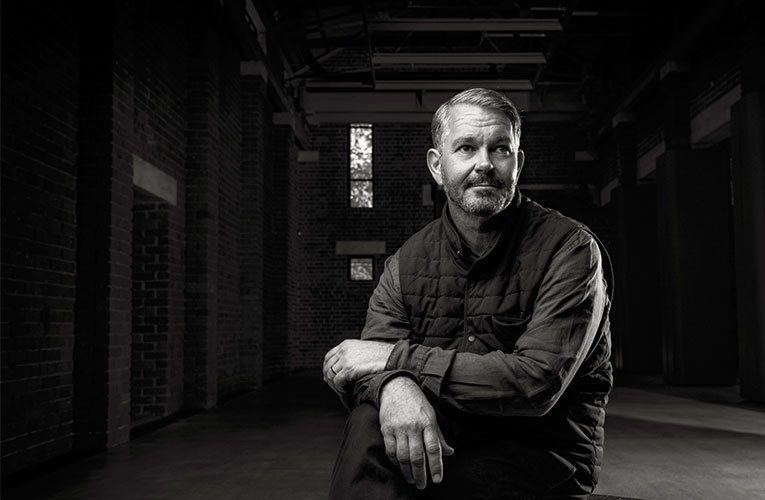
Nkgopoleng Moloi sat down with Clive Kellner, Executive Director of the Joburg Contemporary Art Foundation and Editor of the JCAF Journal, to gain insight on the institution and its position in the Johannesburg art ecosystem.
How has JCAF positioned itself within Johannesburg’s contemporary art ecosystem?
JCAF’s role from inception has been, and continues to be, that of profiling Johannesburg through the lens of the Global South. All of JCAF’s programmes and activities foreground the artistic, cultural and scholarly work being produced in Johannesburg, in relation to a broader paradigm that encompasses the Global South as a conduit for creating knowledge in and from the South. Moreover, as a philanthropic institution that is free to the public, our mission is to provide high-quality artistic programming that combines research, technology and art exhibitions (and associated talks, podcasts, publications) that sit adjacent to the commercial market in Johannesburg and South Africa, thereby enhancing the cultural offerings of the larger art ecosystem in the city.
Since opening in 2020, what unexpected discoveries have you made about operating a non-collecting contemporary art foundation?
There have been several incredible discoveries since launching JCAF in 2020. Firstly, the response from our audience to our exhibitions, which is warm and generous feedback on the curating, artists, artworks and exhibition as a whole, but also to the guides and the ‘JCAF experience’ that includes friendly staff and a professionally run operation. Secondly, the response to our content (publications, podcasts, lectures and knowledge talks) and how this is tailored to developing a knowledge community in Johannesburg. And thirdly, the privilege of serving the public through our programmes, where the effect is a genuine thirst for knowledge from a very diverse audience comprising both regular returning visitors and new audiences.

Frida Kahlo, Self Portrait with Hummingbird and Thorn Necklace (1940). Oil on canvas pasted on board. Collection of the Harry Ransom Center, The University of Texas at Austin, Nickolas Muray Collection of Modern Mexican Art. © 2022 Banco de México Diego Rivera & Frida Kahlo Museums Trust
How do you engage diverse audiences through your art-historical approach, and what has the response been to JCAF’s educational mission?
Since launching in 2020, our audience has grown exponentially. 63% of our audience comprises women. Our audience includes professionals from various backgrounds (legal, medical, marketing, business, policy, etc), NGOs, schools, tertiary students, academics, creatives and architects. We also have repeat visitors who come to every show, school children who come from a variety of African countries, and a centre that works with survivors of abuse. In recent years, we have also seen an increase in kids’ tours and elderly groups such as the U3A (The University of the Third Age), showing that our programme can be equally enjoyed by different generations. What our aim has been and continues to be is to educate local audiences through modern and contemporary art from the Global South, together with modern and contemporary South African artists. One such example was the Frida Kahlo, Irma Stern and Amrita Sher-Gil exhibition in 2022-23, where we brought works by Sher-Gil and Kahlo to South Africa for the first time. Many South Africans do not have the opportunity to travel overseas to see work by Frida Kahlo, and by bringing artworks like these to Joburg, we make art accessible to many.

Installation view of Structures exhibition, from foreground: Kader Attia,Untitled (Ghardaïa) (2009); Hélio Oiticica, PN 28 “Nas Quebradas” (1979); MADEYOULOOK, Dinokana (2024). Photo Graham De Lacy.
Can you also tell me to what extent the programming considers site specificity and Joburg as a city?
JCAF is located in a former tram shed and electrical substation and is a local heritage building and, as such, is embedded in the fabric of the history of Johannesburg. In thinking about a name for the institution, it was important for us to centre the city (Joburg Contemporary Art Foundation). Moreover, for JCAF’s logo and CI, we drew from old Johannesburg street signs to develop the font used in our branding. Johannesburg is at the core of our activities that are informed by this wonderful, crazy city, which is constantly reinventing itself and which continues to connect with the rest of the African continent. This plays out in the formulation of our programming at JCAF – through exhibiting Johannesburg-based artists such as MADEYOULOOK (a collective who call themselves ‘deep inner city kids’) who are currently showing their work Dinokana (2024) (which premiered as the South African National Pavilion at the 2024 Venice Biennale) on our Structures exhibition, or guest speakers on our Knowledge Talks like neurologist Dr Kirti Ranchod, or including the visual essay ‘In Situ: Stories of Johannesburg High-Rises’ by photographer Mpho Mokgadi in the JCAF Journal, to commissioning a jazz soundtrack by Mandla Mlangeni, to scholars like Achille Mbembe who have been so instrumental in forming intellectual work around the city.
How does JCAF collaborate with other cultural institutions in Johannesburg, and what role do you see the foundation playing in South African art?
JCAF has incorporated a different focus when it comes to collaborating with local cultural institutions in Johannesburg – our emphasis is on the creation of a knowledge community that ordinarily may not attend art exhibitions or congregate socially in an art space in Johannesburg. Through sustained cultural offering (our exhibitions, lectures, live talks, podcasts and performances), a community of Johannesburg residents are regularly attending JCAF’s programmes, and in some instances this has led to them participating in our programmes. The longer-term aim is to further activate this space into one in which further knowledge (content) is created by Johannesburg-based professionals, academics, intellectuals, artists, architects, musicians, etc. Strategically, JCAF’s contribution is to assist in putting (and keeping) Johannesburg on the global map as a cultural destination, but also position contemporary South African artists together with other significant contemporary and modern Global South artists, in a dialogue that contributes toward local audiences in the city, and also profiles them globally.
This interview was part of a larger feature that profiled Johannesburg for Art Basel Stories, African art gets a global stage in Johannesburg.