Leslie Lohman Museum
11.09 - 18.01.2026
The following is an edited conversation between Athi-Patra Ruga and Nkgopoleng Moloi, a few months before the opening of Ruga’s exhibition at the Leslie Lohman Museum, titled ‘Athi-Patra Ruga: Lord, I gotta keep on (movin’).’
Ruga speaks about key moments in his practice and sheds light on his philosophies that centre queer, femme and Black folk.
Nkgopoleng Moloi: So, the first thing that’s presented in your bio is this idea of the trope of myth as a contemporary response to post-apartheid South Africa. And I wanted us to start there because I think that’s still in your work, but it feels maybe more entangled?

Installation View | Athi-Patra Ruga: Lord, I gotta keep on (movin’), 2025. Leslie Lohman Museum.
Athi-Patra Ruga: Yes. It has evolved. We can take it from a position of knowing that I have had many touchstones in my career with the different bodies of work that I have shown.
I was born 10 years before 1994. I was raised with that sort of hopeful miasma for 1994. Later, I started realising things as I come into space, I started questioning nationalism and my place in it, along with my various communities, queer, femme and Black. Do you know what I mean?
That results in the Future White Woman of Azania. The Future White Woman of Azania was me, using myth, national myths, global myths, media and images that could bolster a national myth as a play on these ideas.
Having this rich world of Azania that I created, it now consumes me. I was engulfed by it. Now I am engulfed by the queer, the black, the feminist or womanist lineage that materialises in the making of art. This expresses itself as well in terms of materiality, of course, because in the past five years, I have been trying to think more about that world.
I also moved back home to Hogsback in the Eastern Cape. My husband and I live here. And I’m a beekeeper. I’m in a garden club, and the art that is now coming out is art that is a counter-telling – still within myth, a countertelling of masculinity. If it were visual, it would be the history of the Eastern Cape and the founding of South Africa, you know? Once again, I’m still interested in talking about nationalism, but now we’ve all gone deeper with the nuance. We’re still creating avatars within Azania. But there’s a lot more happening.
NM: Yeah, no, that makes sense to me. So this idea of building worlds or world-making or imagining kind of other possibilities of different kinds of worlds. It feels central.
APR: Definitely. Spot on. Because we are manyfold, and there’s a word that I would like to use. And that’s protean, which is the ability to change and evolve and do many different kinds of things.
From when I started in the mid two thousands, my work had always been this sort of like synthesism. Has always been about being able to switch and change. And that’s very much influenced by queer radicalism, you know, to not be clocked. And all of that. And now I’m in this strong protean place where nationalism has moved to me, exploring my inner world within a globalised world that has all these contradictions.
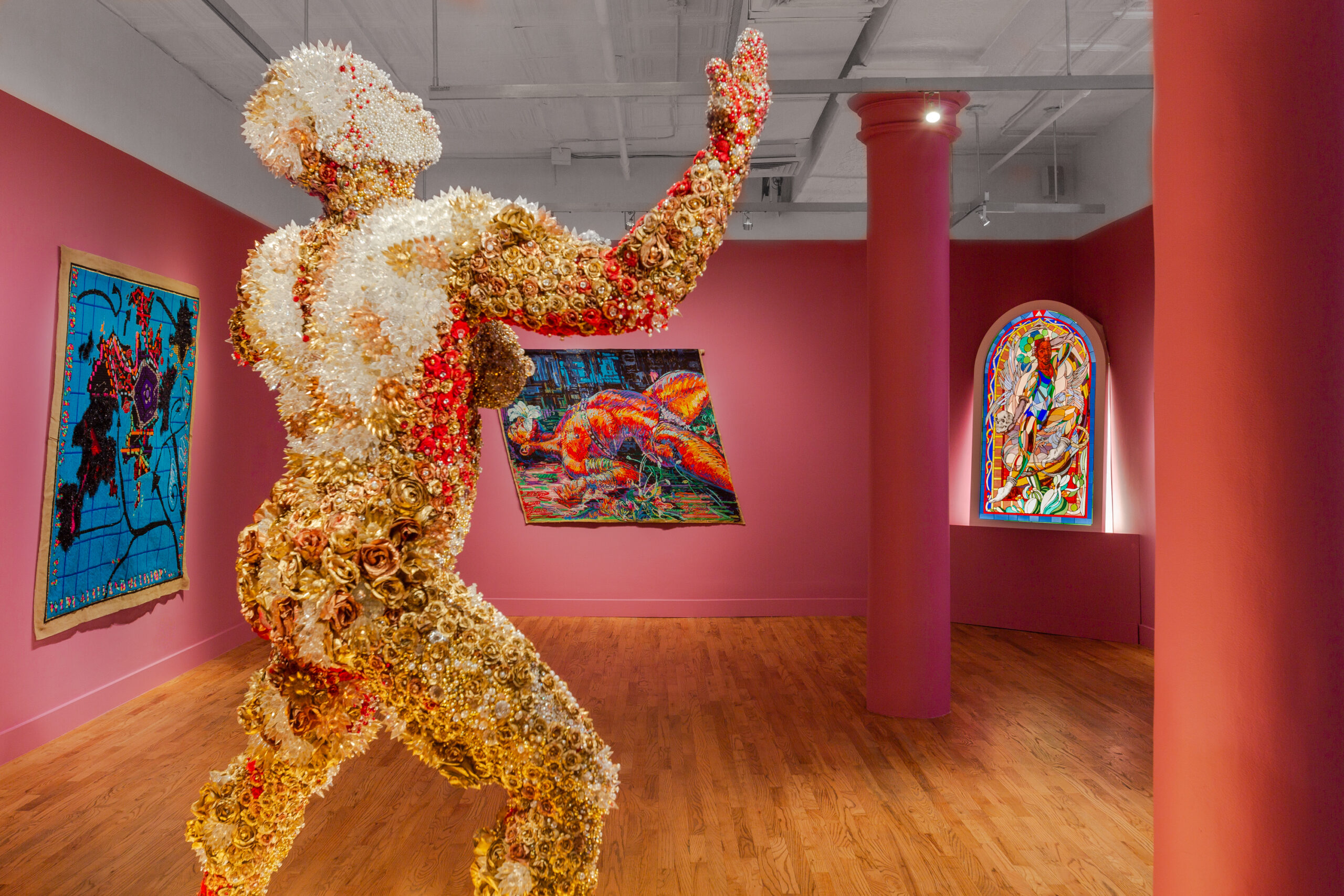
Installation View | Athi-Patra Ruga: Lord, I gotta keep on (movin’), 2025. Leslie Lohman Museum.
NM: Tell me how you relate to this word, utopia, now, which has been used for such a long time to describe your practice. How are you thinking about it now?
APR: The sunshine of utopia highlights its lack.
From the beginning of my work, creating avatars and also moving on to creating worlds and Azania, I knew that I was going to make it a utopia because I know that utopias need borders, right? They need checkpoints. They need passports, visas, ways of accessing, and that becomes an epistemic thing as well. They need to create an image that the grass is green here; however they do it, whether it’s the truth or not, in imagery, et cetera. The one who is outside of the utopian place has to be established by saying that they’re lesser than because they didn’t manage to come into the space. And that usually is the queer, the black, the femme, which is basically what my work is about in relationship to exposing what utopia is. It’s also about creating embodied characters that can carry that through performance, video, tapestry, painting and drawing.
I could even say now that Azanai has become internalised for me, because I’m trying to find out my constitution, and I’m using that word concerning nationalism as well.
I can use examples, The Lunar Songbook, which then becomes my post-future White Woman of Azania moment, whereby I moved to the Eastern Cape, and the way of counting time through these phenomena comes to the forefront. There’s an ecological aspect to it, but there’s also a narrative within the world of Azania. I continued the Luna Song book in tapestry and painting, fortifying it, creating avatars in 3D to somehow fill in this world the same way that I did with those balloon characters in the early days.
From The Lunar Songbook, we moved on and built on the stories of the matriarchy. I then became interested in tracking the imagery or the history of image-making as it pertains to the black male. Thinking about the founding of nations by putting them in the frontier wars with the work Amadoda on the verge, as an example.

Installation View | Athi-Patra Ruga: Lord, I gotta keep on (movin’), 2025. Leslie Lohman Museum.
NM: And now with this show at Leslie Lohman Museum. Can you tell me about that?
APR: The name of the show is ‘Lord, I gotta keep on (movin’)’. It’s from Bob Marley’s 1992 album, Songs of Freedom! It speaks to the protean nature, right? Which is that of keeping on moving, you know, from one medium, getting a hold of it, moving onto another, one concept and another. Also, having a medium call me. I feel that that is something that has always happened. Since the beginning of my career, there has been something political about how I used different mediums.
If we start with performance, that was so that I could reach people quickly. Because that becomes an immediate bounce back, which then feeds into the studio work, and then you go again and you try it out with the people before they even become an art audience. That’s how I started. And then documentation of performance becomes a necessity. And that also then is how I enter the white cube space, showing the documentation of the performances through photography.
Anyway, the show is exploring my early works. It is anchored around three film works that are touchstones from the beginning until now — Over the Rainbow, After He Left and Public Service Announcement.
A lot of it is detailing the world of Azania, but also showcasing other ways of thinking and working. For instance, I also have an obsession with decapitated heads as a conceptual nugget. They speak of so many things for me. From biblical references to art history, Greek mythology, or even the Ku Klux Klan hats. Ideas of beheadings, offerings, monuments and a recurring dream throughout my life of appearing as a floating head.
The show also includes a few of my tapestry works. From the ones that engage with Procession, a performance tool I love using, to more abstracted works, such as the maps. Escape to the End of History, for instance, depicted the old Transkei, Bophuthatswana, Venda, and Ciskei (TBVC) states, which have been turned into Azanian islands. They appear exiled, blocked off from allowing people to come in or go out. In this work, I use the arrows as a way to communicate movement and name the places within the states according to significant events, for example, the death of Winnie Mandela. The names then become ideas and evoke with them the histories they carry.
There’s another work called Trail of Tears. Which is also an expansion on that, but Trail of Tears, as in the great trek in South Africa, the Bantu migration, that’s what these arrows are communicating. The title then adds to the events that happen while these people are looking for a home.
The works are animated and often joyful, but also speak to the enduring theme of nationalism and conditions of the post apartheid South Africa.
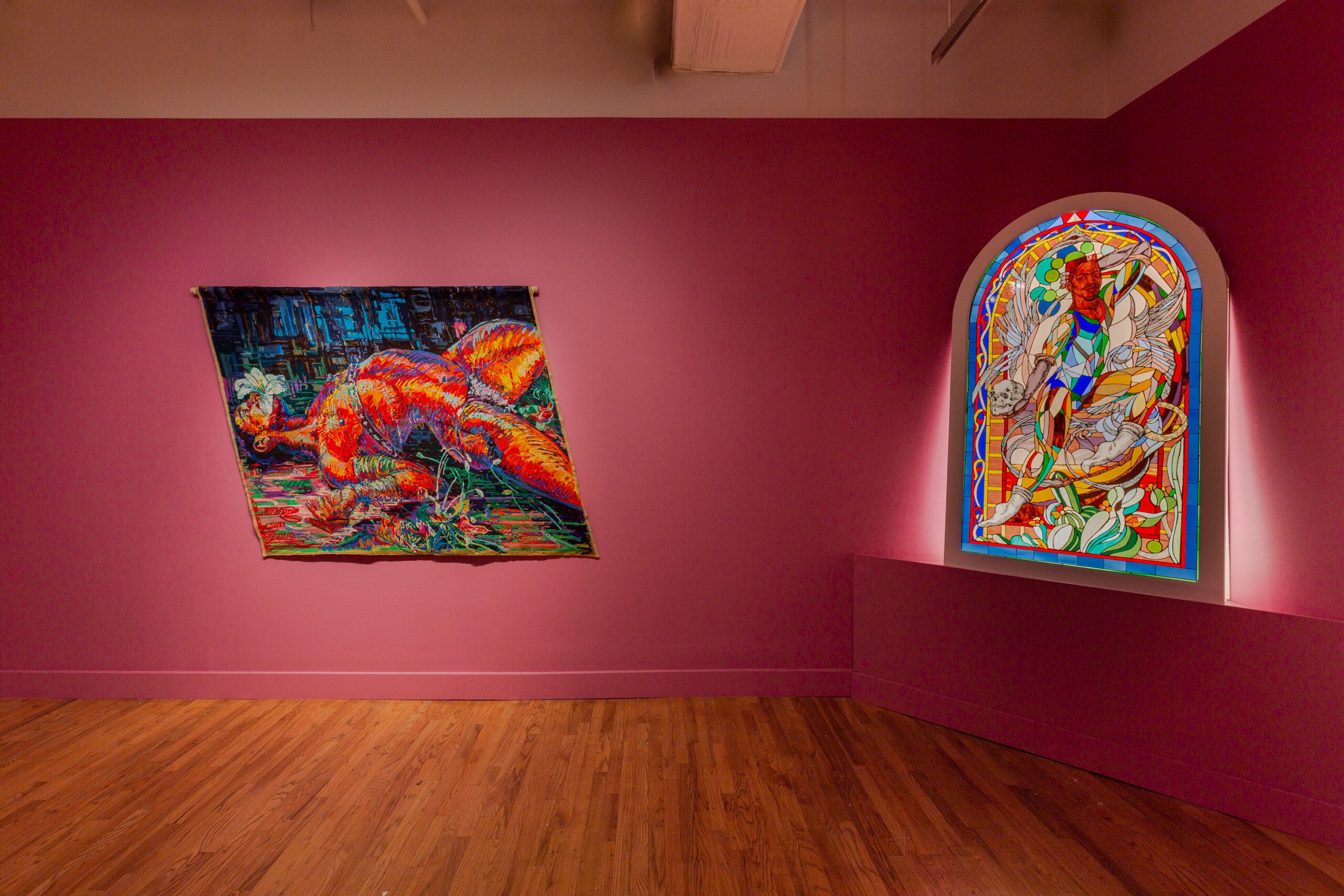
Installation View | Athi-Patra Ruga: Lord, I gotta keep on (movin’), 2025. Leslie Lohman Museum.
NM: Interestingly, you have done the map works. I wanted to ask you about the figure as an image and as a way of accessing something. Because in some instances, I think of the figure as essential in your work. Does this resonate?
APR: Well, I do believe that’s the case. I grew up being looked at a lot. I love performance, and being perceived is everything to me. I see the body as a site. Sight, as in vision, but also site as in landscape. For a kind of contemplation where you can layer things on your body as a performer to be reflected on. Not just in the singular. The person, but also the body nation. The body as an entrance to a landscape. And the many myths around the body. All of these ideas are important to me.
NM: That’s brilliant. Okay. And there’s a kind of poetics in terms of how you think about your work and why you do it. There is a very specific language that you use.
APR: I used to be a frustrated writer. So you’re right.
I think of everything as an ellipsis; everything leads you somewhere, and you find your way. Language becomes a line that allows you to follow your work. Sometimes the titles are in conversation with art history, sometimes they can be verbose. It’s also a lot about creating tension and contradictions.
I love the idea of bathing in paradox. I think that’s how I’m surviving in this world. I’m very aware of paradox.
NM: Back to the floating heads for a second. Are they violent in some way? Do they produce or make you think of different kinds of violence? Why is the head floating? Where is the body?
APR: There’s a work I did in 2008, La tête du Prophète, in Senegal. The Head of the Prophet. I had been working for two years and flying to Senegal for a residency. The country is very homophobic.
The day I arrived, there was an announcement on the news that someone was going to be denied their final burial rights because it had been found that they were homosexual. At the same time that I was there, the president of Gambia, which is the neighbouring country, was saying that homosexuals should be beheaded. I remember thinking that I’m going to need a table. I’m going to need a lot of food on that table, and I’m going to put my head on that table.
So I went around in different places in Senegal, basically in the hot sun, just being this head giving out all this fruit. The head spoke about being scared of being decapitated, literally having my body at risk. But also at the same time, to prove a point performatively and to put my neck on the chopping block. I also thought a lot about heads as capital. How historically you removed someone’s power by delivering their head to someone. We then move on to the decapitation as a way of carrying the head because the person’s head contains knowledge. There are many connections.
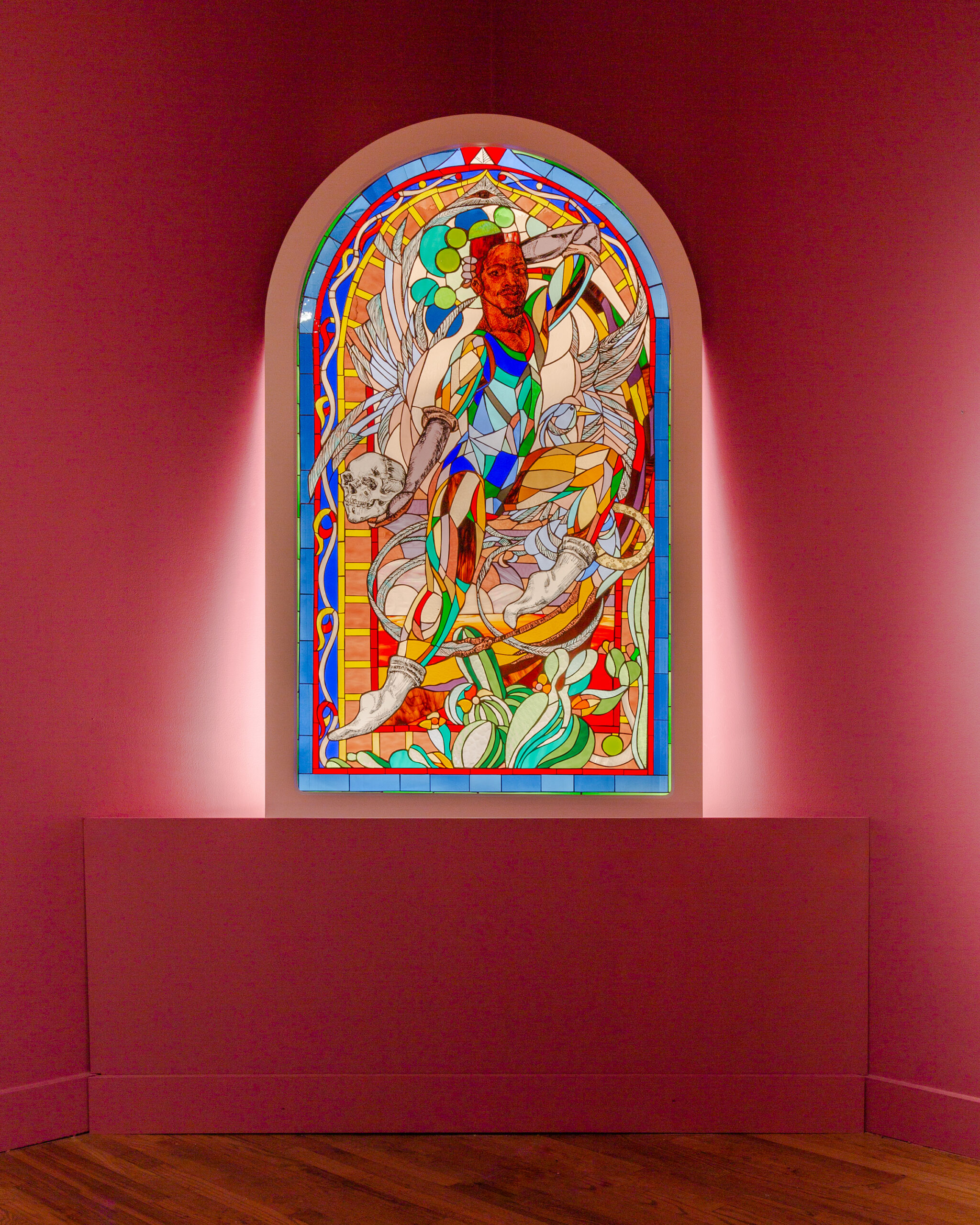
Installation View | Athi-Patra Ruga: Lord, I gotta keep on (movin’), 2025. Leslie Lohman Museum.
NM: Can you tell me a little bit about Beiruth?
APR: I started performing Beiruth in 2007. There I was, still living in downtown Johannesburg, August House, and that’s where she was born. So I would take her out and perform her. And this was in response to gender based violent attacks that happened that winter. As well as the xenophobic attacks that happened. We were quite affected by them. Beiruth was this hyper-feminine character, but also an out-of-this-world character. I was trying to confront xenophobia and GBV at the same time. That work was also engaged in nudity and the erotic as a form of protest. That in itself is an idea that is historical.
NM: I guess that’s also the other thing that I love, that your conception of the historical is not just a question of politics, but it’s coming across in different ways. Like ancient, ancient history as well.
APR: It’s the lineage taking care of and all of that.
NM: And at this moment in your career, are you optimistic? Are you joyful? Are you sorrowful?
APR: I say let’s keep on moving because that is the queer nature of it all.