ASAI
18.01 - 18.01.2021
This interview appears in the forthcoming book ‘On the Map’, published by ASAI, available from 24 March in selected bookstores and from ASAI. It was initally posted on the ASAI website on 18 January 2021. For enquiries, email admin@asai.co.za.
Tuli Mekondjo, whose name means “we are in the struggle,” was born in Angola in 1982 to Namibian parents who joined SWAPO (South West Africa People’s Organisation) in exile in the early 1980s. Mekondjo lives and works in Windhoek, Namibia.
Mekondjo’s works vividly express the generative powers of women, nature and the imagination in healing, and build on her early history of displacement as a Namibian refugee in Angola and Zambia during the struggle for Namibian Independence. A primarily self-taught artist, Mekondjo has been exhibiting her works since 2016 and is represented by Guns & Rain.
EVH: When did you start to think of what you were creating as art?
TM: I recall coming with my mother as a very young child to Namibia from the Nyango Refugee Camp in Zambia to visit my grandmother for the first time. When I saw this old person standing in the mahangu fields, I just instinctively started running towards her and grabbed her hands1Mahangu is a millet-type grain and staple food in Namibia.. When I touched her hands and saw the deep lines engraved in them, at that moment, that image was embedded in my psyche, and I connected with her on a deep level that would make me see her life being streamed to me psychically. Images of the uncles and relatives whom I had never met appeared and I realised that I have that capacity to imagine things and bring them into existence.
EVH: Who or what influenced you?
TM: My grandmother and the difficulties I experienced when my mother passed away when I was twelve years old. A mother is a pillar in your life, and she understands you more than anybody else, so when you lose your mother, you suffer a great loss. My personal experiences of dealing with family members who passed on without ever having met them; they are my relatives but I don’t know how to connect to them. I only met one of my uncles three years ago, shortly before he passed on, and I could take care of him while he was in hospital. I thought, since he is my uncle, my mother’s brother, I should support him; he is connected to my mother whom I lost.
EVH: When your mother passed on, who raised you?
TM: I was put into a boarding school in Swakopmund by relatives, and over weekends I had to work in a coffee shop to have some money to survive.
EVH: How long have you been an artist?
TM: I started while in boarding school. It helped me to process my mother’s death, the struggle to survive and finding my own identity. I never had formal art training, even though I once reached out to a white artist to teach me. She just closed the door in my face, and since then, I decided to just push on by myself. The work for ‘The Bellowing Mind’ exhibition was already conceived and in progress during that time in Swakopmund. After school, I found another job in a curio shop in Swakopmund and would work on my art during quiet times.
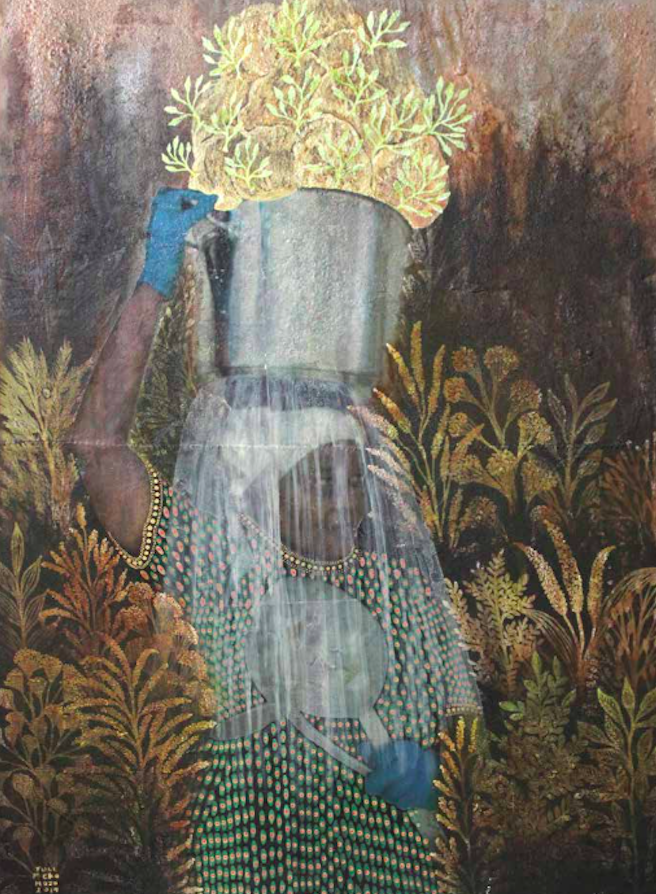
Tuli Mekondjo, Ai-Tsama Mabasen I (Be Independent), from Limbadungila, 2019. Mixed media on canvas (photo transfer, collage, acrylic, millet grain and resin), 88.5 x 60 cm. Image supplied by The Project Room.
EVH: The Bellowing Mind (2016) was your first solo exhibition. In that body of work, you explored psychological themes such as anxiety, depression and trauma. You also used recurring motifs of tree roots and branches that resemble nerves. What do these motifs represent?
TM: ‘The Bellowing Mind’ was very much a self-reflection exhibition, where I dealt not only with personal trauma, but also the trauma in my family. The work dealt mostly with the anguish of loss, the residues of death and how these traumas are embedded within our bodies. The roots/veins in the work represented the storage of these traumas within one’s body. Bipolar II documents what it felt like when I felt like being in two polarities, almost like a surreal kind of reality. I had to grow up real fast. When my mother passed on, it was a tough time, because I was mostly left to my own devices, to look after myself. I had an identity crisis, and my mind was always burdened with thoughts of abandonment. There was a constant sense of not belonging, and I wasn’t able to connect with my extended family, to talk about my feelings of sadness and loss. I was a young person who was about to have a nervous breakdown, and I felt alone in the world, without parental support nor an immediate support system. With this exhibition, I dealt with the loss of my mother, abandonment, the absent father, my own sense of self- defeat, the constant rebirth of trauma and feeling caged, just to name a few.
EVH: In recent years your work has gained international recognition. How did that happen, and where has your work been exhibited?
TM: I was invited by Jo Rogge and Julia Hango (JuliArt Cult) to be part of their artist collective, So Namibia Collective, back in 2016. Rogge and Hango made it possible for my work to be exhibited for the first time on an international platform at the Art Market Budapest Fair in 2016. The Collective changed to NJE Collective in 2017, and they have been instrumental in mentoring me as an artist and creating various platforms for my work to be exhibited at the Cape Town Art Fair and Johannesburg Art Fair. I met Julie Taylor from Guns & Rain Gallery at the Cape Town Art Fair, and she took me under her wing, and the work has been showcased at the 1:54 Contemporary Art Fair in London and at AKAA (Also Known As Africa) in France, to name a few places.
EVH: What time elapsed between your first and second exhibition, and how do you feel you have matured as an artist? How are your current style and themes different to what you were doing earlier?
TM: After my first solo exhibition it took me a while before I could start working again. I needed to figure out the next step. I took a long time to start working again, as I needed a new body of work to be born. I had my first solo exhibition in 2016 and my second solo exhibition in 2019. The three-year break was critical and an important learning period to rediscover myself and to honestly self- criticise everything that I was. The mahangu style came to me through a kind of spiritual, experimental moment; it developed spontaneously, and everything else simply fell into place. I am still learning and will always be learning; perhaps I am ‘afraid’ of maturity with regards to being a creative, but I would like to believe that every time that I am working on a new art piece, I am learning something new and discovering new techniques/ways of creating. The only difference now is that I employ mahangu, image transfer and, sometimes, burning of the canvases, but the essence remains the same. Together with the birds and stitching of the canvases, the fine lines are also reappearing now in gold. I suppose there is more vegetation and metallic hues in the current pieces. I also see correlations with the plant imagery and the stitching in both body of works. The plants are ‘alive’ now — perhaps a reflection of my own state of being at this moment in time.
EVH: Which materials/ textures/ colours/ themes attract you?
TM: I started with the marker pens and continue experimenting with different mediums such as resin and mahangu, testing what works and what not. This is how the technique with the mahangu and resin came about. This was wonderful for me, coming from a culture where we plant mahangu and having the memory of my grandmother in the mahangu fields, to have discovered a technique bringing these thought processes together. The core of my work is about women labouring for their children and survival, creating community and forming, in the end, the backbone of a society. My themes address the lives of women and how mahangu connects them with working on the land and survival.
EVH: Can you elaborate on this cultural practice of women working the land and its significance for you in your work?
TM: It is significant to me from that moment when I saw it within the deep lines on my grandmother’s hands. For centuries, the women in the northern part of Namibia toiled the soil and planted the mahangu seed, and they would ask the ancestors for a good harvest. What a wonderful way to pay homage to these hard-working women, by incorporating mahangu in my work as a symbol of their strengths, how they nourished us with this mahangu and how they taught us the meaning of work through the whole process of working the land, sowing the seed, tending to the mahangu sprouts, harvesting, and pounding the mahangu into a fine meal at the end of the whole process. Every Ovambo person who grew up in the northern part of Namibia knows the importance of this mahangu field education and the value of it.
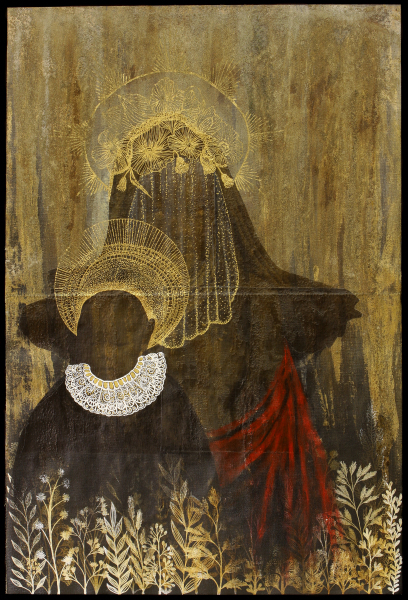
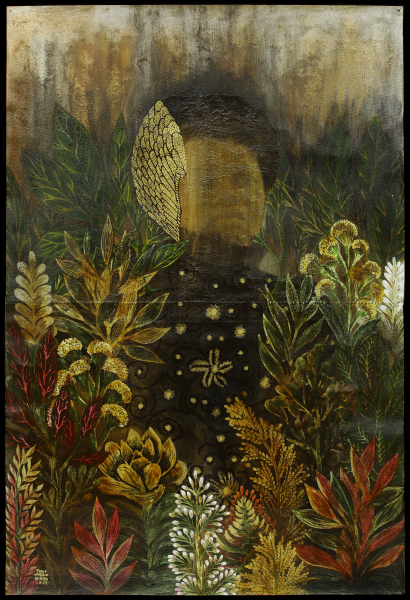
Tuli Mekondjo, Omuiingona (The Holy Child), 2019. Mixed media on canvas, 90 x 61 cm.
EVH: Does colour play a significant role in your art? Previously, your work was characterised by many white lines.
TM: In the very beginning, it was more about the lines which were my connection to the lines on my grandmother’s hands and the [use of] repetition to create patterns. Now, all of a sudden, with the mahangu, I am creating my own universe with the golden colours of the mahangu. The transferring of the archival images/photos brought an otherworldly element to my work. I create a different type of atmosphere, darker and golden tones, coming from the archival images that I am now using. I also draw on a myth in Aawambo culture saying that the Aawambo people emerged from a great lake and that there was a huge moon shining on them. They would start worshipping the moon and teach their children about the cycles of the moon and its importance in their culture. These kinds of stories influence my work.
EVH: This is fascinating. Tell me more about these stories that you create/draw from? Are they imagined by you, or do they originate from Aawambo folktales?
TM: It really depends, these stories are mostly a combination of my own imagination and Aawambo folktales. Sometimes, I would borrow from the folktales and create a story set in this mahangu otherworldly place or at the lake.
EVH: At the opening of Limbadungila, your exhibition at the end of 2019, there was a performance by you and a traditional healer. Can you explain that performance and its significance to your two-dimensional works?
TM: That was a very intense performance; as soon as Kuku2Kuku is Oshivambo (Oshindonga) to refer either to an old person (as in grandmother or grandfather) or to an uncle or an aunt (e.g. Kuku Samuel or Kuku Maria). and I stepped out and started interacting with the audience, the atmosphere changed. Kuku went into a trance, and I was transported to another place. When we stepped into the centre of the ‘enclosure, and we sat down facing each other, that represented ancestors in dialogue. The performances and the two- dimensional works are intertwined because, in both cases, I am seeking the presence of my ancestors. They influence my work — I am simply a channel, channelling them on various levels. The performances allow me to embody them in the physical form; thus, I am covered in ash to look like them.
EVH: This exhibition featured the female form and was more colourful; it celebrated women. It reminded me of the works of Dante Gabriel Rossetti, the Pre-Raphaelites and Gustav Klimt. Have you been inspired or influenced by these artists?
TM: Gustav Klimt’s golden hues are very much inspirational and timeless.
EVH: Which artists inspire you?
TM: Frida Kahlo and Gustav Klimt. I believe my connection to Kahlo and Klimt is rooted in being born in July and in [shared] individual hardships. I immediately connect with their work. I look at their work, and there is this familiarity, that I have known it before. John Muafangejo, the Namibian printmaker, who was actually born in Angola — he was documenting what was happening in the northern part of Namibia at the time of the Border War3The Border War (1966–1990) was originally the South African name for armed conflict that was mostly fought in southern Angola. At the time, South Africa was occupying Namibia (then South West Africa). The term is still used along with subsequent nomenclature, such as the Namibian War of Independence and the Namibian Liberation Struggle.. He also used Oshiwambo in his titles, preserving the language and culture. There was a sense of pride he expressed for his own language. I find that truly inspirational and realised the importance of preservation of our mother tongues.
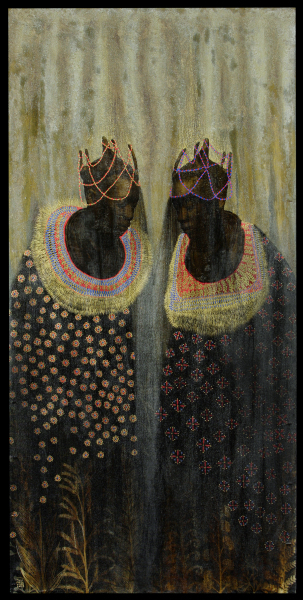
Tuli Mekondjo, Ova kwanambwiyu vo ko Mtiweedelela. The twins from Omtiweedelela, 2019. Mixed media on canvas. Photo courtesy of the artist and Guns & Rain.
EVH: Art schools in the West have been teaching the anatomy of the body through nude drawings, and classical sculpture prides itself in the aesthetics of the human form. How do you see the (naked) body in our society and as a means of artistic expression? Have you employed your body as art?
TM: It is quite sad realising that, in pre- colonial Namibia/ Africa, African bodies were adorned and patterned with beads and body painting and that it was seen as pure, natural art on naked bodies. It was never an issue to be openly in the nude, as it is today. Christian indoctrination infiltrated the minds and societies and clothed people in cotton cloth, and their artistic expressions via the naked body were labelled shameful and a sin. I am, thus, in awe of the radical body artists, like Julia Hango, who are shattering the notion of ‘shame’ around artistic expressions in the nude. They urge us to retrace our steps and to truly look at ourselves, at our nakedness and how beautiful and natural it is. In my performances, I employ my body as art; I could be clothed in raffia, yet there’s a sense of curiosity whenever I am covered in ash. This is because ash reminds us of our natural selves, a ‘veil’ of protection from evil spirits and a deeper connection to our ancestors.
EVH: Would you say that nudity in art performances can also stand for being vulnerable and authentic?
TM: Yes. When in the state of vulnerability, you are not only showcasing a bare body, but are stripping yourself to the very core of your soul/being without fear but with a deep-rooted understanding of your origin from nature … Nature has always been authentic, why are we scared or ashamed of that authenticity within ourselves?
EVH: Do you think we, in Namibia, have found a form of art therapy to deal with the traumas of colonisation and the Border War?
TM: I think, in one way or the other, different young artists are dealing with the issues of the genocide [through] the removal of statues. We are trying to revisit the generational traumas around Cassinga4Cassinga is a town in Angola where SWAPO set up a reception base camp (refugee camp) during the liberation struggle. The Camp at Cassinga was attacked by the South African Air Force on 4 May 1978 and approximately 600 people were killed. Most of the victims were civilians, mainly women and children. Cassinga Day is commemorated annually in Namibia in remembrance of those buried in mass graves at Cassinga.. We need more dialogues to discuss the pain, but unfortunately, our communities are silent. They are fearful to speak about what happened at Cassinga. Some artists are creating platforms to create safe spaces for healing. There is still that fear to look at the pain and the trauma. The genocide needs dialogue to come together as a nation. We need a true reconciliation.
EVH: Why is that the members of the communities in which these atrocities happened are fearful and reluctant to speak about the pain and suffering? Are there certain cultural taboos that prevent this type of conversation?
TM: I don’t see it as a cultural taboo to not speak; it actually refers to the ‘vow of silence’ that the soldiers took. Today’s veterans are aware of many traumatic events which happened at the various camps; they just fear for their lives. If they were to openly speak about the torture dungeons, there could be politically motivated repercussions.
EVH: In your latest exhibition, Borders of Memory, you are collaborating with Helena Uambembe, and that was organised by Guns & Rain gallery in Johannesburg. For that body of work, you draw on archival material of the Border War, but also from personal experience of that period. How did the war personally affect your life and inform your art practice?
TM: Well, ‘Borders of Memory’ is very much my personal story. Both my parents crossed the border into Angola to fight in this war. They left Namibia as young people with the determination of youth to fight a war and for the independence of Namibia. They sacrificed not only their youth, but also their lives, for us to live in an independent Namibia today. I am a ‘war-love-child’ of my parents; I was born in one of the refugee camps in Angola and spent my formative years in another refugee camp in Zambia. My childhood was quite intense and traumatic; there was displacement, and I suffered an identity crisis, even after meeting my extended family members when we came to Namibia in 1990, when I was eight. I recall the post-traumatic war disorders of my parents and their passing when I was still young. I am still dealing with war trauma and, with my art practice, there will always be chapters from this war, chapters of not only my personal story, but of other brave souls who want to express their journeys from this war.
EVH: You incorporated photos from the National Archives of Namibia into the work. This is radical and deliberately brings in Namibia’s history and suffering. The colour choice is more sombre; there are burnt patches in the canvas, and there is a stitched red line running directly parallel through all the works, linking them together as a body of work. Can you elaborate on the meanings these have?
TM: The colours are sombre because memory, over time, becomes vague within the capsules of time. The burning of the canvases not only represents the four major refugee camps, but definitely the bombing of Cassinga on 4 May 1978, in which the victims were mostly women and children. Through fire, I reimagined the victims as witnesses of the chaos that erupted at Cassinga, of bullets flying in the air, the rupture of scorched flesh and the smell of death, a stale stillness in the air. I use resin symbolically to ‘bury’ the bodies and to create an understanding of the permanency of a burial. The mahangu acts as a connector between them and their ancestors. My personal perspective is that, whenever I look at their archival faces, I begin to imagine their lives, like, what occupied their minds? How did they confront death and the fear of passing away and being buried in foreign soil? The red line is a reference to the internal border still within Namibia. It is beyond belief that, still today, the majority of Namibians living behind the imaginary Red Line in northern Namibia are separated from the rest of the country. This internal border was used to control the movement of livestock and was also instrumental as a regulator of contract labourers in colonial and apartheid Namibia. This Red Line, just like other historical borders, is still ingrained within the minds of the people, and to have it still as a tangible reminder, after it was erected in 1896 by the imperial German administration, speaks volumes to how we as a nation still romanticise the mind and policies of the colonial and apartheid oppressors. It brings to light our inability to find economic solutions that can benefit both the northern farmers and the southern elite cattle farmers5By “southern elite farmers,” the artist refers to privileged white farmers in the south, upon whose land marginalised Nama farmers, not considered ‘legitimate’ farmers, laboured.. Personally, I see the historical role of the Red Line as a segregation tool which was used in colonial/ apartheid Namibia. This line divided the country both physically and symbolically, and it served as a political ‘cage’ that was used to monitor the movements of PLAN (People’s Liberation Army of Namibia) Fighters, the so-called guerrilla movement, and the planning of raids into Angola and Zambia, with the targets being the refugee camps.
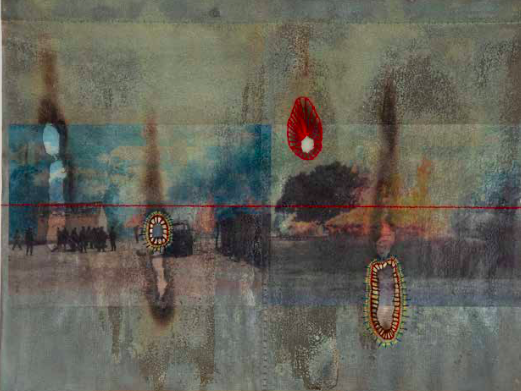
Tuli Mekondjo, Om’dilo mo Cassinga (Fire at Cassinga), from Borders of Memory, 2020. Photo courtesy of the artist and Guns & Rain.
EVH: You work in layers, building upwards from the canvas, yet it resembles a palimpsest. Are these layers referencing the memories? Tell us more about this process.
TM: Yes, that is exactly what it is. I am trying to revisit precolonial Ovambo culture and, whenever I look at these precolonial portraits of Aawambo women, in their finery with those beautiful coiffures, I imagine my ancestors from that time and wonder, what were these women’s thoughts, fears, pains, losses and frustrations? What did they love the most — basically, what shaped their memories? And do traces of their ancestral memories linger deep within me today?
EVH: What does stitching represent or convey in your art? Sewing and textiles are deeply interwoven in African culture. What is your history with sewing?
TM: My history with sewing is rooted within the basketry weaving of my grandmother. She used to weave baskets with a home- made needle made from a flattened metal piece. My grandmother would show me how to fold the makalani palm leaves to create the base of the basket; that is mostly done by the women and, in the end, you would weave either oshimbale to carry or store mahangu or elilo to serve mahangu porridge6Oshimbal is the name given to cone-shaped baskets. Elilo refers to plate-shaped baskets.. This education in basket-weaving set up my passion for sewing in general and to work with materials such as leather. The stitching in the artworks represents the mending of the lost connection to my ancestors and refers to the ‘backbone’ of the women in our society, the many labours they have to endure to feed their children and households.
EVH: Which stories of women interest you most?
TM: All aspects of womanhood, every layer and every fibre of being a woman interests me. From the intricacy of our moods, pains, sorrows, losses, through our abilities of compassion and love during the hardest of circumstances, to the stories of resilient women which speak of their traumas and hate.
EVH: How can we, as women, heal our world and offer alternative modes of dealing with difficulties and conflict situations?
TM: We need to be gentler with one another, hold each other higher and support one another in times of conflicts and difficult moments. It is about time that young women are encouraged to be self-reliant and abolish the notion that there is a ‘prince charming’ out there that is supposed to rescue them. Even with partners, it is important to not lose ourselves in the relationship, but to continue keeping our dreams alive, because in the end, we only have ourselves. To be secure in oneself as a woman should be the goal.