We reached out to South African-based Iranian artists to give them space to reflect on the current war and to share with us their experiences during this difficult and confusing time.
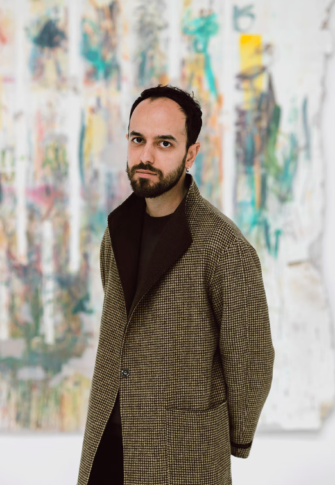
With incredible grace and openness, Sepideh Mehraban allowed us into her world and shared with us her fears, disappointment and hope.
Mehraban was born in 1986 in Tehran, Iran. She currently lives and works in Cape Town, South Africa. Mehraban obtained a Bachelor of Fine Arts degree from the University of Alzahra in Tehran, Iran, in 2009, where she also obtained her Master’s in Fine Arts degree in 2011. In 2012, Mehraban furthered her studies by obtaining a postgraduate diploma in Fine Arts, followed by a second Master’s in Visual Arts degree from Michaelis School of Fine Arts in Cape Town, South Africa.
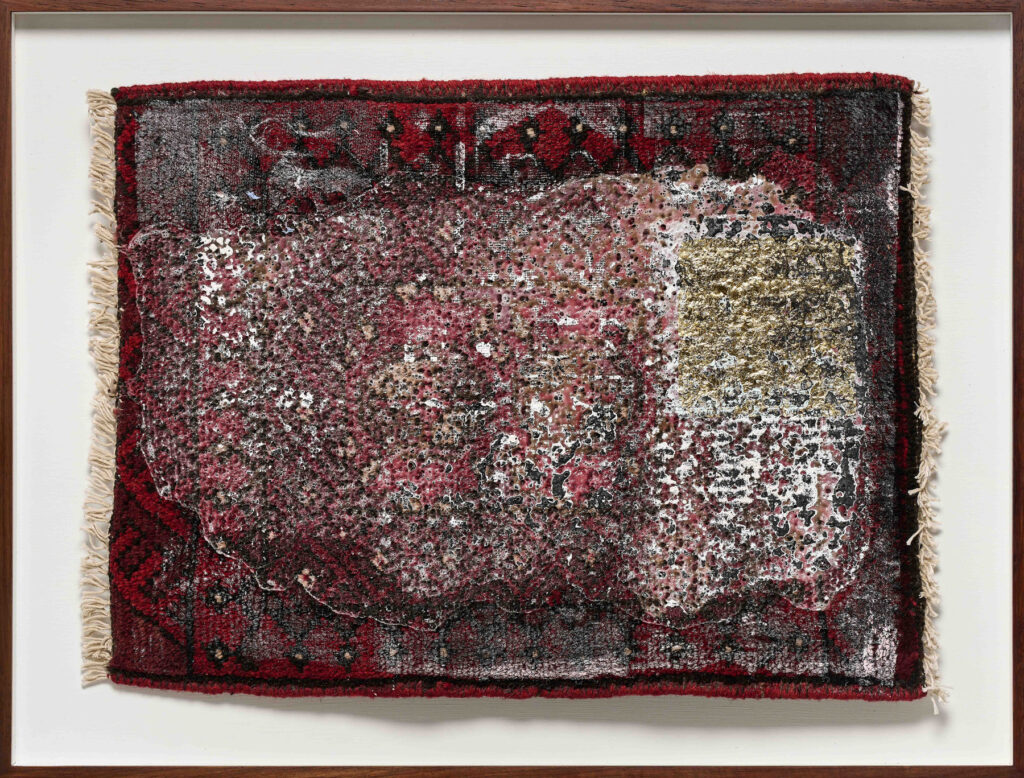
Sepideh Mehraban, Weaving Letters I, 2023
I first wanted to find out how you are doing in general. Do you have family and loved ones back in Iran? Have you been able to keep in touch?
It’s an incredibly difficult time, not only for me, but for all Iranians. My parents, brother, uncles, aunts—essentially my close family and friends—are still there. As I write this on 18 March 2026, Iran has been in blackout for 432 hours. We have no way of reaching our loved ones, and only occasionally does someone manage to get a message through. News then spreads from one person to another, simply confirming whether people are safe. It’s unbearable.
This is not the first time the Iranian government has shut down the internet. It happened during the protests in January 2026, when thousands were killed and imprisoned simply for asking for basic human rights, and again in June 2025 during the 12-day war, when Israel attacked Iran. It reflects a recurring pattern of suppression by the authorities.
It’s also important to note that MTN Group, a South African telecommunications company, holds a significant stake in Iran’s telecom sector. Investigations by Open Secrets have examined how MTN’s operations across Africa and in Iran have intersected with state-led suppression. While companies often say they are compelled to comply with local regulations, this raises serious questions about corporate responsibility, ethics, and values.
If you are reading this and are an MTN customer, it may be worth reflecting on these issues.
Have you been able to work? Do you find yourself returning to the studio differently since the conflict escalated: with more urgency, more paralysis or something else entirely?
I show up in the studio every day; it’s truly my sanctuary. Here, I read, write, paint, and sometimes cry. This space is a place of reflection where I can be fully myself. I feel so fortunate to be an artist and to have a studio where I can channel all my emotions.
At different points in your career, your work has engaged quite deeply with Iran, tracing all the way to 2012. Can you tell us briefly about the position that your birthplace occupies in the work that you make?
My work has always been rooted in Iran. Even when I was living in Tehran, I drew from poetry and, in indirect ways, reflected on the country’s politics—open criticism of the regime was not possible. Since moving to Cape Town in 2012, it has felt even more urgent to speak about Iran through my work. I found a platform where I could express myself freely.
Both my MFA and PhD research explored personal and public histories in Iran, later drawing comparisons with post-apartheid South Africa. I came to realise how little many people truly know about Iran; what they do know is often shaped either by Western media propaganda or by Iranian state propaganda. The nuance and lived experiences of ordinary people are largely absent from these portrayals.
In a way, I have become an activist simply by making work about Iran. At its core, this comes from a deep love for my homeland and a constant hope for better days, a more peaceful, ordinary life for my people.
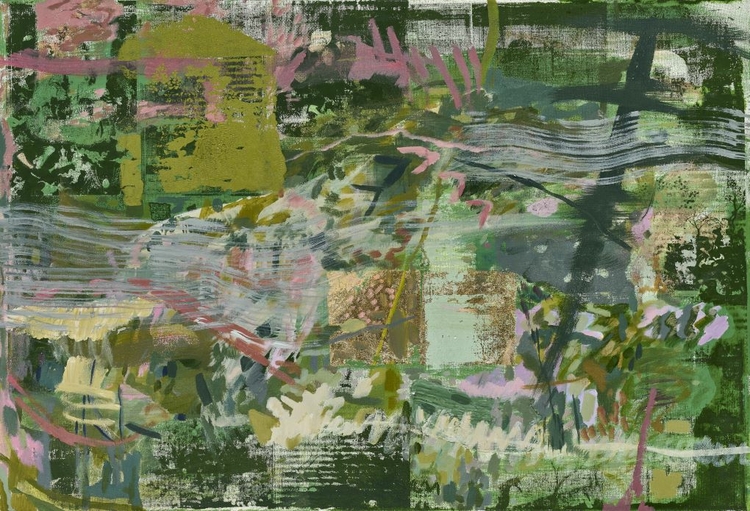
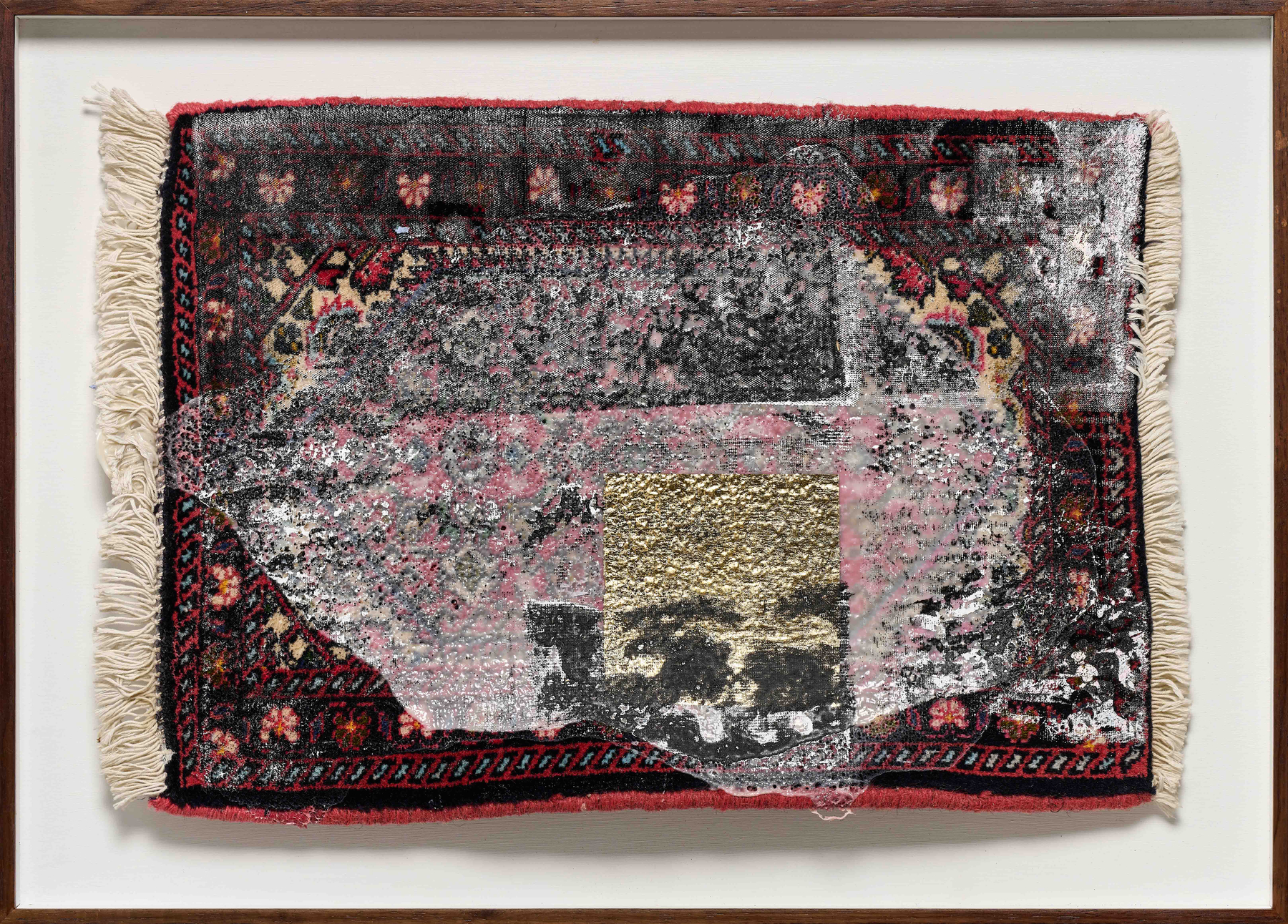
Sepideh Mehraban, Weaving Paradise, 2023
I have found that your work holds a robust articulation of how you think about Iran. At times, critical, reflective and at times celebratory. Your solo exhibition, ‘Promise of Paradise’, saw you offering celebratory scenes that project a more hopeful view on the future of life in Iran. Can you tell us a bit about that series of works and how you reflect on it today, almost two years later?
I’m glad the work is being received in that way. For a long time, I focused on Iran’s 1979 revolution and its aftermath; an uprising against a monarchical dictatorship that ultimately resulted in a totalitarian religious regime. I also made work about the Women, Life, Freedom movement in 2022, a deeply progressive uprising grounded in the demand for equal rights, led by women in Iran. I have lived through, and created work alongside, these moments of upheaval.
With Promise of Paradise, I wanted to shift toward hope. I wanted to emphasise the beauty of my country—its people, its culture, its heritage—and all that is so often absent from the news. I wanted to offer a different narrative about Iran, a kind of good news.
Today, however, I feel devastated. It feels as though 47 years of struggle—of grassroots movements toward freedom—have once again been overshadowed by external interests, and my people are suffering yet again. And still, even in the darkest times, there is a glimpse of light, and we have to hold on to that hope.
In the studio, I find myself making some of the most colourful paintings I’ve ever created, inspired by Persian carpets; their complexity, the hours of labour in hand-weaving them, and the diversity of designs across regions. They reflect the complexity of Iran itself: its many ethnic groups and the dreams and hopes they continue to carry.
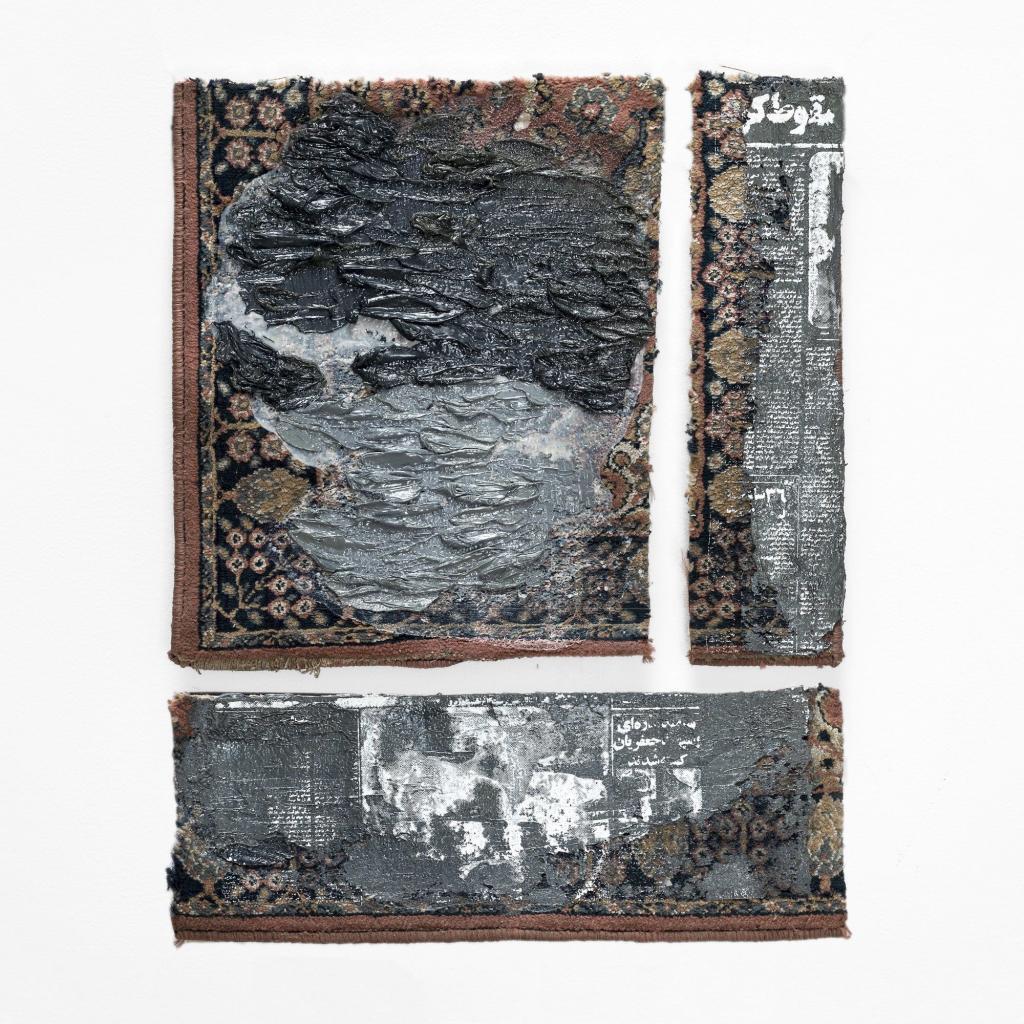
Sepideh Mehraban, Collapse, 2019
I wonder if you might reflect on ideas of ‘revolution’, what it can represent, its potential for success, failure, rupture?
I am a living witness of revolution. I was born in 1986, during the last two years of the eight-year Iran-Iraq war. The 1979 revolution promised hope for change, for a democratic Iran. Yet a totalitarian and religious government seized power, and for the past 47 years, Iranians have been fighting for freedom.
Unfortunately, countries like Iran, rich in resources and geopolitically critical, are never immune to the interests of empires. Their people are often used, exploited, and subjected to suffering to serve foreign powers. Just two months ago, we witnessed another massive uprising by the Iranian people against their authoritarian government and corrupt system. The movement, however, was immediately misrepresented by Israel and the USA as a “Mossad-led uprising.” Certainly, foreign intelligence can exert influence in a society under extreme oppression, but thousands of people would not have taken to the streets if they feared for their lives—they stood in front of a fully armed state despite knowing the risks.
As we were still mourning the young lives lost, most under 30, Israel and the USA began bombing in the name of “liberation.” The politics are dirty, and the media, both Western and Iranian state, portray the interests rather than the real demands of the majority of Iranians. Meanwhile, in the diaspora, some Iranian Zionists celebrate the bombing of their own country, while inside Iran, the theocratic government stages rallies mourning the death of Khamenei—someone who should have faced justice for crimes against humanity.
But where is the voice of the 90 million Iranians cut off from the world? Even looking at South Africa, which I now call home, we see a complex picture: freedom of speech exists, but society remains deeply unequal, and the system is corrupt. South Africa rightly stands with the people of Sudan and Palestine, yet it supports the Iranian regime, citing Iran’s support of the ANC during apartheid. But does the Iranian government truly support its own oppressed people?
My answer is that real change and power come from within each country, from within each individual’s mind. Change happens when we resist consuming the narratives fed to us by those in power, when we recognise the strength of unity and solidarity, when we support grassroots movements, empower our communities, and act with empathy and care. Revolution begins in the mind.
The titles to your exhibitions always seem to carry so much meaning (and one might even say wisdom). I’m thinking about the 2021 show ‘THIS IS NOT PROPAGANDA’ but also the ‘Until The Lions Have Their Own Historians, The History Of The Hunt Will Always Glorify The Hunter’. This proverb about history, how it is written and told. I wonder how this applies to what we see unfolding with the war today?
I have always been fascinated by the power of narrative in politics. Those who shape narratives, write histories, and control the media hold immense power. Watching my beloved country unfold in war before my eyes, I feel the weight of these systems—it makes me sick and angry, because it is so close to my heart.
People often tell me they are confused because they see so many contradictions and feel unable to take a stance on Iran. On one hand, they see groups of Iranians in the diaspora supporting the son of Iran’s former king, funded and backed by Israel, as a supposed path to liberation. They support war and bombing, carrying Israeli flags in their protests. What many forget is how orchestrated and funded this is by outside powers—by empires. Tragically, Iranians forced to leave their homeland, carrying immense trauma, often cling to anyone they think can “save” Iran, sometimes blindly participating in this geopolitical game.
On the other hand, there are rallies inside Iran that appear to support the government and express anti-war sentiments. Both groups exist, but neither represents the majority of Iranians. Yet both the Iranian state media and pro-Israeli propaganda, backed by powerful interests, have poured billions into shaping narratives that create division and confusion. Sadly, they are succeeding.
And yet, where is the voice of the 90 million inside Iran struggling to put food on the table? Who are oppressed on every level—socially, politically, economically, and environmentally—by an extremely brutal government that tortures, executes, and imprisons dissenters. Where is their voice?
Do they want a change of regime? Yes, they have been fighting against oppression for 47 years. Do they want war? No. Yet they are trapped under a violent government, often feeling powerless to find any other way to bring change. Imagine living under so much pressure that part of you might even wish for someone to intervene militarily, but still, many Iranians reject both the Islamic Republic and foreign-imposed war. They believe in change from within, through people’s power and collective choice. Many have sacrificed years of their lives in prison, enduring torture to fight for freedom.
Where is their voice? Where is the voice of the thousands detained during the recent January protests, trapped in prisons under the threat of execution and bombing? Where is the media, where are the historians, to tell their narrative?
More than anything, I’m interested in creating space for reflection on the current war in Iran – outside of the questions that I have asked above (which might perhaps feel lacking or even irrelevant because they cannot possibly hold the weight of the moment). With that in mind, can you share your reflections more broadly – in terms of what is on your mind at the moment?
The urgency of the moment weighs heavily on me: 90 million people inside Iran are silenced. The Internet has been cut off for 18 days since the war began. Their voices are not being heard, yet everyone seems to have an opinion about Iran. Social media is flooded with influencers taking political stances and spreading misinformation. It is terrifying. Stand with the people of Iran, not with the Islamic Republic.
For the past 47 years, the regime has used anti-imperialism and the Palestinian cause to create legitimacy, prioritising geopolitical goals over the well-being or self-determination of Palestinians themselves. The Islamic Republic is not representative of my people. It is time to return the voice to the people. The people of Iran should be at the heart of the solution. The Iranian government must be held accountable for all crimes against humanity committed over the last 47 years. Military strikes and bombing are not the solution—they will only result in more suffering.
We need solidarity with all who are oppressed: Free Congo, Free Sudan, Free Palestine, Free Iran, and all other countries where people are denied freedom. Until all of us are free, none of us is free.