Stevenson
07.03 - 20.03.2026
In her latest solo exhibition, ‘Love in a Turning World’ at Stevenson in Cape Town, Penny Siopis brings to the fore the idea of love – as a position or disposition, rather than as pictorial subject (although suggestions of embracing figures and birth abound). Love is posited as a way of being in relation: to others, to the non-human, and to a world experienced as unstable and in flux.
We reached out to the artist to find out more about the exhibition, its philosophical underpinnings and implications.

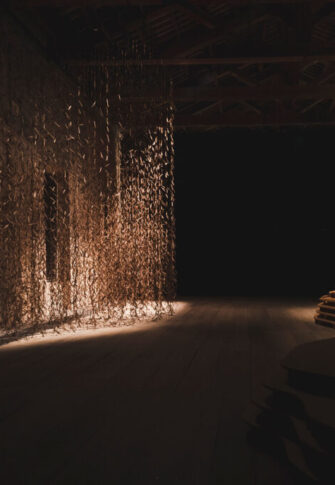
Installation View | Penny Siopis, ‘Love in a Turning World’, 2026. Stevenson, Cape Town.
Your new solo focuses on this idea of rupture through love. Thinking of love as resistance and entangled with grief. Can you expand on how these values play out in art and life? How might we think about what love looks like and how it operates? What is that image of love?
Love is a practice, of freedom. To some, if it looks like anything, its social justice. Love is a way of being in relation to others, to the non-human, and to a world experienced as unstable and in flux. I see it as a transformative force in art and life, with its rupturing side turning grief into a generative form feeding creativity. Vulnerability is its core, and to be vulnerable is to be open, where boundaries loosen to become grounds for empathy and resistance to oppressive systems. For me, painting that asserts material transformation and the agency, the life, of the medium, feels most potent in manifesting the complexities of love in our time. Painting as model: its material acts analogous to a philosophy of relationality. This is how my glue and ink paintings work for me – through chemical reaction and interaction of pigments and glue, the pull of gravity (I work horizontally), the drying effects of the air, all in communion with my bodily gestures as I coach liquid and viscous flows this way and that. The glue is white at first, only revealing the forces of colour and the visual incidents caught in its sticky substance once it has dried and turned transparent. It’s a kind of painting blind where the painter is just one force in the painting-world that is being formed. There is risk. Trust. Then, once placed in vertical relation, the viscous residues beckon for continued engagement and visceral oil paint comes into play. At this point enters a ‘call-and-response’ method of improvisation sparked by the patterns that are given, forms that suggest potential images, ‘fragile and beautiful’, interplays of ‘figure and ground’.
You reflect on a quote by philosopher Antonio Gramsci: ‘The old world is dying and the new world struggles to be born…’. I’m interested in the idea of historical progression – the unfolding of time. How are you reflecting on your art in relation to the state of the world in this moment, compared to, say, a decade ago?
Gramsci was speaking from a clear political position even as his time was also marked by interregnum. What marks our current state of the world is the erosion of geo-political certainties. Gramsci’s phrase still resonates for me, as do his ideas of the ‘organic intellectual, and emancipation through the philosophy of praxis, a combination of creating and doing. His notion of ‘struggling to be born’ speaks poetically to the painful but hopefully productive force of social change. It signals a future. Birth is truly new! About reflecting on my art in this relation a decade or so ago, it’s a long story, but the bottom line goes something like this; in 2016, when some of our common social vocabulary was being formed, there may have been room and even a productivity in perceiving the world in terms of binaries, but now perhaps the hardest challenge is to remain open to nuance.

Penny Siopis, The Kiss, 2026. Found objects. Courtesy of the artist and Stevenson.
This show includes a series of largely abstract paintings with a few sculptural objects, mostly found – The Kiss, Lover’s Discourse, Lost and Found, Under Cover, Afterlife, Sticks and Stones, Dear Ones, Offspring. Why these objects?
Each object combines unrelated found objects. Their strange ‘couplings’ offer another kind of open form, now one of free association. We might recognize parts of the objects as symbols but setting one thing into intimate relation to another, even cliched meanings can fall away, and new imaginings born. Some, through the way they embody irrational thought, could embody what surrealists called convulsive beauty. I’ll just describe a few. The kiss connects a couple of large carved wooden birds with broken beaks. At the site of damage I’ve inserted a thin slice of semiprecious agate stone, technically a mineral due to its ordered crystalline structure, but looking like clouds or moss. Could these birds have breath of stone? Is it myth? Love? ‘Or just a difficult conversation? Afterlife combines fragments of marble sheets which their beveled edge says was once a table, but now, with the tiny porcelain shoed leg wedged into one of its cracks, the certainty of table function falls away. Is it catastrophe? Collapse of older orders? Child-play? Under cover is an off-white Venus figure, her head and torso covered with a croquet parrot crafted for the purpose of protecting human hands from burning while pouring tea from a pot too hot. Venus covers her genitals. Is it shame? Interspecies affection? Offspring is a large carved wood hand with a knot hole where a little porcelain hand is lodged. It is a greeting. A stop sign? Sticks and Stones see a pair of splayed glass walking sticks their handles linked by a delicate chain that also suspends a small rolled up canvas, a reproduction of Picasso’s Guernica. Fragile glass for to carry the weight of human walking? And what of Guernica?
The glue and ink works make me think of porosity, not just to speak to fluidity but also ‘voids within solid materials’ – I wonder if you can speak to your way of working that highlights these positions and how they might be useful in navigating the work?
The glue and ink surface, and how its formed in and through process, acts like skin. And for human and non-human skin to live, it needs to breathe. It is paradoxical that skin, the largest organ of our body that is also its boundary, needs to be smooth enough to hold our innards in, but its smoothness is constituted by a mass of minute holes. There is no concrete boundary separating vibrant matter, the stuff of which we humans and all else is made. It’s a sense that has for long informed my painting practice and what I called ‘the poetics of vulnerability’.
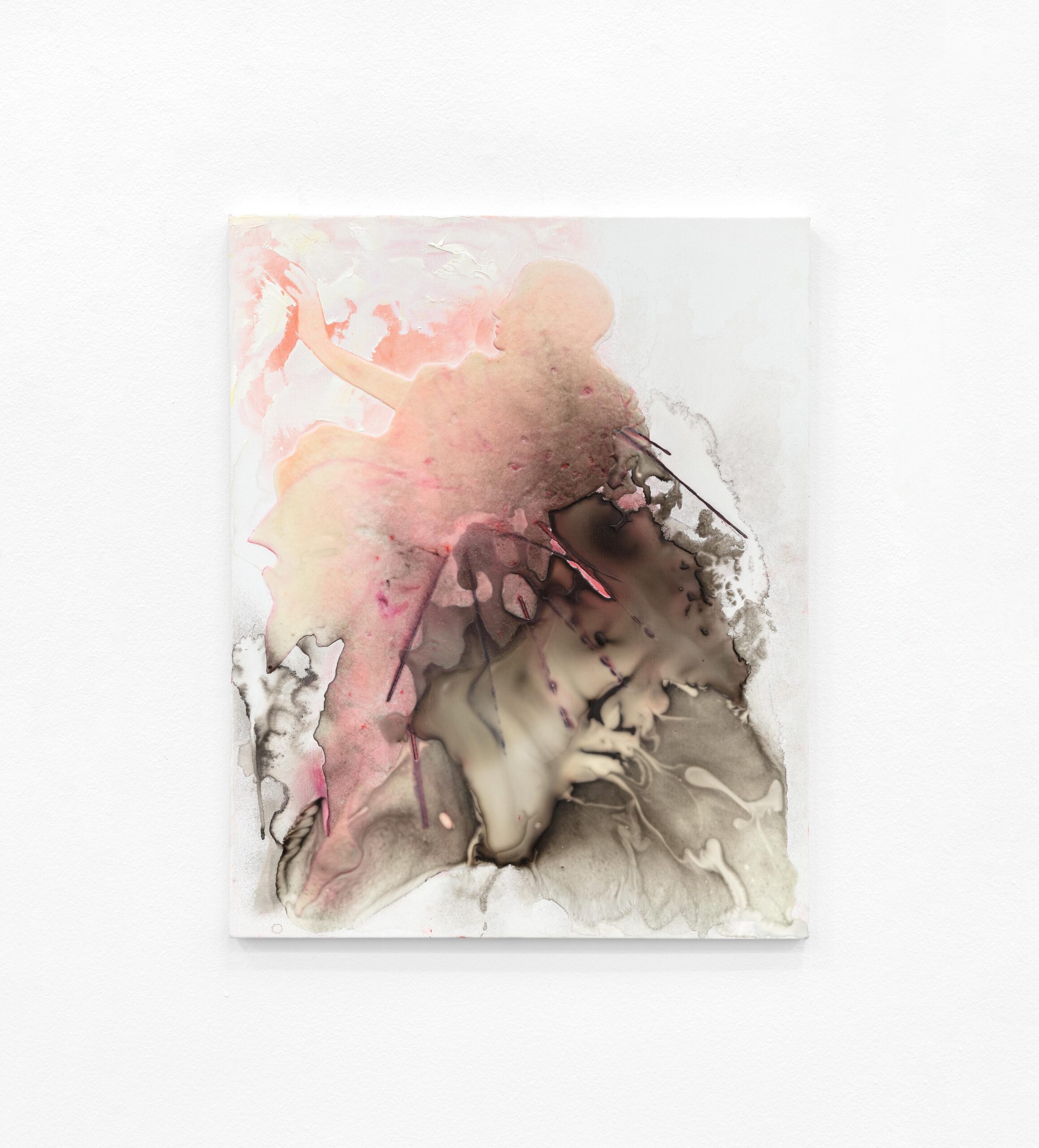
Penny Siopis, Survivor, 2011/25. Glue, ink and oil on canvas. Courtesy of the artist and Stevenson
It’s interesting that visually, the paintings reveal a sense of turmoil. Splashes of colour with a lot of intensity. There are quieter moments too, though. Can you tell us about the work, ‘Survivor’, in particular?
Survivor was a delicate glue painting from my 2011 exhibition Who’s afraid of the Crowd’? onto which I have since spilled more glue and splashed dark ink. The whole image exploded. But she, in her quiet vulnerability shines through as strength.
And finally, why painting today?
That’s an impossible task! All I can say is painting holds a human trace, marking, in the brightest and darkest moments, a commitment to imagining, surviving and creating new worlds.