Stevenson
22.05 - 25.06.2021
One night, my father came home from a motorcycle trip with the look of despair on his face. I had never seen this look – despair – before, and I have seldom seen it since. He explained that the buddy in front of him had driven over some gravel, lost control of his bike, careened into a guardrail which rebounded him onto the windshield of an oncoming car. His helmet came off, and his face was cut by the glass, so that my father saw his skull as he died. Thereafter, my father was perturbed by skeletons, even benign ones like Halloween decorations.
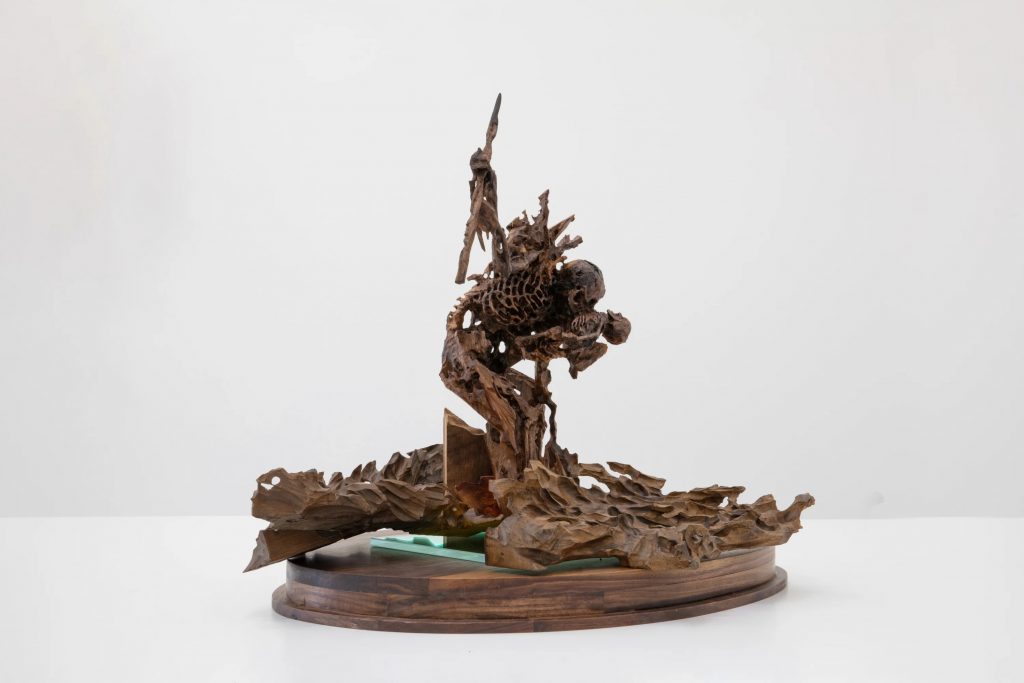
Upon viewing Wim Botha’s latest show at Stevenson, I thought about this story of my father’s. ‘The River’ is comprised of several wood sculptures, many of them skeletons or skeletal forms. The skeleton is a weird symbol. It symbolises death, but it does not necessarily make us think about death – the indisputable fact that we and our loved ones can at any point and will at some point – be ripped from this world. This is a lesson my father learned that day. Images of death cease to be mementoes and become the impetus for much terror and grief, perhaps best articulated by the sculpture Scenes from the River 8. Despair casts a shadow over its face; despair works away inside its chest, eroding.
I also thought about insomnia. My father suffered from it for months after the accident, making him the third insomniac in a house of four, joining my mother and me. I thought about insomnia because Botha’s skeletons seem less so dead than they are caught in a boundary. To have insomnia is to be between sleeping and waking. For this exhibition, whose title suggests the River Styx, the figures are caught in the boundary between the dead and the living.

Wim Botha Scenes from the river 8, 2021. Walnut
In F. Scott Fitzgerald’s essay about insomnia, he describes how these two boundaries – sleeping and waking, living and dead – are closely intertwined. ‘What if this night prefigured the night after death,’ he wonders. ‘What if all thereafter was an eternal quivering on the edge of an abyss … to stand forever, perhaps, on the threshold of life unable to pass it and return to it. I am a ghost now as the clock strikes four.’ I have often felt akin to this, as I feel akin to the sculpture Scenes from the River 4. It is unclear whether the figure is throwing off a sheet with impatience or wrapping it around them for comfort. What is palpable is the feeling of being awake at four: cut off from the world but exposed to the disquiet of one’s own mind, all one’s dreams and anxieties flapping about unformed like unfeathered birds. To be awake at the unforgiving hour is to be a ghost, standing before the veil of death. Or else, standing on the other side of it, unsure if one’s passage back to the realm of the living is guaranteed.
-

- Wim Botha Scenes from the river 2, 2021. Walnut, marble and brass
-
- Wim Botha Scenes from the river 4, 2021. Walnut and brass

‘Four AM can be a devastating hour,’ says James Baldwin:
The day, no matter what kind of day it was, is indisputably over; almost instantaneously, a new day begins: and how will one bear it? Probably no better than one bore the day that is ending, possibly not as well. Moreover, a day is coming which one will not recall, that last day of one’s life, and on that day one will oneself become as irrecoverable as all the days that have passed. It is a fearful speculation – or, rather, a fearful knowledge – that, one day one’s eyes will no longer look out on the world. One will no longer be present at the universal morning roll call. The light will rise for others, but not for you. Sometimes, at four AM, this knowledge is almost enough to force a reconciliation between oneself and all one’s pain and error.
A work that might be enough to force reconciliation is Scenes from the River 16. The figure holds a spear in one hand and a smaller figure, perhaps a child, in the other. There is a way to read this work which puts the child in danger, the figure a protector, holding their weapon high as if to say, don’t dare come any closer. But the way the figure’s spine curls around the smaller body, the way they kiss, lips and chest carved from the same wood, tells me that this work is about closeness and the humility closeness requires. The sense that I get is that the figure has been made to face their pain and their error. If a spear is a tool to rail against death, they send it up to the gods. They succumb to despair, where despair reveals all that is small and vulnerable inside of them. Rather than hide or fight or run away from despair, they relinquish themselves to it. This, a sort of healing.

Wim Botha Scenes from the river 20, 2021. Walnut, glass and dichroic film
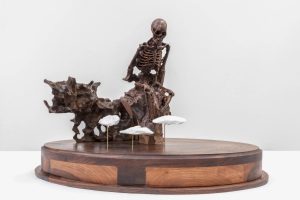
In another part of the same essay, Baldwin says, ‘Despair: perhaps it is this despair which we should attempt to examine if we hope to bring water to this desert.’ I begin by examining the etymology of despair, root spes, meaning success, prosperity, progress, and related to speed, i.e., rapid progress. Despair, then, is a complete lack of progress sometimes read as a synonym for hopelessness. Despair might be thought about, otherwise, as stillness. That is the feeling I get when considering a work like Scenes from the River 2. The figure is sat comfortably on wood the same tone and texture as their bones. Their gaze falls gently on three white rocks. Whereas the other figures felt constricted by the boundary, this one is at ease. In this liminal state, tiny miracles reveal themselves. Despair might be an invitation to regard deeply.
Most of the sculptures in The River radiate the same stillness: egrets bowing before their reflections, an eagle taking flight, a figure looking contemplatively into a pool of glass. My favourite is Scenes from the River 20. 20 is perhaps a revision of Botha’s Mieliepap Pietá (2004). Where Mielipap was monstrous, literally crumbling under its own physical and symbolic weight, 20 is small, delicate. Where Mielipap’s madonna seems averse to touch the corpse (her one hand hovering back, the other protected by a cloth), 20’s cradles the child, her ribcage a hammock, her gaze loving upon them. (Botha is a marvel for managing to carve such a loving gaze into hollow eyes.) 20’s figures are haloed by this intricate walnut – cavernous and alive – through which light pools, like sun reflected on a cenote.
Baldwin believes that the only antidote to despair is ‘the miracle of love, love strong enough to guide or drive one into the great estate of maturity, or, to put it another way, into the apprehension and acceptance of one’s own identity… It is only this passionate achievement which can outlast death, which can cause life to spring from death.’ As a cenote springs like a miracle from rock, life springs from these deathly scenes with each stroke of Botha’s carving knife. That they appear at peace is testament to Botha’s loving hand.