Church Projects is painted like a bar of gold. A narrow slice of heritage building, this double-story gallery reads as a liminal space: a passageway between realms. Founded by Hoosein Mahomed and Sheleen Maharaj, Church was established to host artistic interventions at the centre of the city of Cape Town. I imagine that Church could be the eccentric home to a Helen Oyeyemi character in one of her fantastical broken-fables of migration, in which her protagonists mediate real and unknown places through time travel, bewitched puppets, love letters, rose gardens and ancient family recipes. The project space can be found on Cape Town’s Church Street, itself a pedestrian passage between busy inner-city roads. I like to imagine that the ground floor entrance to Church can be accessed by either turning the handle to the gallery’s old victorian door or, by climbing through one of its massive twin windows. Currently, the interior of Church’s landing has been painted a delicious hue of inky blue, which makes for an even more sumptuous invitation to climb through the gold exterior into its heart.
Again, I am reminded of Oyeyemi’s use of deranged architecture as a middle passage. In particular, I think of the gold-gilded apartment interior of her novel Gingerbread, which sits on the seventh of an outrageously disproportionate set of landings. The gold apartment is home to a daughter, Perdita, who has convulsed into a coma that transports her to her mother’s native country – an unknown land that does not appear on any world map.
The blue interior of Church can be credited to artist Mbali Khoza’s current ‘intervention’ at Church, ‘Native of Nowhere’ (running until the end of August), which, for me, comprises the strongest component of her body of work in this space. Three text panels are hung from gold scrolls along the blue passage, each an excerpt from short stories by Nat Nakasa, Sisonke Msimang and Guilaine Kinounan, which respectively speak to alienation, xenophobia and self-exile. In her multi-part exhibition, including text, video, etching, neon lights and a ready-made painting, Khoza’s blue interior designates the ocean as a historical passage for loss, through which she mediates the “negotiation of black mobility over space and time” (paraphrase). Saidiya Hartman calls it “the middle passage” (2007) and references the small community of African Americans who have made settlements in Elmina, Ghana as “Middle Passage survivors” who “possessed no kin, clan or village home, all of the essential elements that defined belonging in the eyes of Ghanaians.” Likewise, the daughter of Oyeyemi’s novel must navigate her mother’s natal land as a stranger.

Mbali Khoza, Native of Nowhere, 2022. Courtesy of Church Projects. Photograph by Mario Todeschini.
In her short film, A Goree, Khoza presents a POV film of her journey at the helm of a ferry to the small island, Gorée, which served as a significant port for the slave trade off the coast of Dakar. I am curious about Khoza’s situating of her work predominantly in other places on the continent and not South Africa – as she is a South African-born artist. Perhaps it is a negation of this country as homeland. As she shares her own point of view from a largely unknown seascape to her audience at Church, I wonder about the foothold the viewer is given into a conversation about land and mobility – themes which, too, carry weight for collective histories in South Africa.

Jody Brand, Litany for Survival, 2021. Courtesy of Church Projects.
For her solo intervention at Church, ‘Litany for Survival’, some months prior to Khoza’s blue passage, artist Jody Brand invited passage dwellers to light a commemorative votive candle, each ceremoniously placed atop its own small gold pillar at the passage-ending exterior of a twin window. ‘Litany for Survival’ included sculpture, video and photographic images, each an expression of mourning for Brand’s family’s historical displacement from Black River (a suburb in Rondebosch, Cape Town). In 1966, Black River was declared a ‘white’ area under the Apartheid government’s Native Land Act, actioning an edict for the forced removal of people classified as ‘coloured’ from their homes. Brand’s banner-sized photograph of the verdant river bank of Black River was exhibited over the top-story windows to Church. Viewed from the street, the photograph appeared a solid print and, when viewed from inside of the gallery during day-time opening hours, it appeared to be back-lit – a wonderfully imaginative use of the sun as a light-box mechanism. Reflecting on a history of displacement and subsequent longing for home in a post-Apartheid South Africa, Hartman’s Middle Passage might also be assigned to a waterless displacement of bodies from land over time. Writer Amy Soudien opens her essay on ‘Litany for Survival’ with the integral question of Brand’s intervention: “Where do we find a place to mourn, to heal?”

Jody Brand, Paradise Pickles, 2021. Courtesy of Church Projects.
Church facilitates a passageway and, whether the artists invited to ‘intervene’ have consciously curated their work around it or not, the gallery’s narrow interiors facilitate a particular movement through its walls. One is either coming or going. A particularly sumptuous moment in ‘Litany for Survival’ was the meticulous presentation of ‘Paradise Pickles’, which comprised three large glass jars, filled to the brim with various food ingredients, including mussels, red onions and fennel seeds, swimming in white spirit vinegar. Brand credits ‘Paradise Pickles’ to family recipes for pickling, passed down generationally. This was a physical embodiment, a living memorial to preservation. In Oyeyemi’s Gingerbread, Perdita eats a batch of her mother’s gingerbread – a family recipe – before falling into a deep coma of metaphysical return to Druhastrana – her mother’s unknowable homeland. Brand’s placement of her living memorial sculptures at the light-box Black River bank are perhaps an invocation to return to a similarly unknowable place. Soudien muses on Brand’s photograph of the river bed, “Captured, too, is the promise of the river’s bounty and a silent longing for what was, and perhaps, what couldn’t be.” Perdita can only visit Druhastra in her dreams, meaning that she cannot be both in this place and awake at the same time. Perhaps Khoza’s passageway is also liminal space for dreaming: a ‘hydrocommons’ for longing.1In her book, Bodies of Water: Post Human Feminist Phenomenology (2017), Astrida Neimanis designates the ‘hydrocommons’ as a wet eco-system of water, constituted by the bodies through which it passes, including human, animal, insect, mycelial network, plant, ocean, sewerage system, cistern, river, puddle and reservoir. In Khoza’s blue passageway, I consider the ‘hydrocommons’ a wet negotiation of bodies-in-relation to a history of water. The irony being that water does not have a history per-say as it cycles and replenishes itself through living vessels ad-infinitum.
In contrast, I often feel the weight of my own familial history, in an Afrikaans-descended white South African body, as an omnipotent coma, which I have slipped in and out of. I am reminded of an ancient family anecdote of a woman who was tricked to fall into a bottomless gorge, once shaped by a lively river current in the Ceres mountain range. I consider the ‘hydrocommons for longing’ a liminal space for being with water. Both Khoza and Brand find their work becoming wet with it at points in their respective interventions.
-

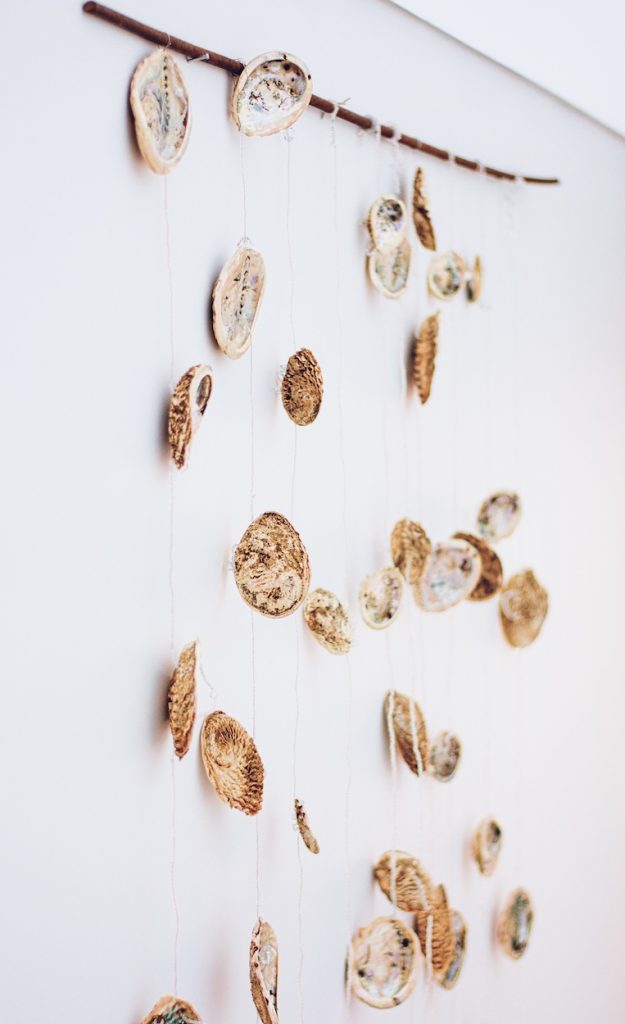
- Jody Brand, Litany for Survival, 2021.
-
- Jody Brand, Litany for Survival, 2021.
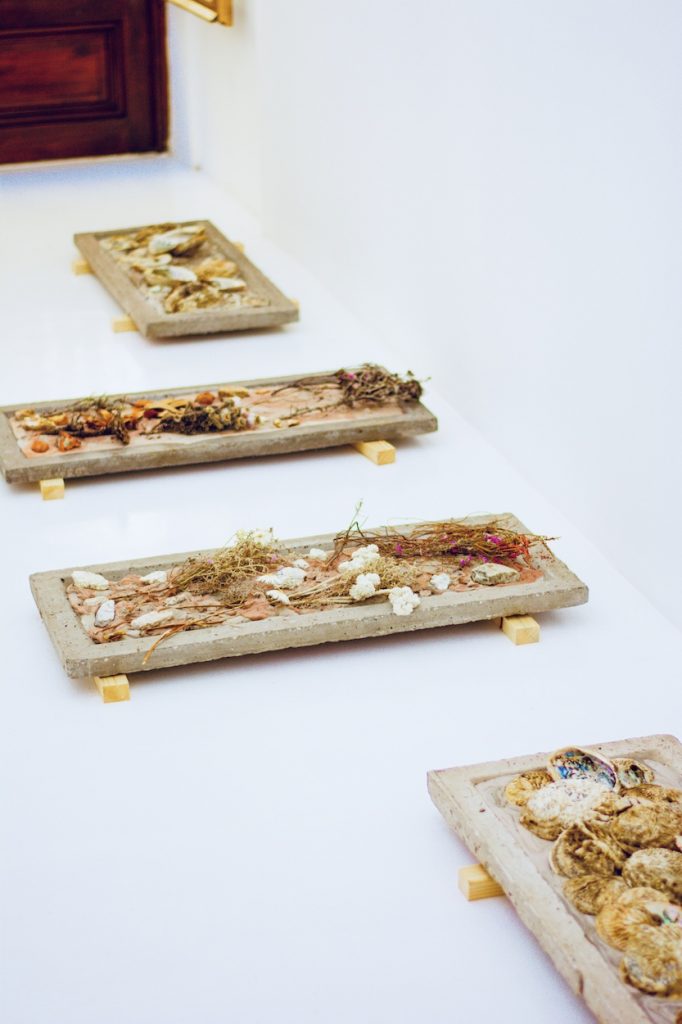
In both, the artists make use of Church’s bizarre two-story passage interior to think about themselves and their work in relation to water. Perhaps the architecture invokes the movement of water in the way that it ushers bodies cyclically through its passages, always returning to the one and only entrance. In this frame, I am curious about the potential for Church as a meditative space for artists to mediate personal and collective accounts of water – as loss, as longing, as missing. And I wonder about the potential for the blue passages of a project space to hold the contradictions of a hydrocommons in South Africa. Collectively, we are all still either wading through it, searching for it or drowning in it – depending on whose story it is.

Mbali Khoza, Native of Nowhere, 2022. Courtesy of Church Projects. Photograph by Mario Todeschini.