Goodman Gallery
09.03 - 22.04.2023
“White people talking about race! White people talking about race!” Repeat. I have had this little refrain stuck in my head ever since attending the opening of Candice Breitz’s Whiteface at Goodman Gallery in Cape Town. The line was recited to a catchy rhythm in the middle of the titular video installation, which was also the main attraction of the show. Across two channels, the artist cut together snippets of online content that involved white people talking about race. An edit of the found footage played on a small monitor at the back of the screening room and the accompanying sound served as material for Breitz’s satirical performance film. On a much larger screen, at the other end of the auditorium, the artist lip synced along to the supercut of race takes wearing an array of blonde wigs and zombie contact lenses. The video was edited effectively, with comedic timing and a mantric rhythm in mind, but the “white people talking about race!” interlude was especially snappy, like a welcome musical number in the middle of an otherwise colourless movie.
Breitz makes good use of perhaps the most regrettable aspect of how video art is presented in gallery contexts. The convention is to play a video on loop while visitors dip in and out of it, which usually makes one feel trapped in an endless middle. It’s an awkward set up that tends to nullify the medium’s unique ability to deal with duration and temporality. However, in the case of Whiteface, the sense of endlessness served. Breitz is primarily interested in how racism is reinforced through repetition, so it felt appropriate that I had no idea where in the video we were. Poised between a white cyclorama and a wall of flat lighting, the artist sunk into the horizon as she recited the material by rote. The visual language of the show spoke for itself by not saying much.

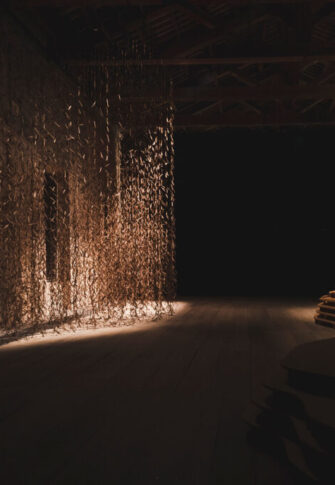
Candice Breitz, Whiteface, 2022. Photo by a Nina Lieska of Repro Pictures. Courtesy of the artist and Goodman Gallery.
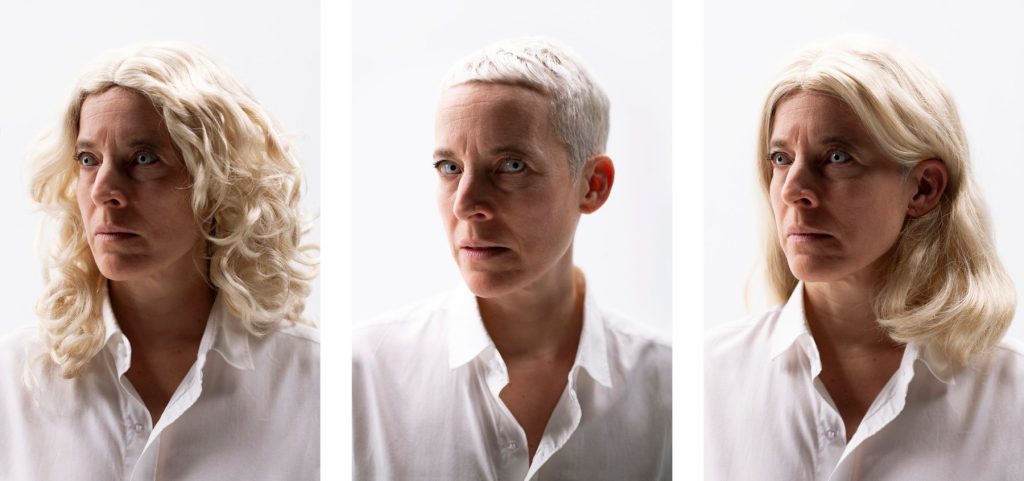
True to form, the accompanying suite of single-channel videos dedicated to each of Breitz’s wigged characters was titled White Mantras (2023) and maintained a similar incantatory metre. The series of portraits taken of her personas in turn repeated the same composition throughout. On the other hand, those who managed to make it through the entire Whiteface video may have noticed a thematic progression of sorts. The work moves through a number of hot button racist topics like fear of extinction, white pride, cancel culture, reverse racism and critical race theory. Nothing new exactly, but Breitz still believes that there is value in not only presenting these popular ideas in an art gallery, but also making them so exaggerated and densely compacted that they come to seem “undeniable.” In this way, she hopes to be able to insist on the social reality of race that her interlocutors wish to deny or misunderstand.
Intuitively there is something kind of cringe, almost unseemly, about a white person spinning their wheels on the topic of whiteness like this and I would imagine that to be part of the point of a spectacle like Whiteface. Breitz is concerned with a world-historical phenomenon that certainly transcends her own ego, one that might well require traversing the cringe or the unseemly in order to be addressed. However, I am not convinced that trying to “visibilise” whiteness by camping out inside of it like this is an effective political project. The impulse behind it is a reasonable one, but simply showing what whiteness is is not the same as showing what whiteness obscures.
The problem with Breitz’s approach is that it misses where the problem lies. Revealing the fallacies of racism does not necessarily do anything to sever the psychic hold that it has. Despite being explicitly concerned with race at the level of the psyche, Breitz still seems to think of racism as a conscious mind problem. Her exhibition suggests that racism is a result of mere ignorance and that once its wrongs have been made sufficiently visible to the world, we will be compelled to abandon white supremacy. To my mind this misses a crucial insight about the psychic life of race that scholars like David Marriott have notably theorised, namely that racism is an unconscious mechanism. The conscious knowledge that racism is wrong does not necessarily interfere with an unconscious investment therein.

Installation view: Candice Breitz, Whiteface, 2023. Photo by a Nina Lieska of Repro Pictures. Courtesy of the artist and Goodman Gallery.
Taking this psychoanalytic turn into account, we might attend more closely to “the propensity to deliberately misunderstand something” that Khanya Mashabela noticed in the testimonies of Whiteface during her Q&A with the artist. Whiteness is clearly already visible to the people in Breitz’s video. It is the very occasion for them to be “talking about race” in the first place. Yet they continue to misunderstand something. They persist in their racism in spite of widely publicised knowledge about its wrongs. Why is that? Marriott’s claim is that the white subject depends on the idea of a racial other that threatens whiteness, or bars the complete satisfaction that whiteness promises, in order to keep the fantasy of such a satisfaction alive, just out of reach. Whiteness only exists as an ideal to be defended if something or someone is seen to prevent it from flourishing because, without such an impediment, we are forced to confront the fact that whiteness as such is insubstantial and ultimately dissatisfying. Simply put, the white subject creates a racial threat as one of “the social diversions by which they avoid common unhappiness.” Bleak as it may sound, the “common unhappiness” that Marriott carries over from Freud is a necessary part of being driven through this world by desire. Racism results from a disavowal of the constitutive lack that drives and defines us.
No amount of visibilising whiteness will allow us to see that whiteness only becomes visible in relation to a racial other that serves as its negative image. This negation, the white unconscious, is its only unifying characteristic. What we might think of as the essential qualities of whiteness are all particular reactions to the void that is at its centre. Breitz is right to foreground repetition in her work, but it is not the repetition of certain racist ideas that constitutes whiteness. It is rather repeated encounters with the threat of its negation that continues to breathe new life into white supremacy. To reveal the truth about whiteness would be to show its internal contradiction. Unfortunately, because Whiteface is only interested in showing us a compilation of arbitrary instances of racism, it ends up feeling rather pointless. In the artist’s defense, this does seem to come with the territory. If it feels as though Breitz is spinning her wheels, it is at least partly because whiteness is always spinning its wheels. It is, in essence, a structure of repetition and there is no way out except through the lack that inaugurates it.

Candice Breitz, White Mantras (Set of 7), 2022. Courtesy of the artist and Goodman Gallery.