Stevenson
18.03 - 29.04.2023
“I have lived everywhere, mostly on ships,” said the assassin Dimitri Tsafendas. Before becoming the man who killed Verwoerd, Tsafendas lived an itinerant life. He was raised between Alexandria in Egypt and Middelburg in present day Mpumalanga. By the time he came of age, Tsafendas wrote a letter to Franklin Roosevelt requesting US citizenship, but Roosevelt reportedly refused. “I am from the United States of Mozambique,” he later proclaimed. When pressed for an answer, however, Tsafendas relented and admitted that South Africa was ultimately “home.” But one could argue (and I am sure Penny Siopis would agree) that it was only from a position of non-belonging that Tsafendas was able to mobilise his attack on the essentialism of Apartheid. It is also only fitting that he serves as the subject for the first film you encounter at Siopis’ current retrospective at Stevenson.
For Siopis, itinerancy seems to be both theme and method. Not only do these films depict a great deal of movement, but the found footage she appropriates is sourced from flea markets across the world. Her life-long interest in the history of globalisation thus marks the content, form and material of this frequently enveloping exhibition. Above all, Siopis wants to attune us to the way history never settles down. It is depicted in these films as restless and perpetually on tenterhooks.
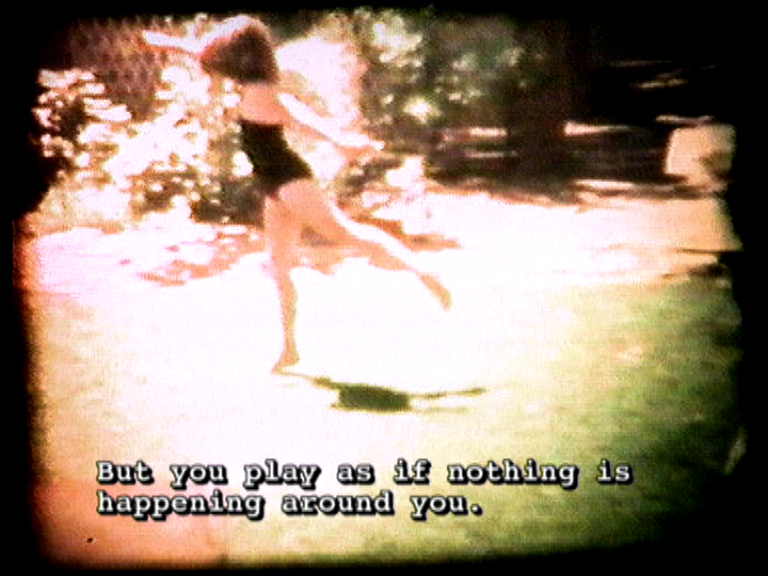
Penny Siopis, My Lovely Day, 1997. Courtesy of Stevenson.
Looking back over her body work, you get a sense that the artist has been asking the same open questions since her landmark My Lovely Day (1997), which is essentially the urtext of her filmic practice. The film pairs an edit of home movies shot by the artist’s mother in midcentury South Africa with her grandmother’s documented travelogue of their winding journey from Greece. It has become a classic of sorts, one that has proven as influential as it is intimate, moving and confusing.
These films are definitely not trying to resolve themselves. Instead, they prefer to remain suspended somewhere in the middle of history. The New Parthenon (2016), for example, is about Greece as a limit case of cold war geopolitics, as well as a waystation in the artist’s own family history. “After the war, Greece thought she’d go East,” Siopis’ father recalls, suggesting that even a country can move away from where it used to be. Welcome Visitors! (2017), easily the lightest of the nine films, tracks the movement of a jazz composition by August Musarurwa all the way from Zimbabwe to the South of the United States. In this case, it is a cultural object that is exiled from its country of origin. Siopis is always looking for something in her subjects that cannot be pinned down. Something slippery or contingent.

Penny Siopis, Welcome Visitors!, 2017. Courtesy of Stevenson.
Her emphasis on contingency also informs the use of text on screen. “Text hooks contingency into narrative,” Siopis stipulates, which is an interesting formal move in the context of essay filmmaking. The essay film form has historically favoured voice-over, which lends a certain grain to the written word. Siopis is particularly sceptical of the more authoritative texture she finds in the narrations of Chris Marker, Harun Farocki and the like. Yet even in the humble work of Jonas Mekas or Trinh T. Minh-ha, which foregrounds a subjective distortion, the grain of the voice still draws you in. Siopis’ use of text, on the other hand, always keeps you at arm’s length. There is something clinical about her helvetica subtitles that resists the nostalgic lure of the footage. I do not like the use of text in these films on purely aesthetic grounds, which attests to its efficacy as a Brechtian wedge between me and the work.
The artist’s preference for text also means that you need to do a lot of reading. Another reason Siopis does away with voice-over is to prompt an internal narration in each spectator. Whether you are confronted with the official testimony of an assassin, the artist’s own poetry or the quips of her Greek grandmother, the viewer needs to find the voice of each film for themselves. Most of her films are built around a recognisable story or thematic concern, with the exception of two works presented at the midpoint of the exhibition route.
The two shorter pieces, She Breathes Water (2019) and Celluloid Body (2021), are even more impressionistic than the others, and I enjoyed spending some time with them. The former is an especially elemental work, full of collisions and jagged editing. At this point, I also clicked that the ocean was probably a significant metaphor for Siopis. I began to feel the sound from all the surrounding films swell up against the walls of the atrium. On screen, an octopus attacked and concluded her most dangerous film.

Penny Siopis, Celluloid Body, 2021. Courtesy of Stevenson.
The scratches and breaks in the celluloid, a recurring character throughout the exhibition, represent what Siopis likes to call “the cut.” In Celluloid Body, most notably, a gaping hole in the film stock is animated like a virus that tears through its host. The host, she specifies, is representation itself. The rupture in the image is therefore to be read as an analogy for the incompleteness of meaning in language. Siopis’ scepticism of representation tracks with her avowed debt to Gilles Deleuze, which was reiterated during her discussion with Sarah Nuttall and Sinazo Chiya.
Both Siopis and Deleuze seem to think that representation locks us into a repetition of established meanings that forecloses the emergence of something new. The disjunctive cut, it is argued, can help to break meaning from its moorings. While there might be something admirable about their shared commitment to novelty, I felt most at odds with the exhibition whenever this Deleuzoid diffusion of meaning came to the fore. I’m down to question dogmatism as much as the next guy, but then what?
Siopis is by no means devoted to the weirdo philosophies of late 20th century France. Her reference points are far more eclectic, but even this intellectual cosmopolitanism adheres to the logic of multiplicity that underlies Deleuze’s writing. In the absence of a universal structure that grounds thought and meaning, post-structuralism sees the world as a multitude of discrete differences. Multiplicity has also become the shifty foundation of most contemporary art. The objects we find scattered throughout the contemporary gallery are frequently dazzling to look at, but one often walks away frustrated by the lack of a binding agent.
Deleuze and his followers are primarily sceptical of a consensus meaning that binds us, hence their interest in that which cuts through it. Through the cut, they believe, we escape the deadlock of representation and open up to infinite possibility. Whenever Siopis assumed a similar position, either formally or conceptually, I felt the work loosen its grip on me. In other moments, when she managed to evoke a more dynamic interaction between representation and cut, I felt myself drawn back in.
“There is a Greek word for remedy that is also the word for poison. Pharmakon,” she writes. Like pharmakon, representation is a remedy that is also a poison. Words fail, but their failure compels us to speak. The cut is therefore a necessary condition of representation, not a way out of it. Representation is always circling around what cannot be said and the latter keeps the former in place, allowing us to share a basic common language.
Never The Same Water Twice was at its best when the cuts and ruptures within its edifice came to signify a universal position, where meaning in language fails for everyone equally, instead of an escape into particularity and arbitrary difference. Universalism might not be a vogue position to take up right now, given the many false universals our history has dealt, but novelty as such means nothing if not directed towards the universal or the international.
Dimitri Tsafendas represents the universal cut, the position of non-belonging that we all ultimately share. Nobody fits in, everyone is at odds. Verwoerd, for his part, was an apostle of multiplicity and irreducible difference. He had no truck with universality. The psychiatrists who treated Tsafendas also tried to particularise him, to banish him to the far reaches of psychosis. “Where most people see a butterfly, Tsafendas sees only red,” they testified. Siopis, in turn, tries to see what Tsafendas saw. To align with the view from exile and show that nobody fits into their symbolic identity without leaving a remainder.

Installation view: Penny Siopis, Never the Same Water Twice: Nine Films (1997-2021), 2023. Courtesy of Stevenson.