The most recent controversy circulating throughout the South African art community is the censored exhibition at the Venice Biennale of Elegy, a work by Gabrielle Goliath. Censored by Gayton Mackenzie, the South African Minister of Sport, Arts and Culture.
Mackenzie, a self-proclaimed Zionist, rescinded the exhibition on the belief that one part of the performance piece carries a geopolitical message that is “highly divisive in nature”, as it alludes to the Gaza genocide actively being perpetrated by Israel, by offering a tribute to honour Palestinian poet Hiba Abu Nada, who was killed by an Israeli airstrike in 2023.
Mackenzie, additionally, believes that support for the performance installation is indefensible since South Africa has been accused by the Trump Administration of a white genocide of white Afrikaans farmers, which is fallacious, unsubstantiated and detracts from real genocides unfolding throughout the Global South, by foregrounding mythologies of white nationalism and white extinction anxieties.
The defining essence of Elegy, as a performance piece, is that it prompts considerations about what meaning emerges from grieving those who are neither proximate nor known to us – by not only drawing connections but critiquing the contexts of gender-based violence and femicide in South Africa, the Herero and Nama colonial genocide and the normativity and permissibility of maiming in Occupied Palestine, with a specific focus on women, children and the LGBTQIA+ community.
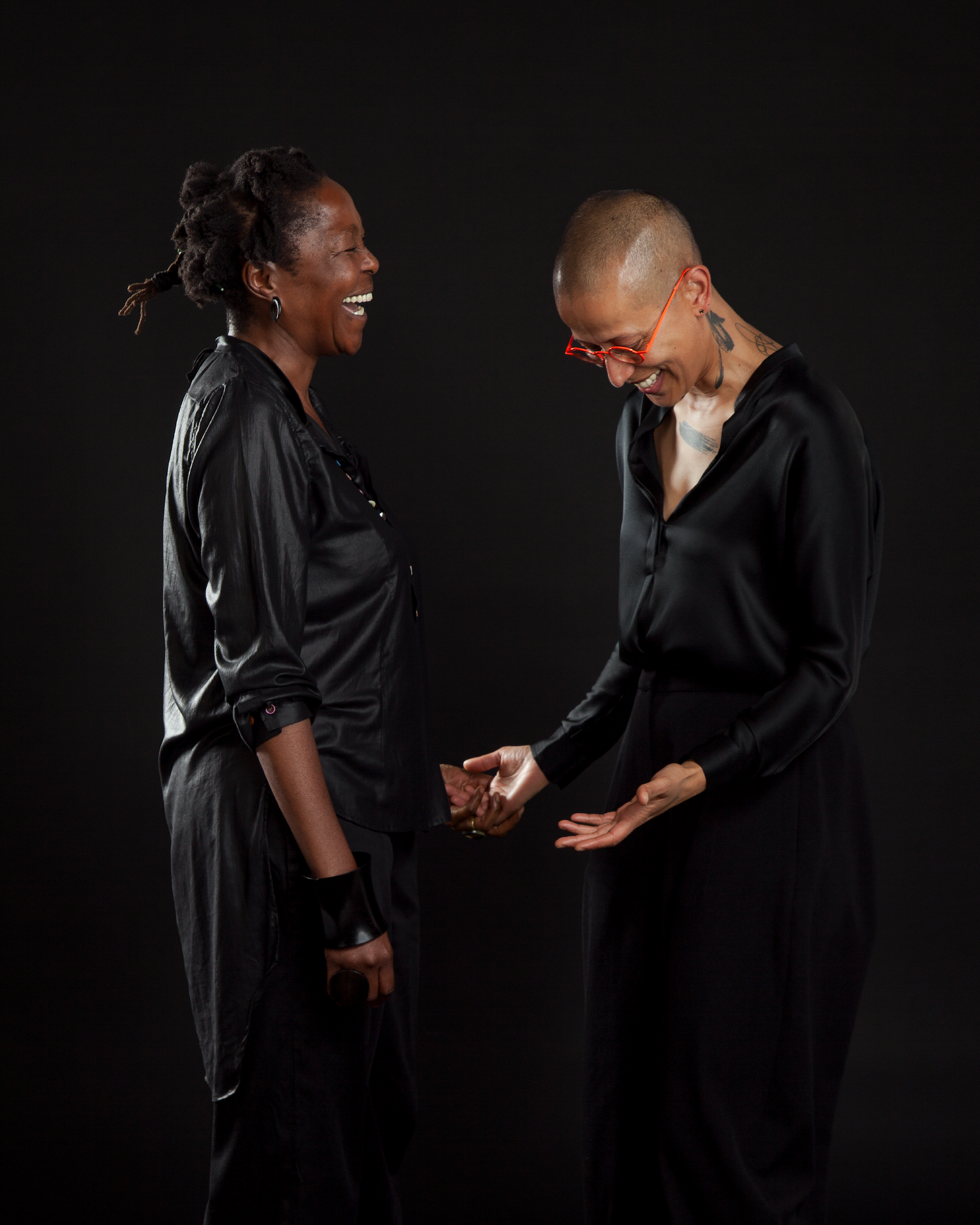
Gabrielle Goliath & Ingrid Masondo, photo by Zunis
Goliath, alongside Ingrid Masondo, selected to curate the 2026 South African Pavilion, has since sued Mackenzie on the grounds of unlawful veto and a contravention of the constitutional right to free speech and freedom of (artistic) expression. The recent verdict, which the team plans to appeal, favoured Mackenzie, dismissing the urgent application to represent South Africa at the 61st edition of the Venice Biennale this year.
The systematic erasure of the Palestinians, the Sudanese and the Congolese serves as an unfathomable reminder that “one’s life is always in some sense in the hands of the other.” Reflecting here on the writings on the politics of grief, by queer feminist philosopher Judith Butler – a life mourned, is a life rendered grievable, with testimony, with reverence. Genocide distorts grievability, as the underscoring of finitude, and the apprehension of a life as inherently precarious. In the act of witnessing human capacities for cruelty, we are reminded to question how the arts can carry practices of ritualistic repair and mourning forward amidst mass loss and how the arts engage with intersecting state-sanctioned violences intended for bodies relegated to the margins.
Rooted in sister solidarity in the arts, this article is a retrospective tracing of South African Pavilions at the Venice Biennale from 2026, back to 1993. Read this article as an homage to the collective meditations of Nina Simone, Toni Morrison and James Baldwin, on the role of the artist – as a looking glass for the times, as the healer of civilisations through sensory language, and the narration of meaning-making to survive, amidst impossible adversity.
Cameroonian-Swiss curator, Koyo Kouoh, who served as Executive Director and Chief Curator of the Zeitz Mocca Museum, was appointed as the first African woman to curate the Venice Biennale, before her untimely death in May 2025. Scheduled to run from May to November, the 2026 international art exhibition is themed In Minor Keys, drawing inspiration from musical metaphors. The 61st edition is expected to showcase innovative artworks that embody the essence of the visionary.
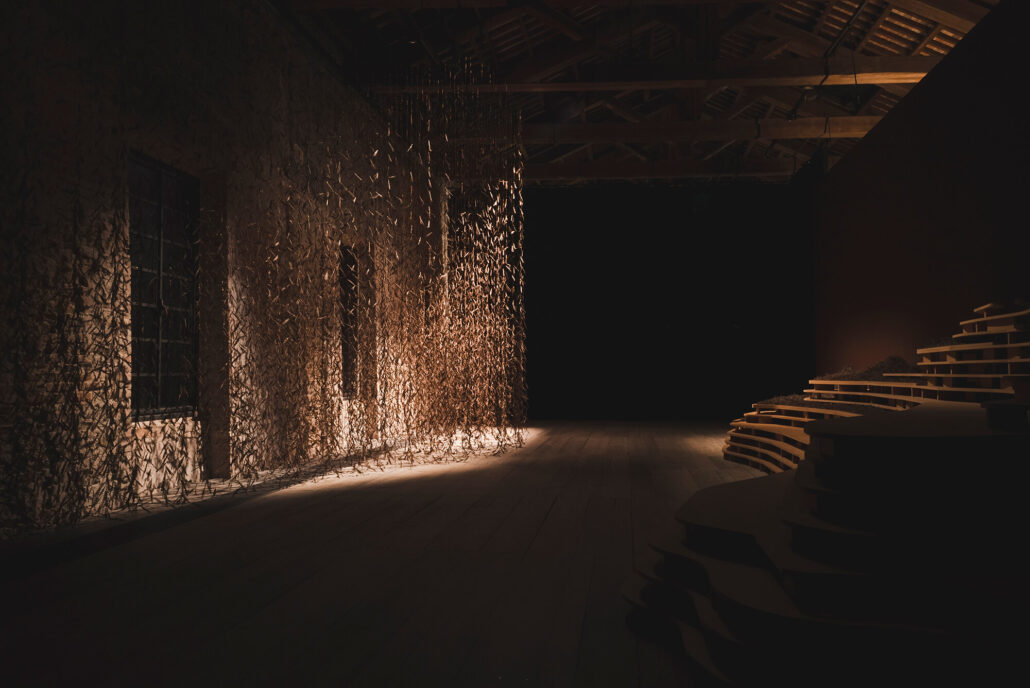
MADEYOULOOK, Dinokana, 2024. Courtesy MADEYOULOOK. Photo by Bubblegum Club.
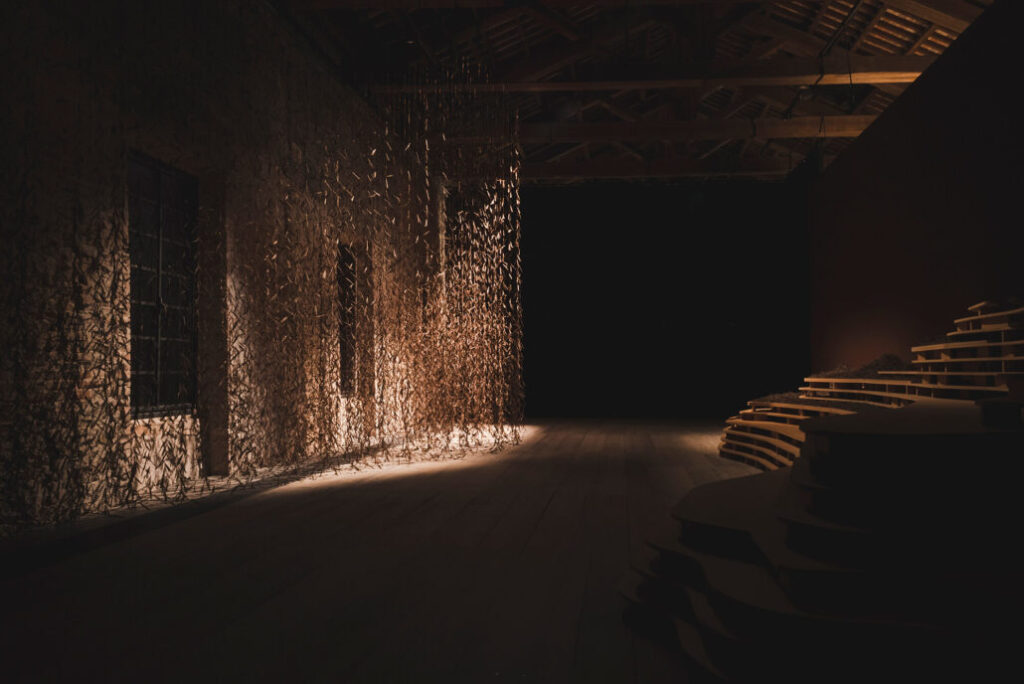
Two years prior, the 60th Venice Biennale was a historically momentous event as Adriano Pedrosa became the first Latin American appointed to curate the international art exhibition. Pedrosa titled the 2024 exhibition, Stranieri Ovunque – Foreigners Everywhere, inspired by the artworks by the Paris-based collective, Claire Fontaine, founded by artists Fulvia Carnevale and James Thornhill. The concept held multiple meanings – that foreigners are encountered in all places and that nobody is immune to the sensation of foreignness experienced by the presence and the meaning of ‘the stranger.’ Knowingly, within this theme of unfamiliarity, there are those who exist in liminal spaces – such as the Indigenous, the diasporic, the queer, and the alternative artists, who shift between worlds and identities. In this iteration, the South African Pavilion, curated by Portia Malatjie, was titled Quiet Ground, rooted in the national commemoration of democratic elections. The pavilion explored the possibilities of repair and restoration in the aftermath of forced migration, water rehabilitation and replacement, and reconfiguring severed sovereign relations to the land. These themes were explored through an immersive sound installation, Dinokana (2024), by MADEYOULOOK, the Johannesburg-based interdisciplinary art collective, founded by Molemo Moiloa and Nare Mokgotho.
The 59th Venice Biennale (2022), themed The Milk of Dreams, was conceived by Cecilia Alemani during the isolation that plagued the COVID-19 pandemic. The title was inspired by a book with the same name, by novelist and Surrealist painter Leonora Carrington. Grounded in uncanny co-existences, the realms of the imagination and the otherworldly, the exhibition theme posed three questions of the contemporary moment – how bodily metamorphoses has conjured the changing definition of the human and what constitutes a life, the human connection and responsibility to the Earth and non-human others, and the emerging relationships between advancing AI technologies and the individual in an increasingly isolated digital society.
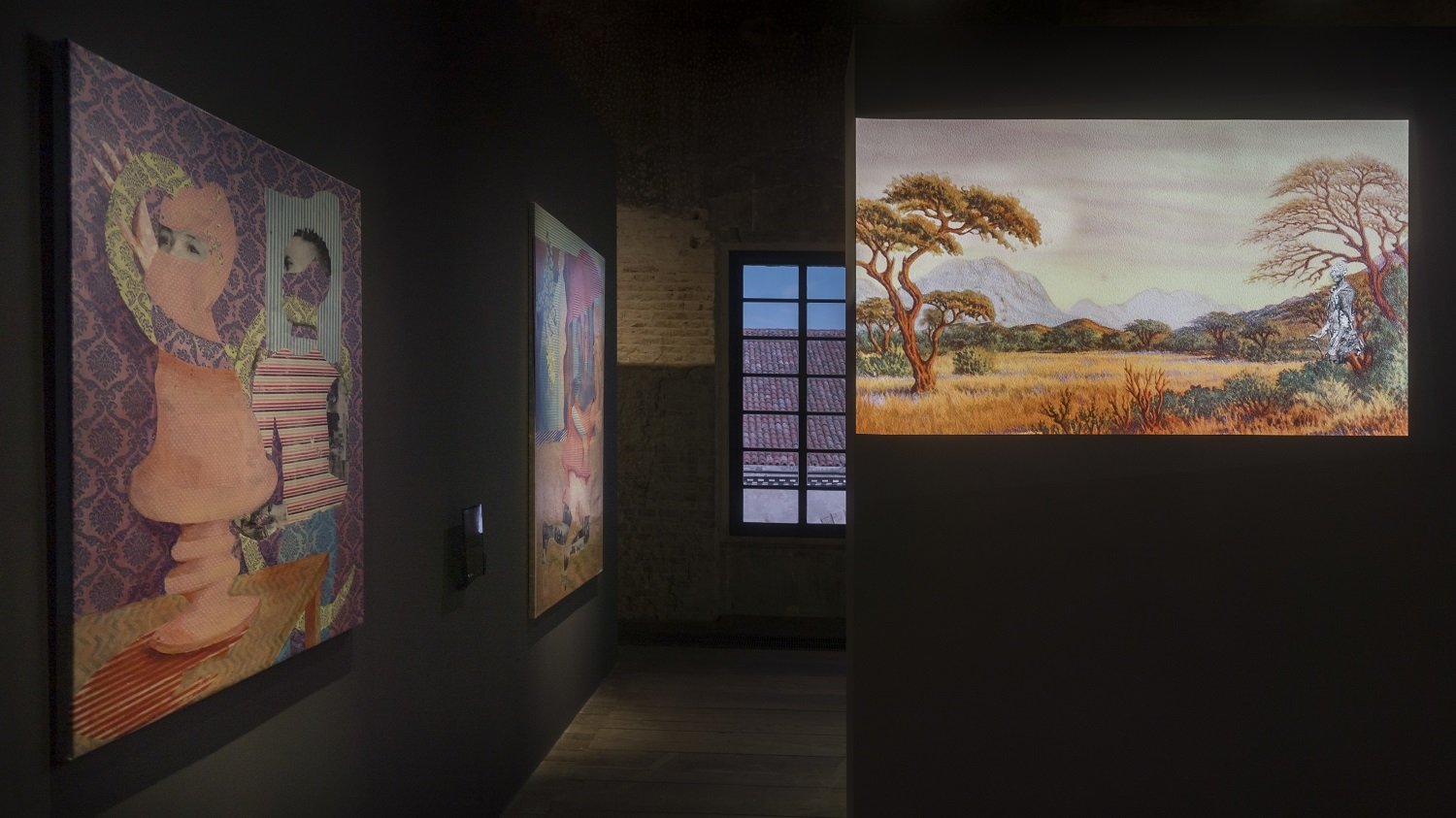
View of the South African Pavilion at the Venice Biennale 2022
In that year, the South African Pavilion, titled Into the Light, was curated by Amé Bell and featured artists Lebohang Kganye, Phumulani Ntuli, and Roger Ballen. Using quarantine as its conceptual background, the national pavilion engaged with the inner and outer lives of its exhibiting artists, relayed through the experiential dichotomies of reality and fantasy, the self and the other, connectedness and solitude.
The 58th Venice Biennale, held in 2019, titled May You Live in Interesting Times, was curated by American curator and previous director of London’s Hayward Gallery, Ralph Rugoff OBE. Its theme, suggested in its title, explored socio-political, economic and cultural realities that require critical thought of the world through the lens of precarity. The primary exhibition considered how art and activism, both situated at the threshold of political discourse, can, when merged, facilitate processes of alternative sense-making and contextualisation in a world permeated with contradictions and polarity. Dineo Seshee Bopape, Tracey Rose and Mawande Ka Zenzile were the trialogue of artists selected for the South African Pavilion, titled The stronger we become, which drew inspiration from (Something Inside) So Strong. The song, which became a political anthem, originally sung by British musician Labi Siffre and later by South African Afro-soul vocalist Lira, comments on the racial violence of apartheid. Curated by Nkule Mabaso and Nomusa Makhubu, the national pavilion foregrounded the unfolding notions of reconciliation yet simultaneously held space for the endurances of self-determination and social resilience needed in a time of neocolonialism, complex historical trauma and injustices. This was echoed in a snippet from the curatorial statement that reads, “The stronger we become leaves behind the ostentation of the consumerist world to understand the discord of contemporary life as a past haunted by its imminent futures. It is a space for raw, unembellished and frank conversation. It is in carving emancipatory spaces that resilience as resistance becomes possible. Within emancipatory spaces, the illusive becomes real and the concealed contradictions surface.”
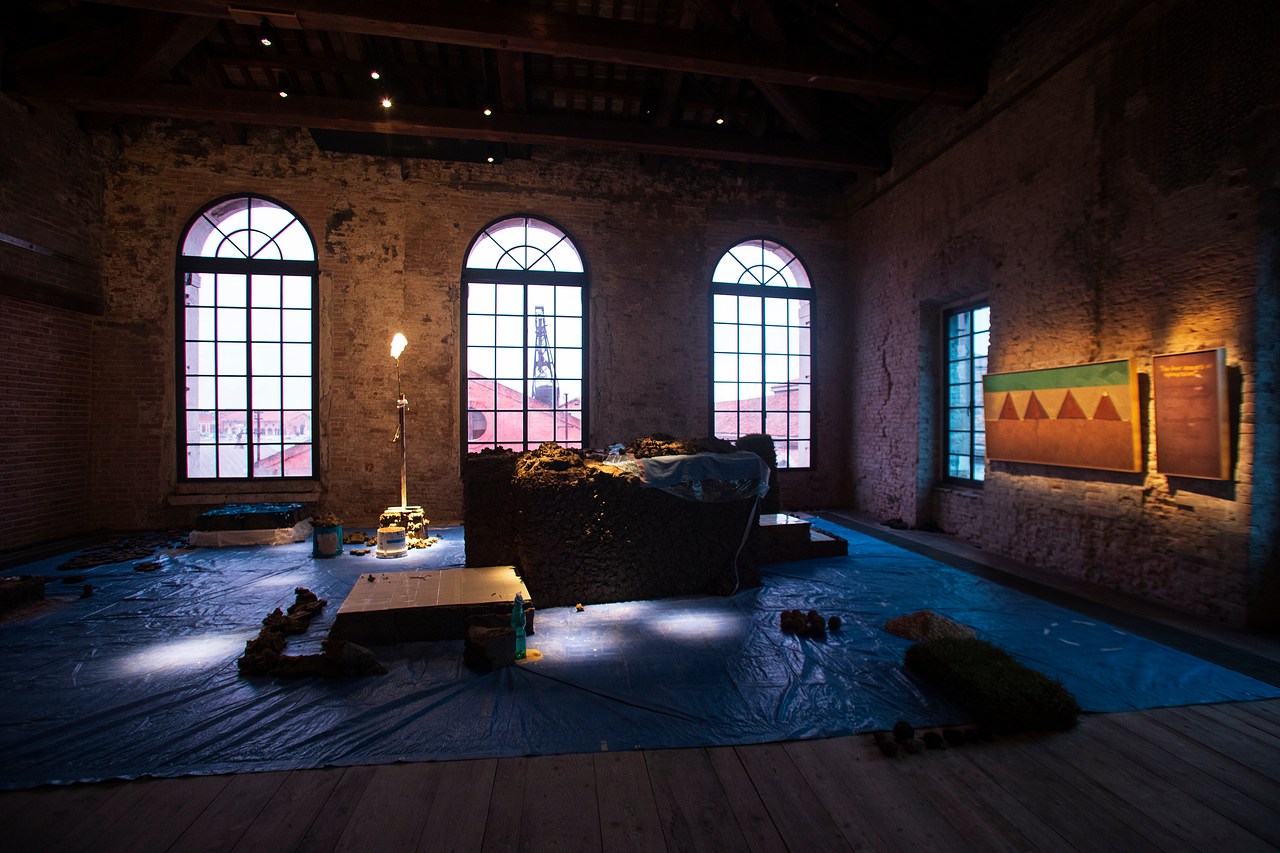
Installation View, The stronger we become, South African Pavilion, Venice Biennale, 2017
Curated by French curator Christine Macel, the 57th Venice Biennale, hosted in 2017, was titled Viva Arte Viva, to celebrate and extend gratitude to artists and the arts for contributing to expansions in perception and perspective. The underlying theme drew inspiration from what can be described as an inverted humanism – that is not defined by political and ecological anthropocentricism, but by acts of creative resistance that engender liberation. The South African Pavilion, curated by Lucy MacGarry, alongside assistant curator Musha Neluheni, responded to this curatorial vision, reflecting on the complexities of constructing selfhood and the unsettling narratives of forced migration and xenophobia. These thematics were realised through a duo exhibition that featured Mohau Modisakeng and Candice Breitz, whose works engage photography and time-based media, requiring a still interrogation with temporality.
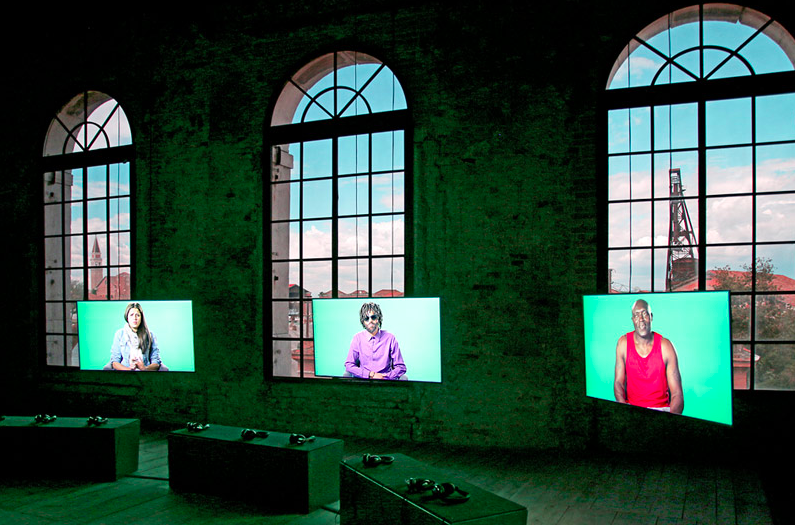
Candice Breitz, Love Story, 2016
In 2015, Nigerian art critic and curator, Okwui Enwezor, became the first African to curate the Venice Biennale under the theme, All the World’s Futures, which investigated how the internal sensitivity of the artist responds to radical ruptures in the societal fabric, in an age of hyper anxiety and pronounced inequality. In his introduction, Enwezor wrote that the principal question of the exhibition meditates on how art and cultural practitioners may “bring together publics in acts of looking, listening, responding, engaging, speaking in order to make sense of the current upheaval.” Guided by Enwezor’s curatorial vision, the South African Pavilion was curated by Christopher Till and Jeremy Rose under the theme, What Remains is Tomorrow. The pavilion sought to think alternatively about being in the world and about what it means to transcend the hauntology of past colonial and imperial horrors – those quick and slow violences that are witnessed as spectacle and the need to interrogate the porosity of nation-state borders that stir xenophobic rhetorics of insider and outsider narratives of belonging. Both of these contexts were relayed collectively through the artworks of Diane Victor, Mohau Modisakeng, Nandipha Mntambo, Gerald Machona, Haroon Gunn-Salie, Serge Alain Nitegeka, Brett Murray, Jo Ractliffe, Robin Rhode, Jeremy Wafer, Angus Gibson, Warrick Sony and Mark Lewis, and Willem Boshoff.
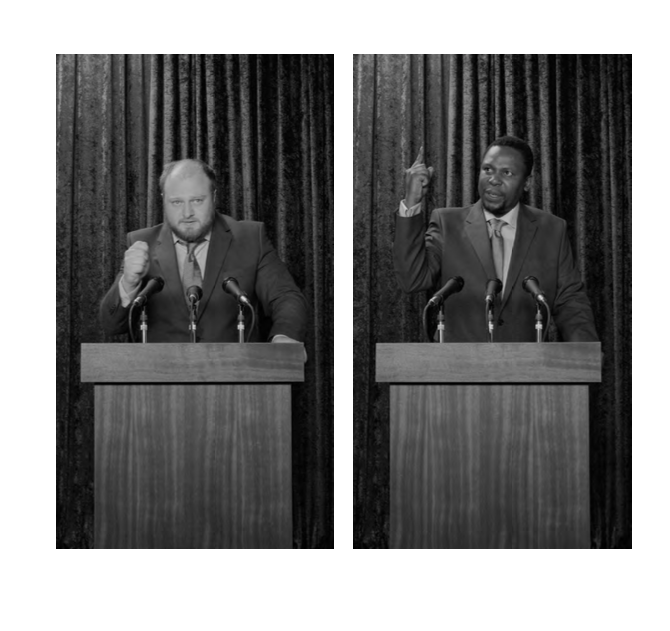
Brett Murray, Triumph, 2015, Dual-channel digital video installation, 6 min 48 sec
Held in 2013, the exhibition Il Palazzo Enciclopedico (The Encyclopedic Palace) took an anthropological approach to dream reality, to envision beyond what is. Investigating the human desire for the tangible and the knowable, the concept drew from a utopian dream of an imaginary museum that would embrace global epistemologies, by “bringing together the greatest discoveries of the human race, from the wheel to the satellite”, those already made and those yet to follow. The 55th edition of the Venice Biennale evoked this 1950s architectural model by Italian-born American artist Marino Auriti, who filed a design of the idea and its philosophical yearnings with the US patent office. The South African Pavilion, curated by Brenton Maart, was titled Imaginary Fact: Contemporary South African Art and the Archive and brought together artists Joanne Bloch, Wim Botha, David Koloane, donna kukama, Gerhard Marx, Maja Marx & Philip Miller, Zanele Muholi, Sam Nhlengethwa, Johannes Phokela, Cameron Platter, Andrew Putter, Athi-Patra Ruga, Penny Siopis, James Webb, Sue Williamson and Nelisiwe Xaba. The concept was influenced by the artistic practice of returning to the archive, as the use of bygone materials to provide commentary on contemporary happenings that are anchored to spectres of history. In this context, the national pavilion showcased a visual timeline documenting the shifting expressions in South African art, tracing back from the apartheid era to the promises made for the post-apartheid era with an implemented constitutional democracy.
The 54th Venice Biennale, titled ILLUMInazioni–ILLUMInations, focused on the innovations of international art in the era of globalisation and cosmopolitanism. The South African Pavilion of 2011, commissioned by Monna Mokoena and curated by Thembinkosi Goniwe, selected a trio of artists which included Lyndi Sales whose materiality merges art and science, Siemon Allen whose practice reconciles the aesthetic of the archival and the political, through a displaced and detached identity, and lastly, Mary Sibande, whose work explores the racial and gendered nuances of domestic labour by situating the Black female body as a site of stereotypes to be contested through counter-historical persona.
A sixteen-year hiatus was imposed on South Africa between the years 1995 and 2011. The country exhibited at the 46th Venice Biennale, themed Identità e Alterità (Identity and Alterity) in 1995. The exhibiting artists of the South African Pavilion included Brett Murray and Randolph Hartzenberg, alongside a solo exhibition by Malcom Payne, who also served as curator.
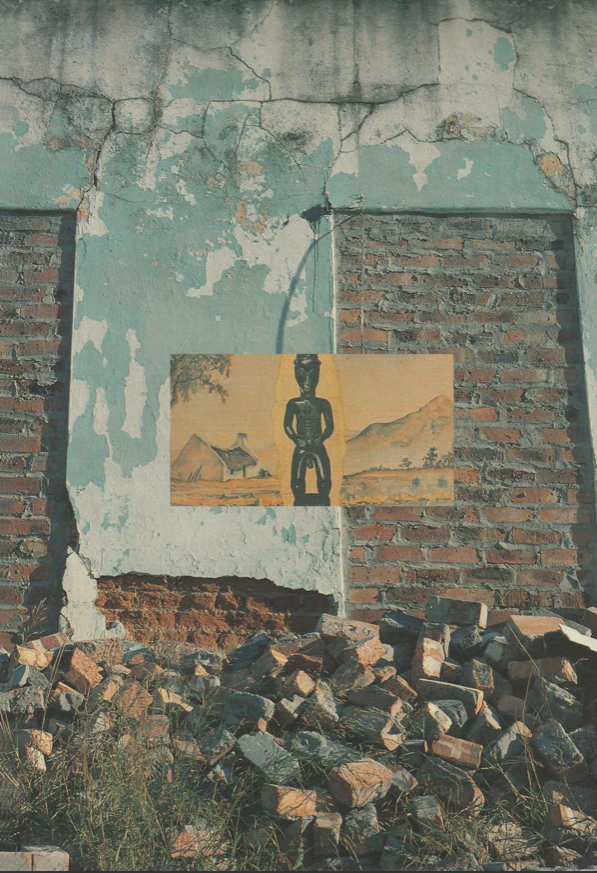
1995 South African Pavilion
Before that, in 1993, South Africa did not present a national pavilion at the 45th Venice Biennale, titled The Cardinal Points of Art. The South African Association of Arts (SAAA), as the selected curator, titled its presentation, Incroci del Sud: Affinities (Southern Crossings: Affinities), with artworks exhibited within three segments dispersed throughout the Biennale – in the Italian Pavilion with artworks by Sandra Kriel and Jackson Hlungwani, the Aperto with artworks by Bonnie Ntshalintshali, and the Fondazione Levi with the exhibition of 24 artists including: Willie Bester, Andries Botha, Norman Catherine, Keith Dietrich, Kendall Geers, Philippa Hobbs, Sfiso Ka Mkame, William Kentridge, David Koloane, Noria Mabasa, Trevor Makhoba, Johannes Maswanganyi, Tommy Motswai, Karel Nel, Tony Nkotsi, Malcolm Payne, Joachim Schönfeldt, Helen Sebidi, Mashego Segogela, Penny Siopis, Pippa Skotnes, Willem Strydom, Sue Williamson, Tito Zungu.
Reminiscing ten years back to 2016 on social media, trends of nostalgia underscore a symbolism of a society in stagnation – gripped by past contemplations, as global crises destabilised the axis of certainty. As demonstrated by both the historic primary and national thematics of the Biennale, arts can evoke dialogues about reimagined futures that may exist outside the spheres of violence, ecological collapse and the colonial. This can only be done through the often uncomfortable, yet necessary confrontation of the present. Artists then cannot be censored but must rather be allowed to continuously stay with the trouble, because, to quote feminist multispecies theorist Donna Haraway, “our task is to make trouble, to stir up potent response to devastating events, as well as to settle troubled waters and rebuild quiet places.”