Goodman Gallery
21.09 - 11.11.2023
Diffused late-September sunlight melts across the courtyard of Cape Town’s Goodman Gallery on the afternoon that I visit Unbind, a group exhibition bringing together key works by a selection of artists based in South Africa and Angola as well as artists from the diaspora. Anchored by the multimedia work of Franco-Algerian artist Zineb Sedira, Unbind brings into conversation a range of viewpoints on visual strategy in a postcolonial context – and what it may look like both to process history and to imagine liberatory futures.
On arrival, I first encounter a photograph from Angolan artist Kiluanji Kia Henda’s 2017 series In the Days of a Dark Safari. Foregrounded against a cheerful artificial landscape stands a taxidermied sable antelope, draped in a black shroud. The unknowable animal becomes an almost Vantablack void that demands the viewer’s gaze, complicated by a diorama-esque backdrop evoking the dusty violence of the colonial museum display case. With Dark Safari, theatricality and hyperrealism are in tension, rendering evident the potential for subjectivity, complexity, nonlinearity, fiction – and even absurdity – within dominant narratives of historical memory.

Sue Williamson, A Few South Africans- Nokukanya Luthuli, 1983. Courtesy of Goodman Gallery.
To the immediate left is Sue Williamson’s resurfaced body of work A Few South Africans, which honours impactful women of the liberation struggle – Nokukanya Luthuli, Winnie Mandela and Annie Silinga are featured here – who were rarely acknowledged in white-dominated press when Williamson undertook this project in the mid-80s. Featuring photo etchings collaged onto screen-prints, the portraits were widely distributed as postcards at the time. Viewing these artworks – just a few days past Heritage Day, 40-odd years after the pieces’ creation and 29 years post-transition, in a South Africa that continues to navigate through the albatross of oversimplified historical narratives – Williamson’s work lends new credence to public memory as a body politic. Its omissions or gaps not only merit acknowledgement but, moreover, function as grounds for enquiry unto themselves.
By this point, it is apparent that Unbind intends itself to be a container for multivalent understandings of African narratives. That is, it is no longer sufficient merely to deride either the fallacy of the old Dark Continent portrayal, or the populist view of postcolonial Africa as a lost Eden, or a failed experiment. Rather: what lies below, between and amongst those exhausted sites of discourse? What possibilities lie beyond them? The implicit preoccupation around which the artists of this exhibition orbit: how to document and digest an inherited subaltern past, whilst also divesting from its psychic and narrative chokehold? Throughout the exhibition, archival materials are elegant springboards for these acts of re-memorialising, re-contextualising, re-imagining.
In 1969’s Archaeology of Knowledge, Michel Foucault argues toward an historical analysis in which “statements” are made significant by their context: the archive less an immovable canon of source material than an ever-evolving, self-referential web. Such an understanding of archival material as an active experience of circularity is what theorist Jaimie Baron calls “the archive effect.”1Jaimie Baron, The Archive Effect: Found Footage And The Audiovisual Experience Of History (Oxford: Taylor & Francis, 2013). I’m thinking about this whilst watching Hand-Me-Downs, Yto Barrada’s single-channel video piece, which collates found footage and family/amateur images to recount and reconstruct autobiographical stories. Comprising 15 personal tales set during Morocco’s transition from colonialism to post-colonialism, the video evokes nostalgia – and troubles it. Images and audio narration fall in and out of sync, and the stories being told contain pockets of implausibility. The nature of memory is called into question, as is the unreliability of the storytellers. But can memory ever be entirely objective, linear, reliable?

Yto Barrada, Reprendre Casa, Carrieres centrales, Casablanca, 2013. Courtesy of Goodman Gallery.
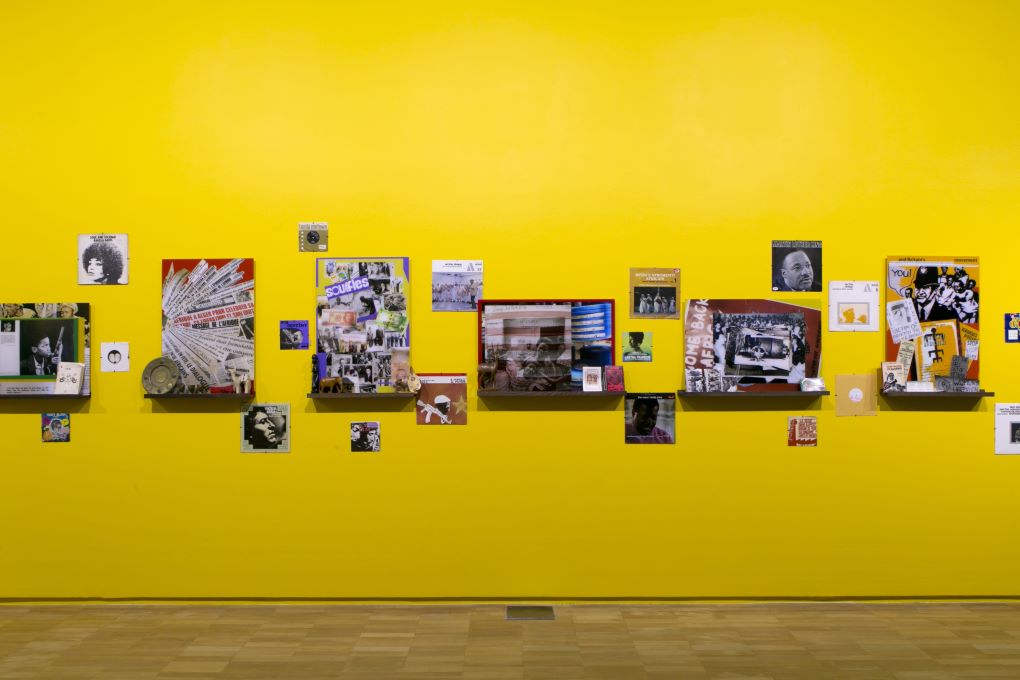
It becomes clear that archival memory emerges as testimony to an encounter, not as a stable statement of fact. And if that’s the case, to engage with archival artefacts – home videos, repurposed imagery, household items, anything given meaning by dint of its context – is to stage an embodied encounter with the archive. It is, as Sedira does, to take up the archivist’s mantle. The centrepiece of the exhibition is Sedira’s For a Brief Moment the World was on Fire, for which the artist has collaged archival images and texts into photomontages, then hung alongside wall-mounted vinyl records (largely from her personal collection of protest music) and shelves containing books and objets d’art. Throughout, the 1969 Festival panafricain d’Alger (PANAF) is a leitmotif. An inflection point of possibility and future-thinking, the historic 12-day festival saw delegations of thinkers and artists from each African country (and a diasporic contingent, including members of the Black Panther Party) converging in a newly independent Algeria to celebrate African identity, culture and pan-continental unity between liberation movements. Sedira’s installation—kaleidoscopic and richly layered as it is—offers a compelling visualisation of a thrilling historical moment. Archival photographs and programmes from the festival’s talks and events overlap with Cuban banknotes bearing the visage of Ché Guevara, Jimmy Cliff’s “The Harder They Come” on vinyl, maps, postage stamps, a Lonely Planet guide to Algeria, a vintage copy of Présence Africaine magazine with a cover article by Léopold Senghor, a compilation of Frantz Fanon writings and other ephemera.
Set against a bright yellow wall, For a Brief Moment feels expansive and exuberant. The work commands the space, both physically and intellectually. The moment it contains – one of revolution, independence, song, thought, literature – deserves as much. What were once just images and items of marginalia, souvenir or enjoyment have been reconfigured and reimagined; perhaps, too, the spirit and verve of PANAF may be a point of reference for a discursive future that is similarly audacious, communal, radically possible.
Sedira refers to her artistic approach as “joyful resistance.” This turn of phrase reminds me of the late filmmaker and activist Toni Cade Bambara’s words: “As a culture worker who belongs to an oppressed people, my job is to make revolution irresistible.”2Toni Cade Bambara quoted in Kay Bonnetti, “An Interview with Toni Cade Bambara,” Conversations with Toni Cade Bambara, ed. Thabiti Lewis (Jackson: University Press of Mississippi, 2012). The archive may be a great many things, often at the same time: political, fluid, reflective, contradictory, nostalgic, true, false, rife for interpretation. Above all, in Sedira’s hands, the archive is dynamic, alive – and it is irresistible.

Zineb Sedira, Black Panthers (from the series For a Brief Moment the World was on Fire), 2019. Courtesy of Goodman Gallery.