blank projects
06.12 - 17.01.2026
Following a successful solo exhibition, ‘Inzonzobila’ in 2024, Asemahle Ntlonti is set to present her third solo exhibition with blank, ‘Gqal’emgqubeni’ (6 Dec 2025 – 17 Jan 2026).
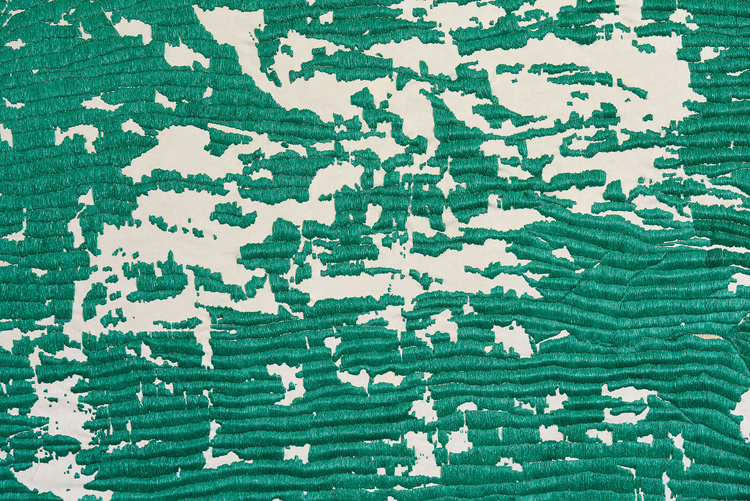
Working in layers of paint and paper, Ntlonti gradually builds up her works on canvas by intuitively applying and stripping away material to reveal chance compositions which refer to the textures and hues of the vernacular cob architecture found in the Eastern Cape of South Africa. Resembling topographical charts or maps, the paintings conjure landscapes imbued with nostalgia and longing, reflecting Ntlonti’s complicated relationship to her ancestral amaXhosa homeland, which is at once both familiar and strange. Through the act of stitching, Ntlonti seeks to mend, to heal over, the scars of generational traumas caused by the internal displacement and scattering of communities.
Here, Ntlonti answers five essential questions.
Your last show pushed boundaries in scale, form and material. What can audiences expect from this new exhibition?
I’m big on materiality and this show is a deeper exploration of ingxowa. It’s also me allowing myself to have fun. You’ll see that translation of scale, the movement between smaller and larger works, sculpture, and you’ll feel the stretch of my growth. Growth as an artist, as a creative person, and just as a human being, learning and unlearning. This show carries that energy of experimentation and expansion.
The exhibition title, Gqal’emgqubeni, feels deeply rooted in lineage. What does it embody or allude to?
For most of my life, Gqal’emgqubeni (Gqomgqayi, Chananatu) was the clan name I knew. Only recently, through research, did I discover that the correct form is Gqele ’emgqubeni. That small shift opened a whole world for me. I’ve spent years researching my people’s history, and I’m deeply troubled by the erasure of Black history — the gaps, distortions and silences that shape how we understand ourselves.
That’s why this project sits so close to my heart. The loss of accurate records created a huge displacement for many of us. So Gqal’emgqubeni speaks directly to that search for my ancestral home, but it also speaks to how we, as Black people, dig into our histories and our knowledge systems. It’s about the distance between how our ancestors lived and how we live now.
The show lives in that in-between — the pain, the dislocation and the grey space of what hasn’t been fully told or remembered.
What source materials became important to you during the making of this work?
I began the year with Dr J. J. Klaas’s Triangle of a Hundred Years’ Wars. It helped me understand the landscape of the Eastern Cape and the movement of people. He writes about a century of resistance against white settlers and how the land itself became a shield, a strategy for survival. That really challenged this narrative I grew up with, that we are a conquered people. Instead, I saw resistance everywhere.
This book also pushed me deeper into the questions I had about my own clan’s name, questions that have followed me for years.
I also went back to bell hooks’s Yearning. There’s a chapter that gave me goosebumps because she articulated my own feelings so clearly. She speaks of homeplace as a site of resistance, a place where we dignify ourselves, especially as Black women. That resonated so deeply.
Outside of text, my process is always a conversation with my ancestors. Learning to listen. Paying attention to the cues or instructions that come through in ways I can’t always control or predict.
Were there aspects of the process that you found especially challenging?
Once I know what needs to be done, that part becomes the easiest, because then it’s time for my team and me to sit down and embroider. As time-consuming as it is, that’s the grounded, predictable part.
The hardest part is always the conceptualisation. It’s a whole emotional cycle: searching for the idea (which can arrive in different ways), getting excited and thinking it’s brilliant, then hitting the phase of doubt and frustration and finally pushing through with grit.
If you’re impatient or under pressure, frustration will get the better of you. You really have to allow the idea to take shape in its own time.
What do you think abstraction has to offer today?
I can only speak for myself. Just like there’s no single rule when it comes to spirituality, there’s no single rule when it comes to abstraction. For me, abstraction is freedom. It allows me to speak to memory, to feeling, to spirit, without being boxed in by literal representation. It lets me honour what is present even when it can’t be named.