blank projects
29.01 - 14.03.2026
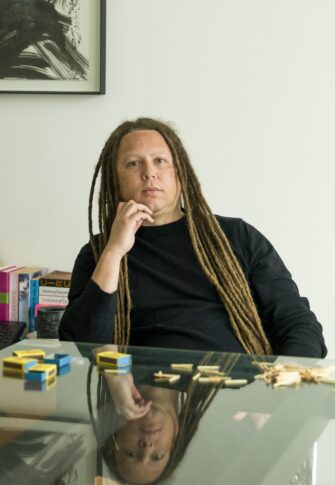
Gregory Olympio’s practice is an inquiry into ways of being in the world. His investigations are sometimes led by personal questions, and at other times, they are the result of universal and unconscious observations, both explorations treated with delicacy.
In this latest body of work, ‘Vaisseaux’ at blank, his fourth solo with the gallery, Olympio presents the reclining figure as a central motif. A subtle allusion to art histories of the painted recumbent body in renderings of devotion, intimacy and looking – from the Pietà to the odalisque and more contemporary meditations on rest and vulnerability. Aware of this lineage, Olympio draws on it only lightly, presenting his reposing figures in a quieter register where meaning is held in reserve.
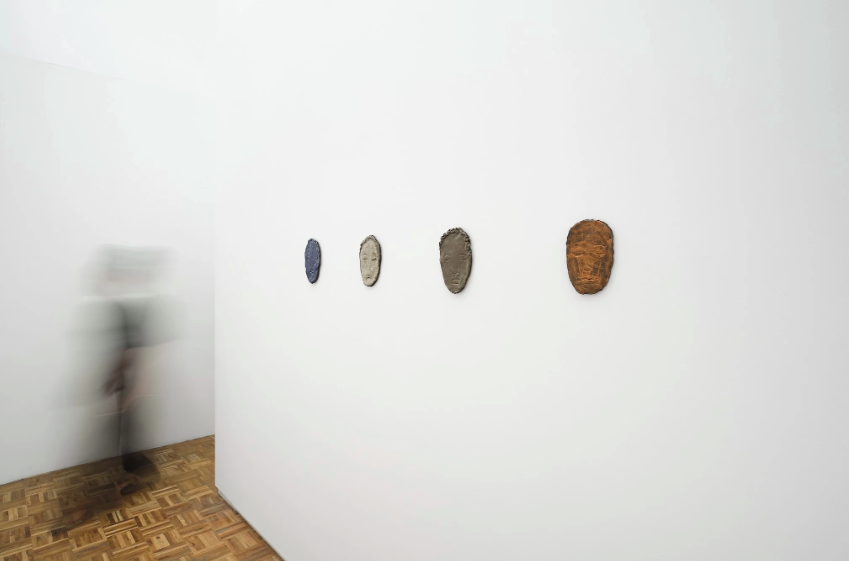
Installation View | Gregory Olympio, ‘Vaisseaux’, blank projects, Cape Town
This is your fourth solo exhibition at blank, following ‘Ceux qui sont partis et ceux qui sont restés’, ‘Ligne’ and ‘Lisière’, all of which were painting shows. Here, alongside paintings, we encounter some ceramic works in the form of apparitions. Can you tell us about these works?
For some time now, I’ve wanted to share something other than painting with those who encounter my work. I sometimes experiment in the studio—mini-installations, texts—but it all remains quite anecdotal. This time, these clay faces came about rather naturally, almost by accident, but I quickly felt they had something different to offer. These clay faces primarily prompt me to question myself; using a new medium brings new sensations and thus opens up a new way of seeing the world. I hope they also complement the language of my painting.
What draws you to the figure in your work? In particular, the reclining figure in this exhibition?
How can I explain this? I imagine the human figure is almost a logical subject for me, as a human being. But I would like to say that I’m not specifically trying to represent humans. Rather, I’m trying to question existence; and the practice of painting is a way of observing and experiencing being alive.
Regarding the figures at rest, I would say that for some time now, I haven’t been trying to put my characters in particular actions; this has to do with this desire not to represent. So, as in previous series, my characters are in an inactive state. A state of latency. But they are still there, and their presence in the world is important. That’s why what surrounds the characters, the colour, is just as important as the characters themselves.
These paintings are not simply characters in a field of colour. They are also fields of colour sheltering characters. The whole thing forms a unified whole.
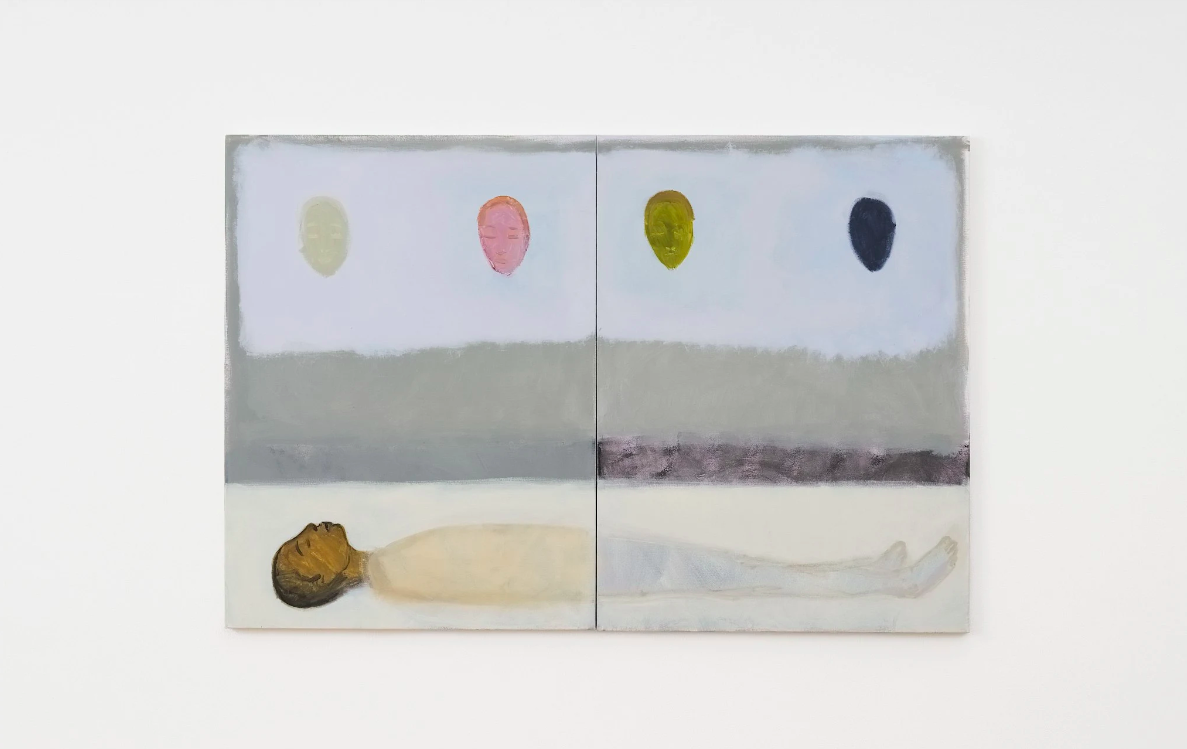
Gregory Olympio, Étranger, 2025
In this show, you work across different scales, and some works appear merged or split apart (such as Alédjo or Étranger). Can you tell us how you think through scale in your practice?
I work at different scales, and my compositions are often linked to the size of the canvas. Colour doesn’t inhabit a 50-square-centimetre space in the same way as a 1-square-meter space. The largest works in the exhibition are all diptychs. Again, this is the result of explorations in the studio. It turns out I had several canvases of the same size, and I wanted to try a larger format, so I tried placing two of these canvases side by side, and that’s how it all started.
I chose to keep this composition made up of two halves because this separation in the middle feels important to me.
There is a sense of restfulness or composure in the images where we clearly see faces (especially the heads), and yet this restfulness also presents itself in a very eerie manner – perhaps suggesting death? Can you speak to this juxtaposition?
I’m glad you feel calm and serenity. I strive for this serenity, as well as neutrality in the expression of my characters.
I was thinking a few days ago that on social media and in the news, we too often see bodies in action, suffering, or agitated. It does me good to feel calm when you enter the exhibition space. As for whether they are sleeping or dead, I leave it to each person to take the time to look at them and decide. But in both cases, they are here with us.
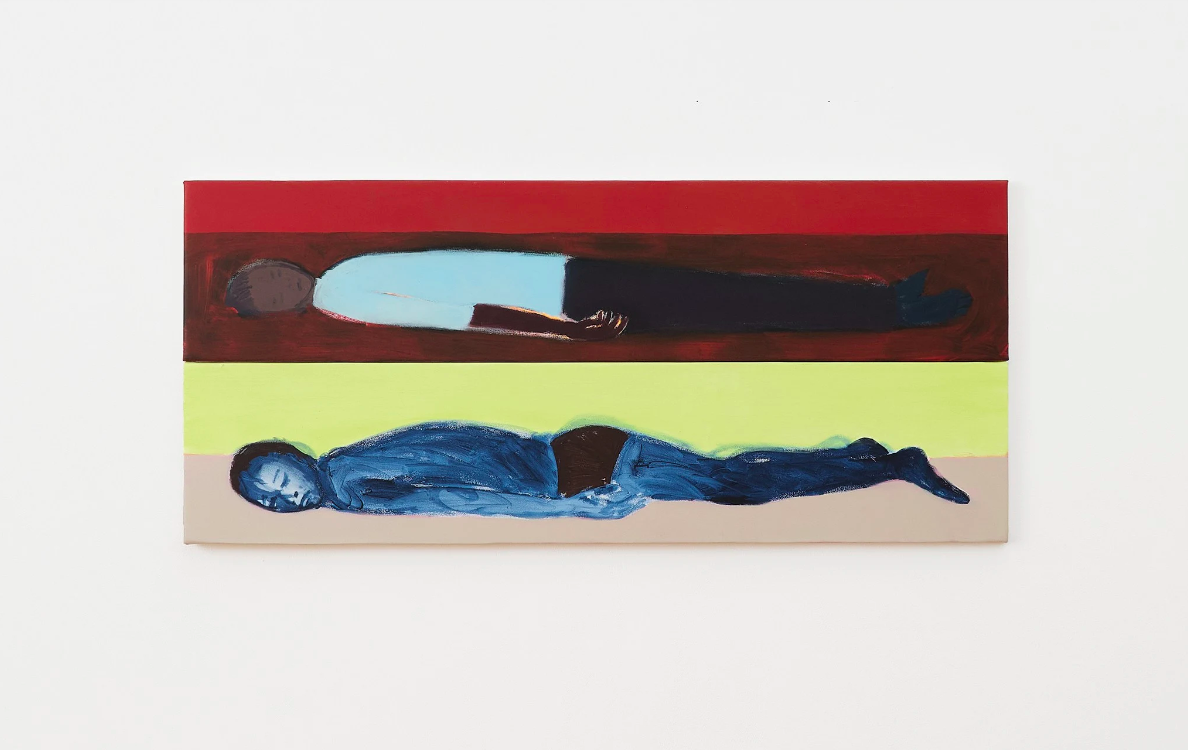
Gregory Olympio, Corps Couchés, 2025
There is an intensity in how you use the colour red in this body of work, in Corps Couchés or Terre Rouge, for instance. There is a potency in these works that does not present itself in the other images. Can you tell us about these two paintings?
It’s interesting that you mention these two paintings. I wanted to show them because red isn’t an easy colour for me to work with, especially a bright red like that. So, it was a bit of a challenge for myself, for my eyes to accept these paintings. I could have changed the red in the process, but I felt that in these two paintings, red had its place and something to tell me. I don’t paint using colours for their meanings; colours often impose themselves through experience or chance, and if they evoke an emotion in me, or if they seem legitimate, then I let them be and express themselves. And I find that despite the bright red, these paintings are neither violent nor aggressive. What do you think?