breakroom
15.02
Alia’s practice is a laborious movement through location(less) spaces organised within large installations and ambient collages of sound. Manoeuvring between decay and sustenance, her work encounters an assertion of material agency and ethics of care. To speak-with and re-member the deaths, labour and grief, situated as a passage or site of conquest, as to navigate the residues of her familial histories. Alia investigates the structures or agendas of the ‘postapartheid’ and ‘postcolonial’ through practised Cape Muslim rituals.
Her latest exhibition, ‘hayth taksib eishka, abqa’, is an installation structured after the rhizome, a continuously growing horizontal underground stem with lateral shoots and roots at varying intervals. She uses ginger and bamboo, both rhizomatic plants, to trace familial narratives of place and belonging.
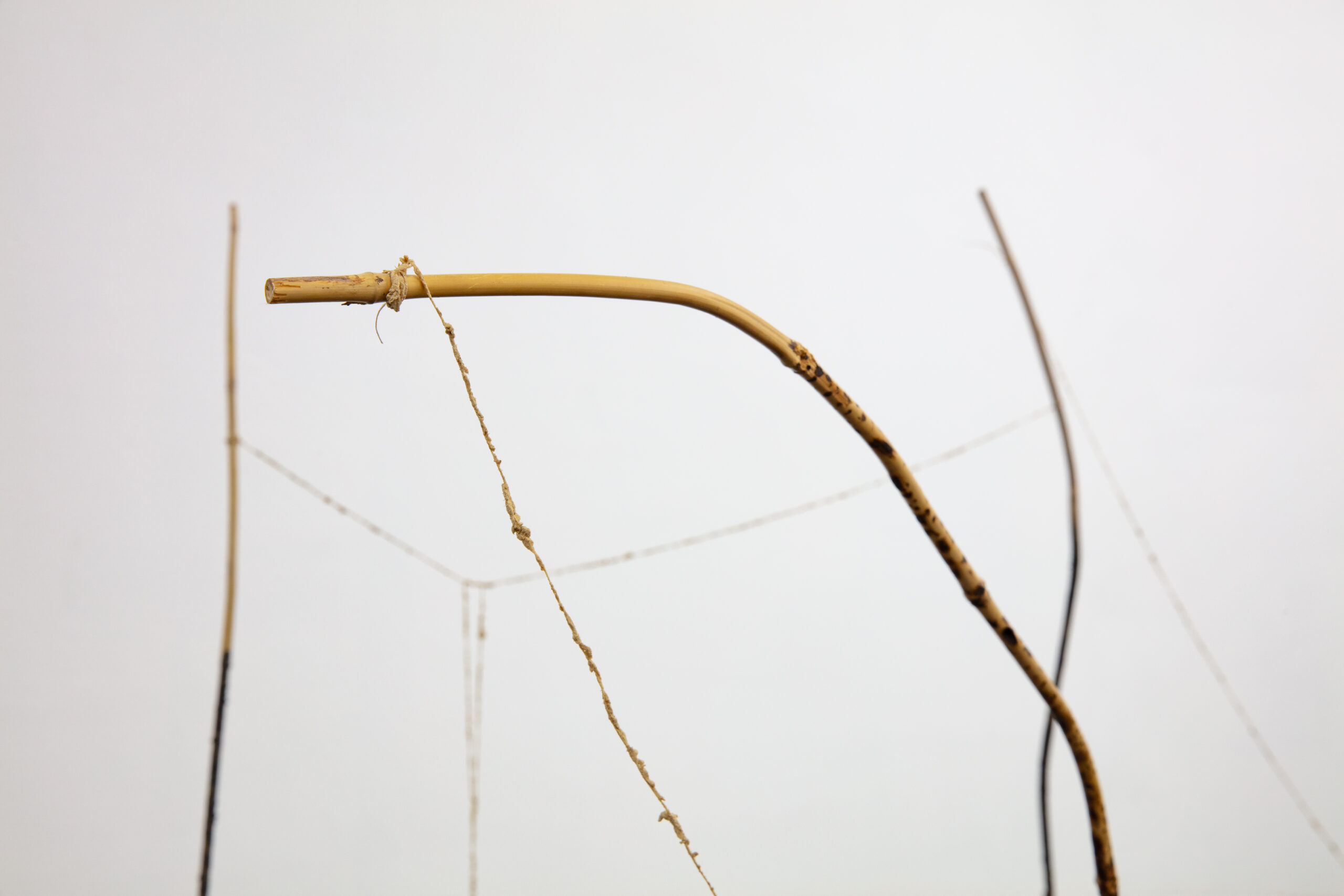
Alia, ‘hayth taksib eishka, abqa’, 2026, Bamboo, charcoal, nigella sativa and ginger powder, site-specific installation. Photo, Mario Todeschini. Courtesy of the artist and breakroom ©
The work you are presenting at breakroom is titled, ‘hayth taksib eishka, abqa’ – where you get a living, remain. Can you tell us a bit about this idiom? Perhaps what it means and how it has guided your thinking in making this work?
I recently visited my great aunt, before she passed, who told me of this farm she and my grandmother worked on as children (around 1935), just outside of the Kruger National Park. Their labour consisted of weeding and packing crops, such as sugarcane, but also bamboo, which was an alien plant (originally brought to South Africa in 1653). They had plenty of European/western visitors to the farm, considering its proximity to the park, but it was always affronted with this ploy between being marketed as ecological preservation and settler land occupancy. And she drew parallels to the park – possessing and detaining bodies under the agenda of power and capital, yet arranged it as though it were conservation. She articulates this violence to equate to “harvesting” – “to pick and add to the collection”. And it was repetitive and unrelenting. When asked, how do you move away from something that you can never escape? She said: “you learn to make do”. Not because you possess the agency to “accept”, but because there is no alternative.
The phrase, ‘hayth taksib eishka, abqa’, connects to what my mama used to say: “al harakah barakah”. This is to suggest that movement is a form of grace, and by extension, a mercy or a privilege that not all can access. My aunt extended the rest of this phrase to mean: “where you get a living, remain”. Out of necessity and the inability to move in search of survival, one must stay. In the trajectory of her life, I see this to mean “where you are harmed the least, wait for as long as you can”.
I am interested in how you describe the labyrinth as “a collection of paths, making a structure, that orders bodies in spaces, to reach a specific point”. But you also make a distinction between the maze and the labyrinth – one as a path with a dead end, intended to deceive….the other a path of twists and turns that could lead a journey toward one’s innermost self. How might one hold ideas of the labyrinth vs the maze vs/and the rhizome as social structures or philosophies for approaching art-making (and maybe even being)?
I think this work struggles between the maze as an allegory of power or an occupation, and the labyrinth, which is less about “trickery”. The labyrinth seems to reject the social order of the walker and the one with the map. It is about walking and following to the “centre”, which we are actively and never-endingly reaching. Though it may be fixed in a space, physically, it is never fixed in time. One may do this walk over and over, reaching this “middle” and finding nothing. It is not about immediacy. A labyrinth is much like becoming, encountering the interconnectedness of all things around and with oneself in mutual co-constitution. In the same way, a labyrinth may be “one” path, but consider many strands, in a spiral (or in this case, a semi-spiral), in which nothing is truly linear and separate. Similarly, I think artmaking involves encounters with collections of things. I am just witnessing myself following the surface of these materials, with no set start or end. I sometimes like to think that they are conversing beyond the structures of what I will never understand.
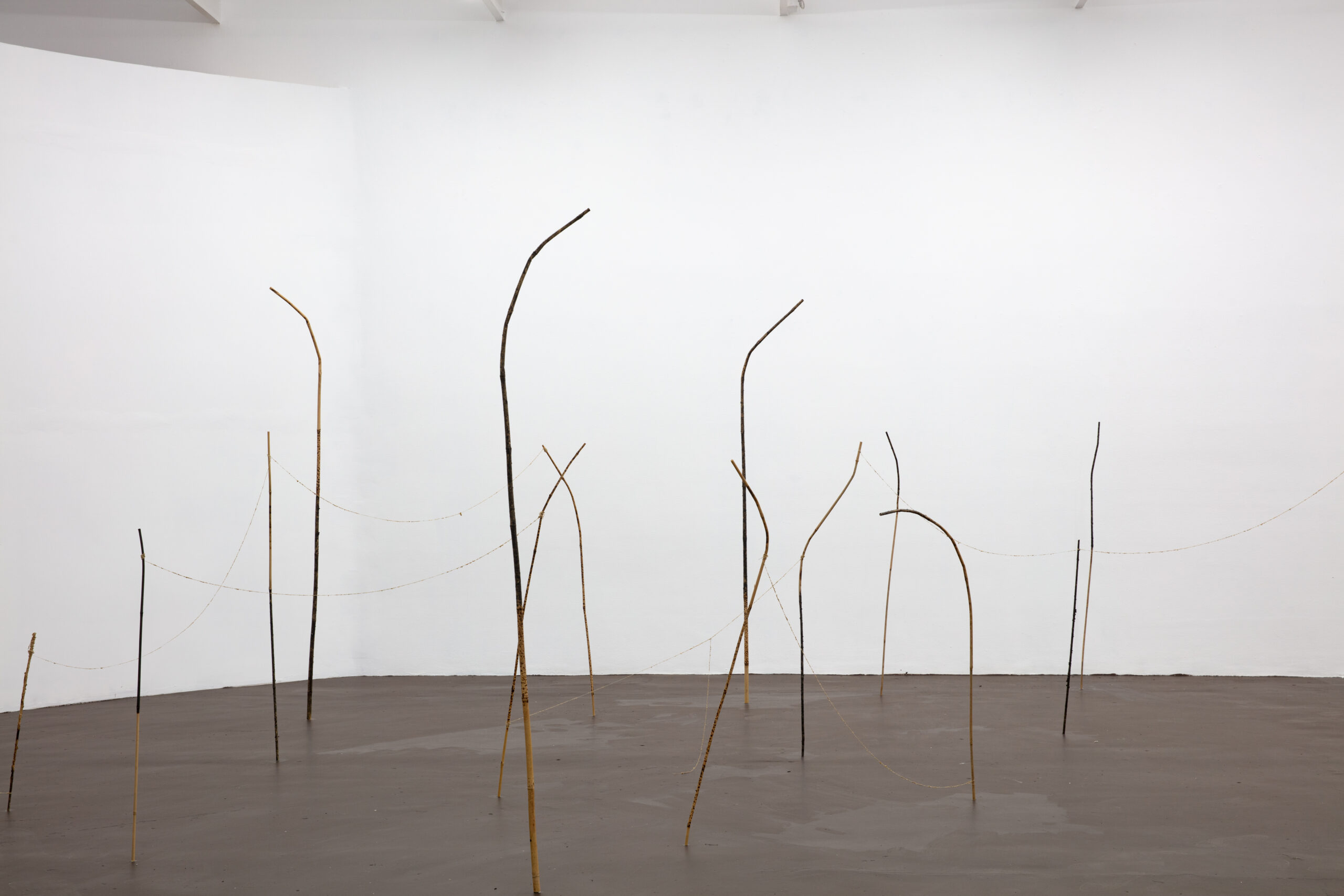
Alia, ‘hayth taksib eishka, abqa’, 2026, Bamboo, charcoal, nigella sativa and ginger powder, site-specific installation. Photo, Mario Todeschini. Courtesy of the artist and breakroom ©
Can you tell us about the use of ginger and bamboo as materials in this installation? What is their significance, and how do they bring you closer to rhizomatic thinking?
Both materials are in reference to plants and spices brought by European “visitors” to the farm, at the time, trying to cultivate the perfect environment for alien species to grow, but inadvertently failing to do so because of the drier climate. My great aunt would take piles of discarded ginger and broken bamboo and play near a dilapidated alcove, to the far left of the farm, out of view, and observe the “roots” (or rhizome) of the ginger and the starch inside of the bamboo. She would draw them into the ground or hide them for later. And when she was found out, the farmowners used these same materials to punish her.
These moments made it into her own collection of bamboo, which she burnt each time she remembered the past. Eventually, she carved bamboo that she used as walking sticks.
After conversations I had with members of her community, I got whole ginger to grind down into a powdered form, swung from one stick to the next, as a barrier, and spread over the floor, so that when you walk through and reach the middle, you carry it under your feet.
It is to leave a prominent reminder, to never forget. Rhizomatic thinking rejects hierarchical heteronormative models, which may situate us within paralysing bounds of forgetfulness and leaving things behind.
The bamboo that you source is from George? What we might call the starting point of the work is a farm where your great aunt lived just outside of the Kruger National Park. And yet the bamboo plant and ginger are connected to subtropical areas (India, Malaysia and Indonesia). Can you tell us a bit about how you think about place, the land, “the natural world,” and interconnectedness through this work?
I think of displacement. The plants are all taken from various spaces, travelling along the Indian Ocean and forced to be where they did not come from, in ways they did not ask for.
Within this installation is a sculpture made with Nigella sativa and charcoal. Can you tell us a bit about this work? Can you speak about the sound aspect, and perhaps more generally, how do you think about sound conceptually?
In our encounters, my aunt would gesture the shape of the fallen alcove with her hands to explain how it would look. In turn, she made a long scooping motion. Though it may also seem like a boat or something that holds and carries. The work is made from nigella sativa (black cumin seeds), which are said to heal every illness but death. It is also made from the char of some of the bamboo sticks, which were lit aflame during the process of burning marks into the bamboo. The char is layered on the sticks that make up the installation. The seeds came in from two conversations I had with members of her community: Mr Ndlovu, who measured the steps she took in the last few months of her life and Tannie, who used the oil extracts of the seeds to rub into her wrists before she slept. Inside this made-up alcove is a sound piece, collaging recordings of me collecting the sticks from various farms. I have been using sound as an echo of the site or a product of the environment. It holds transience, forcing us to listen rather than (just) look.