Goodman Galllery
31.01 - 07.03.2026
Guy Simpson’s practice merges documentation and abstraction, translating photographic record into dense, materially layered, innovative and often sculptural paintings. By focusing on the minutiae of the spaces we inhabit, he offers an understated and tactile meditation on the transitions of places and communities.
‘Was Here’ brings together a group of paintings created by Simpson towards the end of 2025. Simpson has witnessed acute examples of Johannesburg’s shifting suburban landscape: shrinking diasporic communities, dislocation and generational shifts in ideas of belonging. In this show, he reflects on the school bus, which passed through Goodman Gallery every morning, that took him from the suburb of Orange Grove/ Sydenham in Johannesburg to the Jewish day school he attended, King David Victory Park (KDVP). He turns to the now-empty grounds of his former school, whose recent and controversial closure highlights the contraction of Johannesburg’s Jewish community. Before the site was vacated, he photographed and archived the campus, revisiting his ambivalent relationship to Jewish schooling as a way of thinking through broader changes in the community – shrinkage, securitisation and ideological divergences between schools. He notes that such politics are embedded in the spaces he paints.

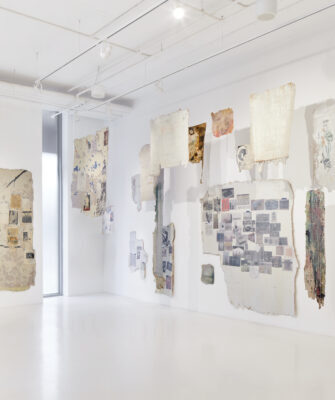
Installation View | Guy Simpson, ‘Was Here’, 2026. Goodman Gallery Johannesburg
How does it feel to be back showing in Johannesburg after your successful presentation at RMB Latitudes Art Fair in 2025, where you presented a series of works that drew inspiration from Louis Botha Avenue and Orange Grove.
Showing in Johannesburg is always a treat for me. It feels very right, like the artworks are home, because they’re about where I grew up and how I grew up. So, it makes sense in that way.
Latitudes was really a perfect little moment for me. The works were about Orange Grove/ Sydenham. I’d never really had a big presentation in Jhb, and the fair took place just around the corner from where I grew up, so everything just aligned. The audience really responded to that; it felt really special.
I was really struck by the work, ‘Part of the Shul’s Mozaic’ made from acrylic, wall paints and crafting sand on cut and layered canvas. The detail is impressive. Visually, it feels quite different and carries a different energy than the other works in the show, which are much more subdued. Can you tell me a bit about this work?
I agree! Part of the Shuls Mozaic does act differently from the other wall works in the show, but also feels like a natural progression of the process that I’ve developed. Usually, when I’m looking for walls to create these layered paintings from, I’m looking for cracks, chips or discolouring on the surface of walls. When I came across this mosaic on the outside wall of the shul, I knew immediately how it would be done. Although it doesn’t directly show a moment of decay like other artworks, it shows a section of a wall that may no longer be there for much longer, as the property the shul resides on, King David Victory Park (KDVP), has closed and is up for sale – its future is very unknown. I thought it was worth recording, while at the same time, learn a new technique to add to my bag of tricks.

Guy Simpson, Part of the Shul’s Mozaic, 2025
Holistically, this show feels much more expansive in your exploration of colour and composition. There are quite a few works that diverge from each other, for instance, the Blackboard works vs the more chestnut and rustlike works. Can you tell us about these shifts?
In the past, I’ve worked with much smaller spaces, my childhood home, for example. Now, an entire school, there’s a lot more detail and texture and moments to capture, to build the world. I need the blackboard, the face brick, blue blinds and pleather seats to build up a version of the space that feels honest. KDVP was an important space to many generations of the Jewish community here in Joburg. I want to do it justice. It doesn’t just feel like it’s for me this time. It’s a shared experience.
I am also intrigued by the title of the show, ‘Was Here’, alongside the small work (15.5 x 13.5 cm), ‘Sam was here’. Am I right to read it as a kind of assertion to space, maybe even time? Can you speak about this title?
I think my artworks have an element of time travel to them. On one hand, I’ve captured the space in the present moment. The ‘Here’ of the title. On the other hand, I’m reminding myself of everything that happened in that space. There are 20-year-old memories that come up, that’s the ‘Was’ in the title. So, you’re right, I am speaking to space and time. The school now and then. When I noticed the “Sam was here” written on the blackboard, I thought that was something special to highlight. I don’t know who this person is, but I can relate. I went to that school, and I had that experience. I was also there. Maybe, like Sam, I want to be seen too.

Guy Simpson, Sam was here, 2025
Can you tell us about the idea of ‘change’ and how you think about it in your work?
I think that change is the only constant; it’s reliable like that. When I’m cutting and layering canvas to create a crack based on a wall that I’ve seen, I know it won’t be there forever. The crack will change; it will grow or get repaired. I want to show it before that happens. It’s like trying to capture lightning in a bottle. Change is the story I want to tell. The South African Jewish Community is witnessing change in very real time with the closure of KDVP. For me, it’s like a physical representation of what people might be feeling and experiencing. When I heard the school was closing at the end of 2025, I knew I had to go there, take pictures and create these paintings. This was the moment to catch that lightning before it got demolished, sold or forgotten.