blank projects
28.05 - 04.07.2026
‘Photography changes our awareness of beauty and hope’ – Robert Adams
In his latest solo exhibition at blank in Cape Town, Thembinkosi Hlatshwayo offers us fragments of a family biography through images that speak to memories of his father, who has since passed. In another sense, the exhibition offers a rethinking of how photography can be rendered and interacted with. Pigment ink on rags and paper reflects a complexity in what images and stories, materials are able to hold. His way of handling material produces a visceral quality that pierces directly at what we see and what we remember. And somehow everything is fragile, obscured, unknowable.
The work I first became familiar with, ‘Slaghuis’, at times very difficult to look at due to its unflinching confrontation with violence, placed the artist squarely in my mind as someone in the business of showing the gritty… He was not trying to soften or coat anything, just show things exactly as they are. And yet even within that brutal work, there was a kind of ethics of care – an aesthetic that did not render the brutal as inhumane. In ‘Song 1: To be left behind’, Hlatshwayo is even more contemplative, evidently, not only regarding the construction of personal histories through imagery but also of the process of constructing the image itself. To be incredibly dull and obvious about it, his medium is the message.
Writing on the medium, curator and author Marvin Heiferman noted that ‘photography, in all its forms and guises, has been notoriously difficult to assess.’ This difficulty, what we might call stickiness, is precisely what I find interesting in Hlatshwayo’s show and his practice. I’m drawn to how he continues to innovate within the medium, turning it around, breaking things and piecing them back together – with some parts missing.
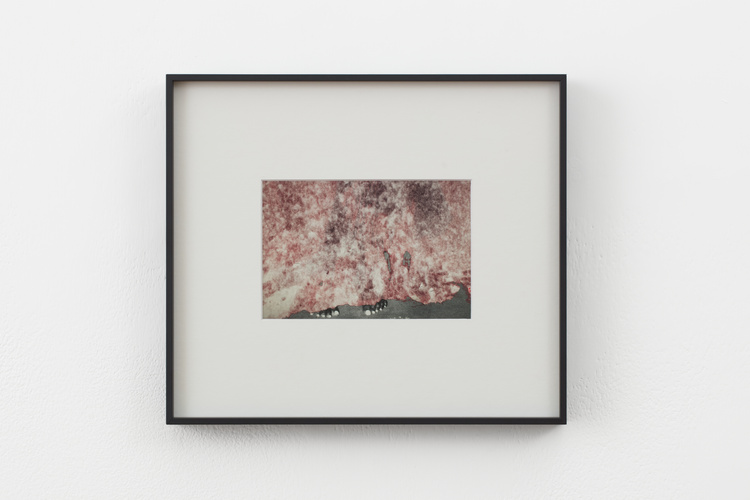
Thembinkosi Hlatshwayo, Bulelwa (2024). Pigment inks on cotton rag 310gsm, 28 x 32 x 3.5 cm (framed)
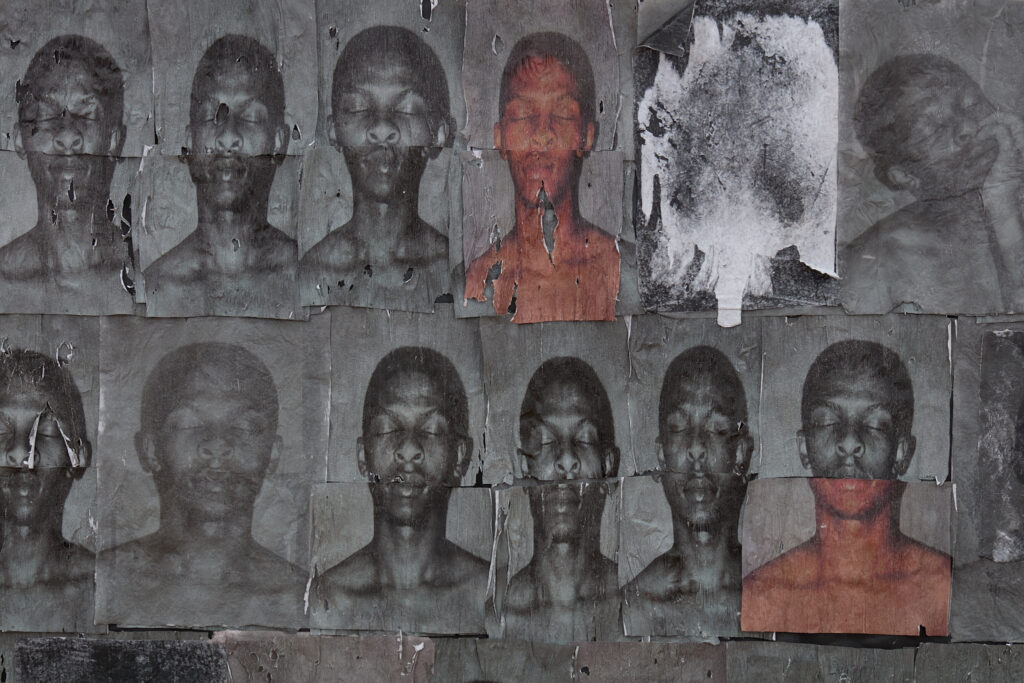
Through his fractured approach – a partial figure mid motion, serialised self portraits, and what is that? Toes partially veiled? – Hlatshwayo seems to be poking holes in the adage that we need to see more to know more. He seems to be suggesting that there are, in fact, times when the whole (the full picture, as it were) is less than the sum of its parts. It is interesting too to trace his shifting mood through how he chooses to title the work- ‘I dreamt of a greying world’ – speaking to fading hopes in a difficult world, ‘Young Father’ and ‘Inkumbulo’ [memory], perhaps evoking ideas of lineage and survival, set against much more cynical feelings; ‘The Void’, ‘Taking a piss’ and ‘Sobaleka’ [we will run]. Throughout the show, what echoes is the conversation with his father, or more broadly, the figure of the father.
If Louise Bourgeois was obsessive about the mother, as indispensable and useful as a spider, Hlatshwayo hints at the father as an unstable symbol… through grief, loss and the potential for restoration. For me, part of the title ‘To be left behind’ suggests a kind of passivity or at least a sense of accepting a state of circumstances without resistance. By choice, fate, the choice of Gods… death, the father is rendered absent, and painfully, one is left behind. What Hlatswayo can do then is to memorialise. He takes self-portraits (a stand-in image of his father), multiples them and stretches them across the wall as a collaged memorial. The result is unsettling, evoking feelings of death itself. Unsettling and almost beautiful. I say almost because to be fully and perfectly beautiful would be to resist the potential for rupture, which is a necessary condition for creation… for life.
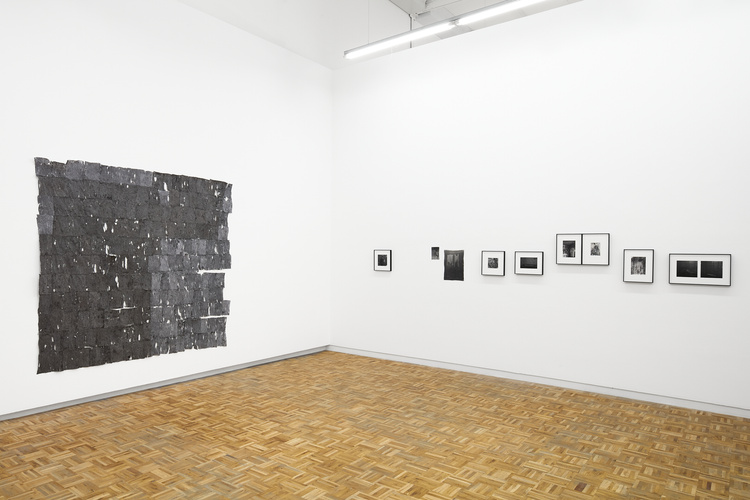
Thembinkosi Hlatshwayo, ‘Song 1- To be left behind ‘(2026). Installation view at blank projects, Cape Town
Through its poeticism and subtle hints, ‘Song 1: To be left behind’ reminds us of the possibility of expanding our consciousness by taking in the reality of others. Hlatshwayo, himself a father, wrestles with his being by reflecting on his father’s life. We, in turn, can reflect on our being through the faces, torsos, toes and tiny objects from his life. We see the image and imagine the emotional state that led to its creation.
As he moves across different forms of experimentation, what remains consistent in Thembinkosi Hlatshwayo’s practice is the feeling of trying to figure (some)thing(s) out. Perhaps he is trying to figure out the truth between the image and experience. Between the personal and the universal. Between the sacrosanct and the mundane. When I look at his work, at particular moments, what I am trying to figure out is the relationship between beauty and hope.
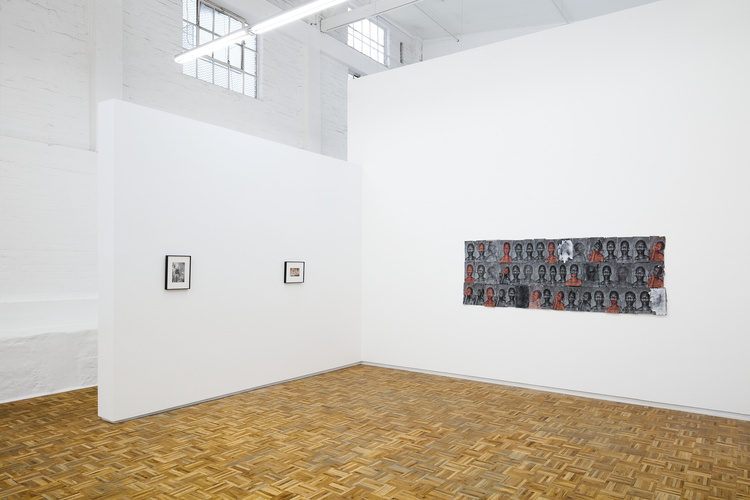
Thembinkosi Hlatshwayo, ‘Song 1- To be left behind’ (2026). Installation view at blank projects, Cape Town