AVA Gallery
18.06 - 30.07.2026
Opacities can coexist and converge, weaving fabrics. To understand these truly one must focus on the texture of the weave and not on the nature of its components. For the time being, perhaps, give up this old obsession with discovering what lies at the bottom of natures… Thought of self and thought of other here become obsolete in their duality…. What is here is open, as much as this there. I would be incapable of projecting from one to the other. This-here is the weave and it weaves no boundaries.
Édouard Glissant, in Poetics of Relation1Poetics of Relation. (Translated by Betsy Wing). University of Michigan Press, 1997.
We must return to the point from which we started. Diversion is not a useful ploy unless it is nourished by reversion: not a return to the longing for origins, to some immutable state of Being, but a return to the point of entanglement, from which we were forcefully turned away; that is where we must ultimately put to work the forces of creolization, or perish?
Édouard Glissant, in Creolization in the Making of the Americas2Glissant, Édouard. Caribbean Discourse: Selected Essays. (Translated by J. Michael Dash). The University Press of Virginia Caraf Books Series, 1989.
‘Paivapo (There once was …)’ is a solo exhibition by Zimbabwean-born, Cape Town-based artist Pyda Nyariri, at the Association for Visual Arts (AVA) in Cape Town. The title teasingly positions the artist as storyteller, authoritative narrator of a cautionary tale rooted in indigenous knowledge systems. Within this frame of reference, the viewer expects guidance towards a cocooned, dark, womb-like place of safety or, at the very least, a place of firm ground. The tale, about an elusive character called Pidgin, will ostensibly demonstrate the consequences of transgressing a boundary: “Listen to your elders,” in other words. “Look at what happened to adventurous Pidgin. Don’t go astray. This is what will happen if you do.”
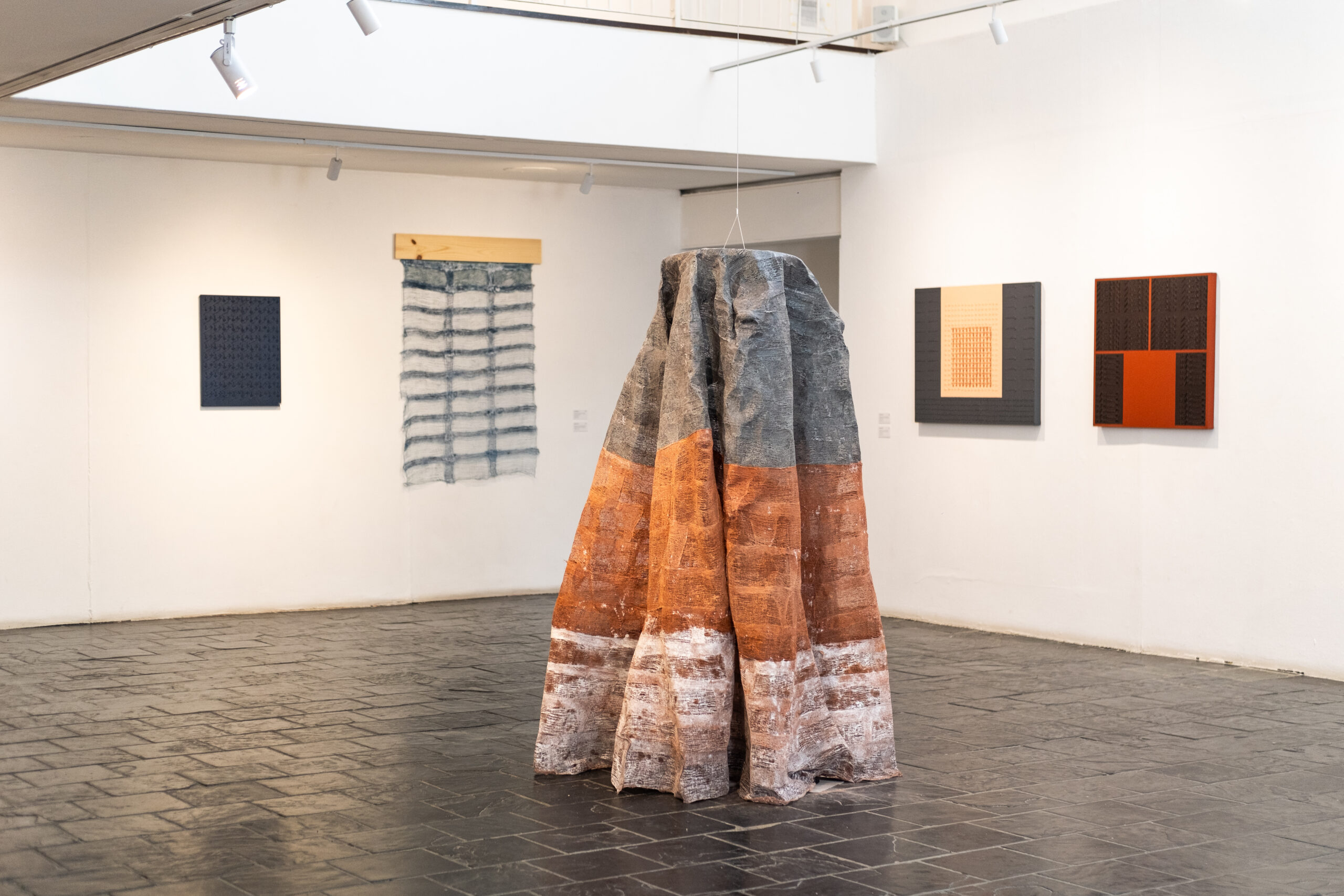
Installation View | ‘Paivapo (There once was …)’, solo exhibition by Pyda Nyariri at the Association for Visual Arts (AVA). Cape Town. Photography by Nicola Helia
But Nyariri’s bold and thought-provoking work unsettles the terra firma beneath the viewer’s feet and throws up a fine, obscuring red dust. It is as if the earth itself is breathing, trembling, its skin a site of exchange. Drawing on the eminent postcolonial theorist, poet and novelist Édouard Glissant, the artist invokes a poetics and politics of illegibility and instability, a site of resistance to Western imperatives of transparency and knowability. Hannah Fleishman, commenting on curator Hans Ulrich Obrist’s recent archival exhibition on Glissant’s work at West Den Haag, makes a resonant comment:
[I]n his essay “Stumble Dance” (2008) [theorist André Lepecki] considers the politics of the body’s relationship to the ground. Western dance, he argues, often treats the ground as flat, neutral, ahistorical, as merely a stage for human happening. In contrast, he proposes a politics of stumbling, of being moved by the irregularities and histories sedimented beneath our feet. The stumble disrupts mastery, opening us to new and unexpected ways of being in contact with the world. Glissant’s trembling shares this impulse. It insists that thought must not seek stability at all costs but must remain sensitive to cracks, ruptures and the unpredictable ground of relation3Fleishman, Hannah. “The earth is trembling: Édouard Glissant’s archipelagic model of exchange.” Metropolis, 15 October 2025. https://metropolism.com/nl/feature/the-earth-is-trembling-edouard-glissants-archipelagic-model-of-exchange/. Accessed 22 July 2026..
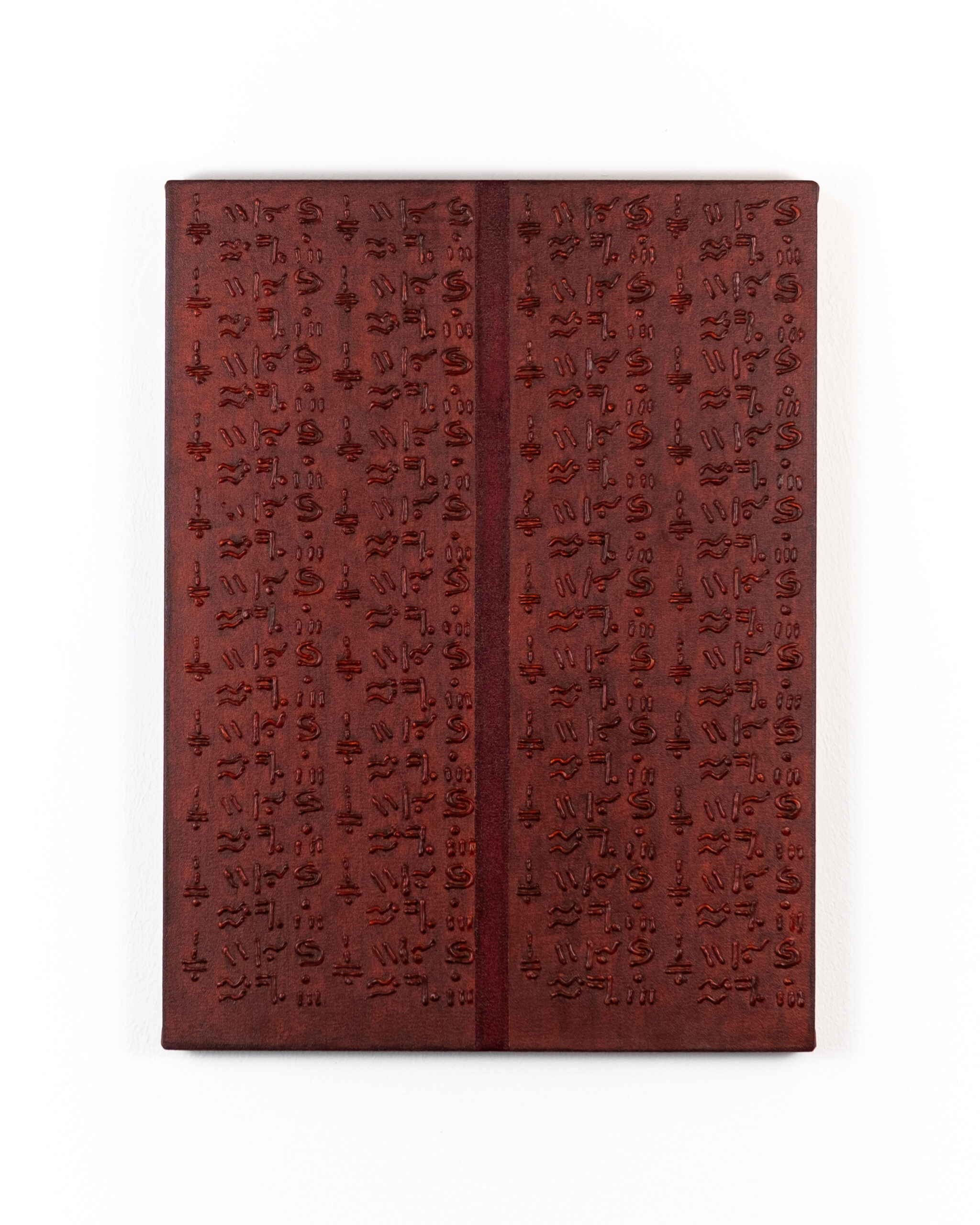
Pyda Nyariri, Kwatanura chisununguke (Peel and let it be free), 2026. Photography by Nicola Helia
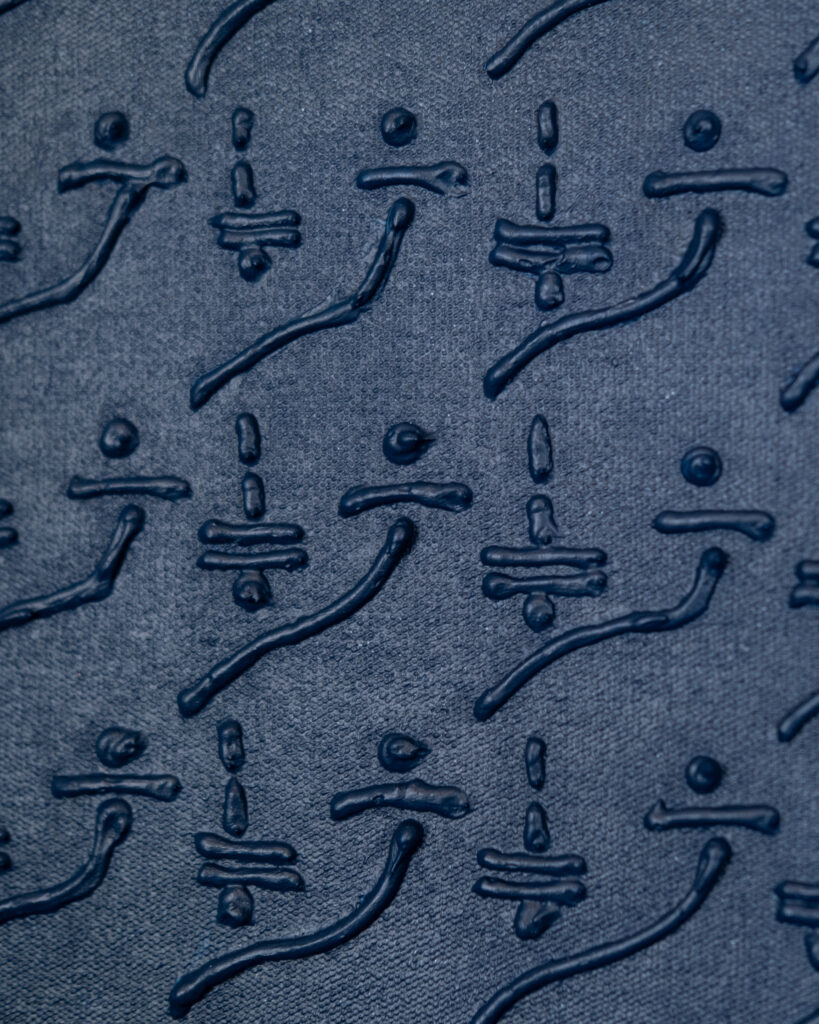
Pidgin, a being both phantom and physical, “a shadow that holds weight,” gives fictional form to Glissant’s poetics of relation. Playfully rebellious, irrepressible, generous, by nature a trickster, Pidgin is hybrid, contingent, iridescent, ever-shifting, ever-transforming, a chaotic, creolizing “grammar made from dust.” While a spectral presence, a figment intuited rather than seen, Pidgin is still very much in and of the earth, an all-pervasive material presence that resists identification, classification and control. The character of Pidgin is tantalisingly traced and effaced in the indeterminate alphabet of the artist’s raised-relief acrylic paintings; across the diaphanous works of cotton gauze, clay slip and wood that serve as a threshold into Pidgin’s world; and through the porous material folds of Denise Onen’s polyphonic sound piece, the voice of Pidgin that is also the uncanny “respiratory system” of the exhibition as a whole. In this piece it is as if a new language, an embodied, breathing language, is being forged in the spaces between signification, in the dust of the earth itself, in the texture of silence. It is the language of the “common,” the “all.”
The words of political theorist and public intellectual Achille Mbembe are apposite here. In a “Theory of the Margins” interview in 2020, he revisits his 2010 text Out of the Dark Night: Essays on Decolonisation4Mbembe, Achille. Out of the Dark Night: Essays on Decolonisation. Columbia University Press, 2021. and remarks:
Decolonisation is … philosophically … a radical openness, of and to the world. It is, if you want, a deep breathing for the world as opposed to an insulation, as opposed to ‘fermeture’ … the fact of closing in on oneself … It has nothing to do with seceding from the world, or partioning the world again. It has … to do with a radical embrace of the earth and of all who inhabit it.
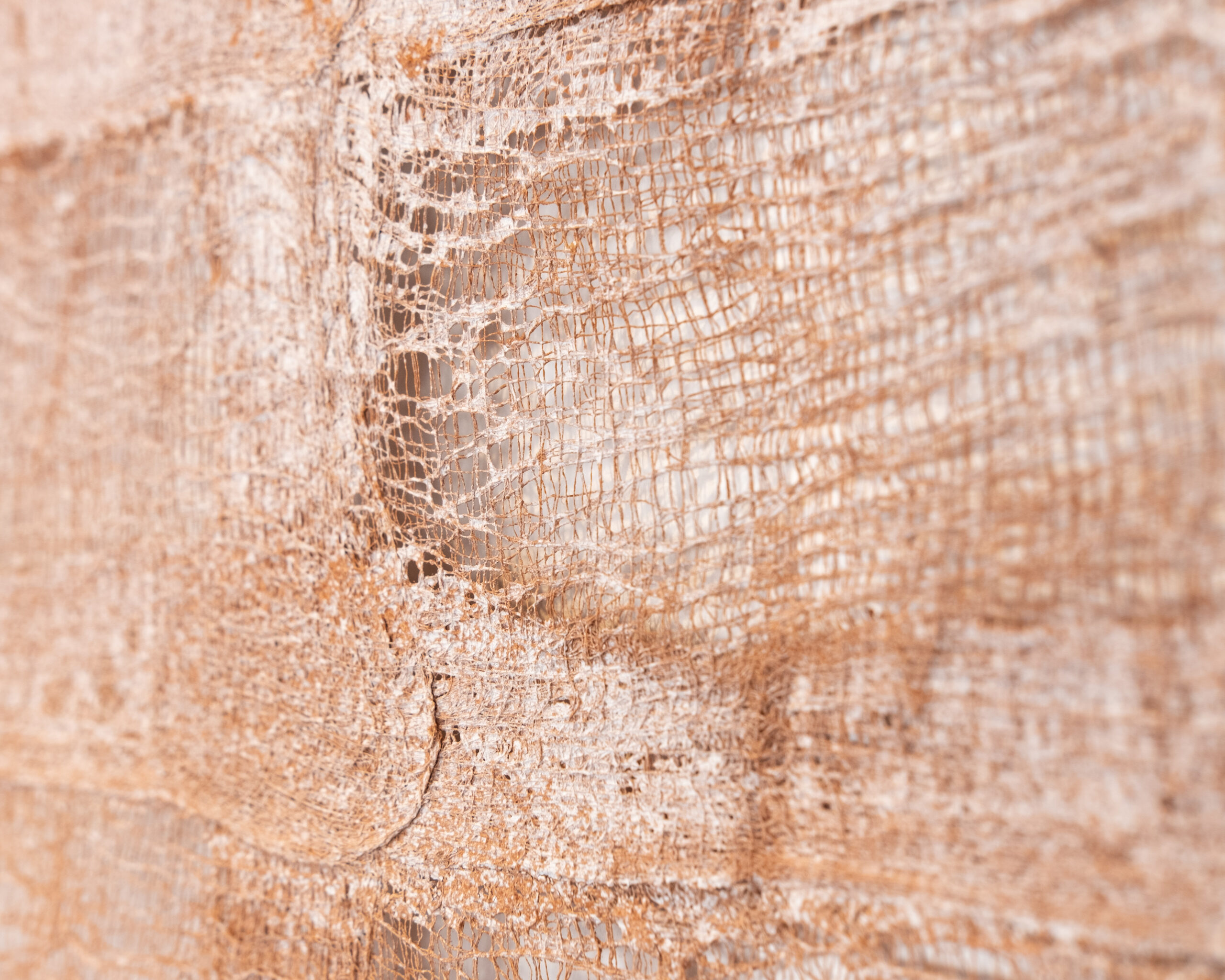
Pyda Nyariri, Mutauro wakagadzirwa nehuruva (Grammar made from dust), 2026. Photography by Nicola Helia
Nyariri’s pieces made of stretched cotton gauze and clay slip embody this notion of radical openness, this soft porousness, in which one is drawn to what Glissant calls “the breathable texture of the weave and not the nature of its components.” Each poetically titled piece is a distinct work of art but it is not insulated from its earthly context. Each work, pigmented with organic shades of ochre or blue clay slip, is in dynamic conversation with the other artworks and open to its surroundings. The viewer becomes part of the conversation too, transformed by each encounter with an artwork and leaving an invisible trace in turn, if only an unseen exhalation or a disturbed speck of dust.
Against this backdrop, Rabia Abba Omar’s fictional text plays with Western concepts of scientific documentation and forensic investigation, teasing the viewer into seeking meaning in the “anthropological” archival metadata provided by the Keepers of Whispers, the Pfimbi Yemashoko Collective, who have documented their sightings and sensings of Pidgin. But this collated “collection of whispers,” rigorously recorded, is an ingenious piece of Afrofuturist speculative fiction, imbricating science and myth. Like the obscure, indeterminate signifiers of Pidgin’s alphabet, visible in the raised-relief acrylic paintings described as “carvings in the rock-face of Chivure near Tembera,” the “archival” documentation that accompanies the exhibition is not denotative or instructive in any sense. It is an ironic commentary on a coercive colonial ideology that sought to order and exploit an “unruly other”, to suppress mother tongues and to extract valuable resources from the material world. It also hints at the persistence of colonial othering and exploitation, through today’s emerging retro-nationalisms and rigid borders, algorithmic surveillance, environmental collapse and widening inequality.
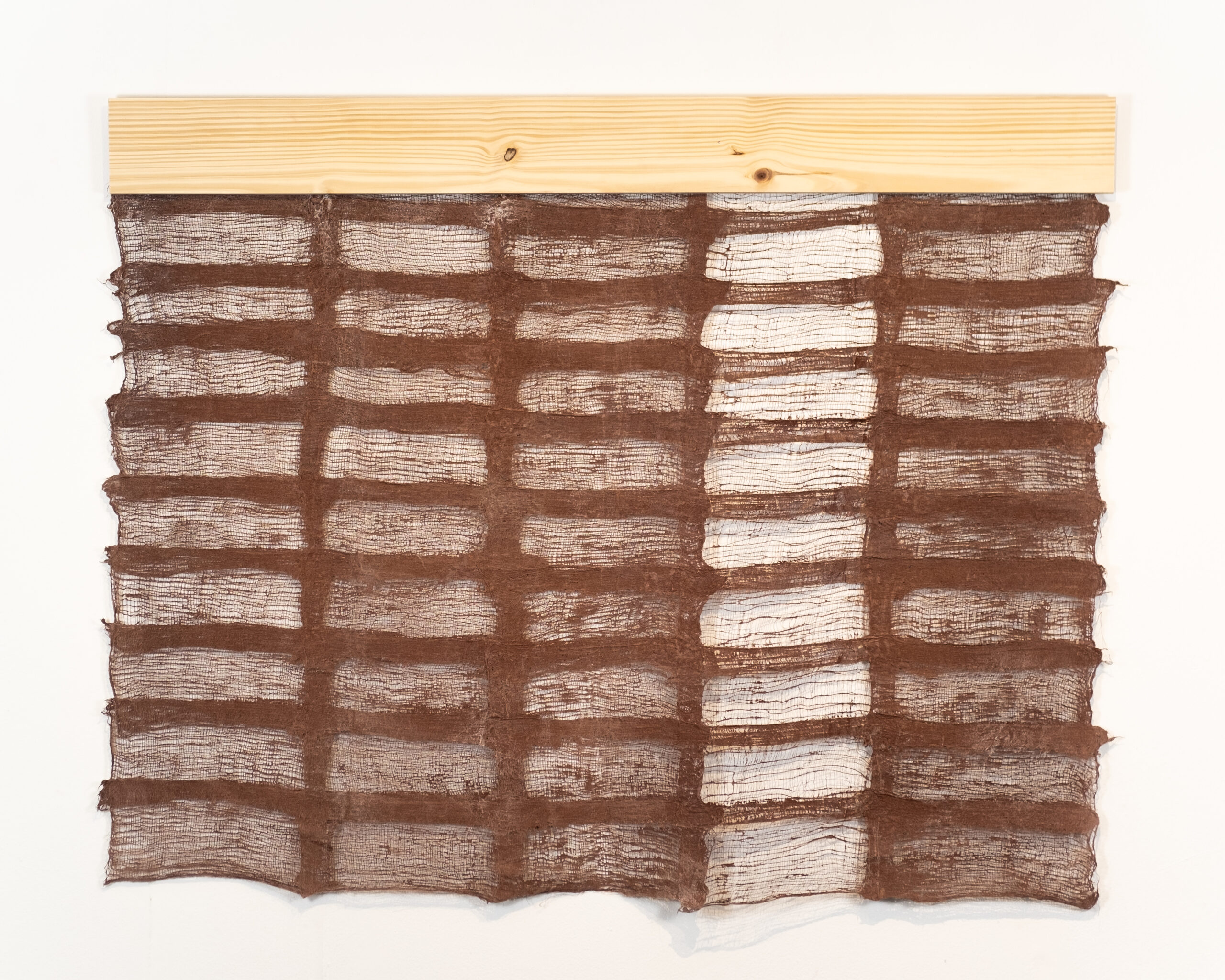
Pyda Nyariri, Vakaviga mazwi erukuvhute (They buried the words of the umbilical cord), 2025. Photography by Nicola Helia
One of Nyariri’s artworks carries the title, “They buried the words of the umbilical cord”. Now that the mother tongue is buried, only the earth, the “marrow of the land”, remembers your name. But this nostalgic return to source, to originary meaning, is shown to be an illusion. Just as the character of Pidgin endlessly eludes a fixed or unitary identity, the time-space of the “once” invoked by the title “Paivapo” folds endlessly into itself. The meaning of “once” is elusive, indeterminate, opaque; never originary but always receding from view. In a decolonial turn, “Paivapo” becomes fertile ground for radical optimism and reimagining, a gesture of looking not only back but ahead and beyond. The distant horizon of the story is deliberately open-ended, gesturing outward towards infinite possibility but also inwards towards something intuitively known, felt, familiar: “The horizon folded inwards to greet it”. Instead of a pure and distinctive mother tongue, there are sounds of something tentatively coming into being: stuttering, stumbling, silence and soft whispers: “It whispered a soft word that hung in the air”; “It was shaped by our collective breath.” The hybrid sound of collective breath suggests the emanation of a new reality, a new world, the sound of what Glissant calls “the exultant divergence of humanities.”
The fictional reference to the surreally open-closed cocoons, emerging from the earth’s red dust and floating above it, suggests the potential for a new, decolonised way of thinking and being, an iridescent butterfly configured of the “brightness and dust” described in one of the artworks. As cultures and languages converge, as borders dissolve, entirely new forms of relation and presence, contingent and egalitarian, become possible. In this light, the cotton gauze artworks may be remnants of burial shrouds but they are also the breathable gauzes applied to a wound, sites of healing, repair and potentiality: “We are wrapped in its aftermath”; “We became witness to its blossoming.”
The cotton gauze also calls to mind the billowing sails of a boat traversing the unbounded, universal waters of a world in which humans, in their contingency, have no dominion over the earth’s materiality or over the human and non-human beings who inhabit it. In Glissant’s words:
This is why we stay with poetry. And despite … the exhausting flashes as we pass from one era to another – from forest to city, from story to computer – at the bow there is still something we now share: this murmur, cloud or rain or peaceful smoke. We know ourselves as part and as crowd, in an unknown that does not terrify. We cry our cry of poetry. Our boats are open, and we sail them for everyone. ― Édouard Glissant, Poetics of Relation5Poetics of Relation. (Translated by Betsy Wing). University of Michigan Press, 1997.
Notes
Glissant, Édouard. Caribbean Discourse: Selected Essays. (Translated by J. Michael Dash). The University Press of Virginia Caraf Books Series, 1989.
Glissant, Édouard. Poetics of Relation. (Translated by Betsy Wing). University of Michigan Press, 1997.
Mbembe, Achille. Out of the Dark Night: Essays on Decolonisation. Columbia University Press, 2021.
Fleishman, Hannah. “The earth is trembling: Édouard Glissant’s archipelagic model of exchange.” Metropolis, 15 October 2025. https://metropolism.com/nl/feature/the-earth-is-trembling-edouard-glissants-archipelagic-model-of-exchange/
Peterson, Angeline. “Achille Mbembe tackles Afrofuturism, Afropolitanism and Decolonisation in Theory of the Margins interview.” Brittle Paper, 20 November 2020. https://brittlepaper.com/2020/11/achille-mbembe-tackles-afrofuturism-afropolitanism-and-decolonisation-in-theory-of-the-margins-interview/