KZNSA Gallery
04.10 - 02.11.2026
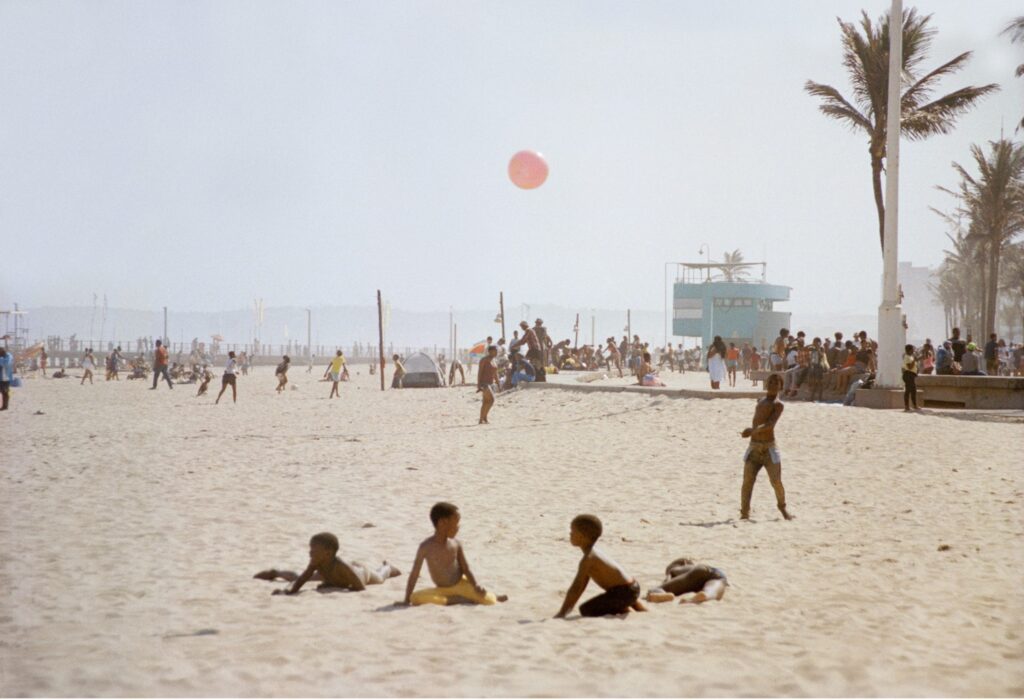
Sabelo Mlangeni’s ‘Honeymoon. The happily ever after?’ is a body of work built over five years, inspired by a honeymoon trip to eThekwini (Durban). The work is an intimate account of multifaceted life in Durban, capturing the everyday experiences of beachgoers and passersby alongside architectural frames that highlight a sense of instability and the energy of the city. Framed as a question, the work explores the city’s history and contentious present, reflecting on structural effects: a failing government, environmental impact such as the 2022 floods and infrastructural collapse. While looking at the city with a sense of clarity and fresh eyes, Mlangeni also considers its parallels of beauty and decay, joy and struggle, and emerges with quiet moments of humanity.
We interviewed Mlangeni on the work, following its presentation at the KZNSA Gallery (4 Oct – 2 Nov 2026).

Sabelo Mlangeni, I love you Durban, (2023). Courtesy of KZNSA Gallery.
The work was very well received when you showed it in Cape Town in 2025. How does it feel to be showing this work in the very same town where it was developed?
It is totally different, but at the same time exciting to see the work in Durban. I’m especially thinking about the choice of the colours – the orange, for me, is more of the sunrise in the city, and the blue is the distance of water. Sunrise and sunset, settled water.
Presenting the work in Durban suddenly makes sense.
Even though I had a few unpleasant incidents at the beginning when I was installing the show, which really affected me, the work did go on. Somehow I had to split myself into two. I had to focus on what was happening, but at the same time I had to make sure that the show was realised and was a successful show.
How is it received? Durban is totally different from cities like Johannesburg and Cape Town. The scene is very small. But my appreciation is mostly of how photographers are receiving this show and appreciating having a show that focuses on photography, which is something very rare.
It’s my first solo show in Durban, and although for five years I’ve been going back and forth between Johannesburg and Durban, it’s not a city where I can truly say I have a big audience. So I wouldn’t, at this point, say exactly how the show is received. Since the show opened, I’ve spent time with students from photography and fine art, and also the general public.
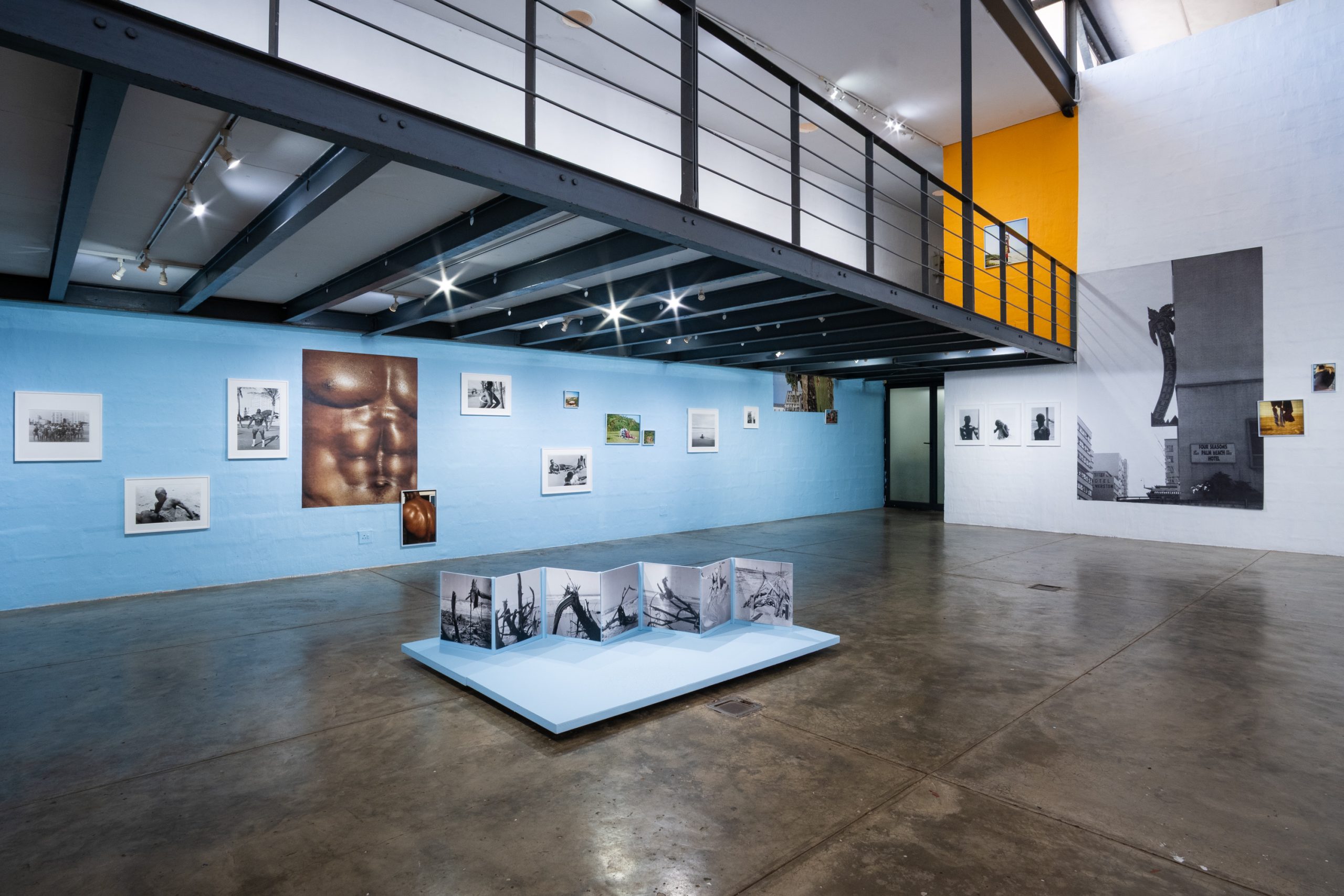
Installation View: Honeymoon. The happily ever after? Courtesy of KZNSA Gallery.
You play around with installation in a very interesting way to hang this work; can you tell us about some of the decisions you made in terms of your hanging style?
If you have noticed, in recent years I have been very interested in exhibition-making, and in thinking about different ways to read photographs, and to install or hang photographs: how photographs take up a space, a white wall. With each and every work, I find a language or a tone that I use to install or place the work in the space.
I think of the work Ngiyobona Phambili, for example. In terms of colours, I chose forest green because the work was mostly dealing with landscape, and there is also a certain way of framing that I used for that body of work. With Isivumelwano, which explored marriage ceremonies in Black communities- it was mostly white – just a straight line, a clean line, thinking about a ring belt, a ring shadow, something very clean.
This time around, I wanted to work with wallpaper for the first time. I’ve never worked with wallpaper. The starting point was to overlap the wallpapers. If you saw the show in Cape Town and now this one, there is a continuation of the overlapping of the wallpapers. I think every work has its character, and you want to bring that character out through how it is displayed or seen. So the decisions come out of understanding the work, but also out of being in the space over time. It is something that is revealed through that.
The work itself questions ideas of a “happy ending” – but it is also very specific to the site of Durban – I wonder how you reflect on the city today (and how it has changed) since the work was made? In particular, how do you see the seaside itself changing and whether it might tell us a broader narrative about the city?
I decided to stop making work in the first chapter of the series when I got arrested by law enforcement for making photographs. But I had these experiences right from the beginning, where I was told many times that I’m not needed, or that they don’t want me there. Still, I kept on going back over the years, until this time.
The city has changed. I think some of the reasons why I was harassed by security and law enforcement over the years are partly because things have been going very badly in that part of the city. The city has also been getting a lot of bad publicity because of how bad things are.
During our last elections, I thought about this question of ‘happily ever after’. The question speaks to arrogance and denial, the ill-treatment that citizens are experiencing and a general attitude that those in power do not care.
I don’t know what kind of leadership can turn things around in the city, and we can simply say things are not different from the previous leadership.
Your work has always been incredibly specific about the lives of the people that you wish to document. Can you tell us a little bit about some of the figures you chose to document for this series?
It’s a different approach, and I find this challenge fascinating: to find oneself in a new space that is a place of pleasure, of honeymoon, of happiness, a holiday destination. That’s how I came to Durban. I went there for a honeymoon, and although I have family in Claremont, I decided I was going to stay in a hotel in Durban for the first time. It ended up being a five-year project, and even now I go back and forth. I consider that I’m based between these two cities now, Durban and Johannesburg.
I’ve been in Johannesburg for more than 20 years, so I already have a community. In Cape Town, too, there’s the art community, which is intimate but feels bigger.
After I decided that I wanted to stay in Durban and work there, the first thing that caught me was the light. The light in Durban is incredible, crisp. It felt like a blank canvas. We have photographers like Peter McKenzie and many others who have photographed Durban, so I’m not the first, but as someone who has lived and worked in Johannesburg for a long time and visited Durban many times for family, I had never seen that kind of beautiful light until I went for my honeymoon holiday.
After finding the apartment, I started running, and I did aerobics. Every morning I ran along the beach. There was a group of young people, – this was 2021, between lockdowns – who came together every morning to exercise. I would jog and come back and see these young people, and I loved what was happening. People were trying to find ways to deal with the trauma of that time. It was also about awareness, about taking care of one’s body and health. One morning I decided to go and greet them and ask how to join the class. I was told that part of what they do is to focus on weight loss and that I could join the sessions for free; I supported their business by buying products. So just like that, I was introduced to a coach, and I would order products like tea from them. That’s how I found my first community, which introduced me to the city. Some of them are still my friends even now, although the workout team doesn’t exist anymore.
That was my entry into the city. And there are also people, for example, who sell hats and beads to tourists, and I got to know those people around the beach.
There is also something about this work that is reminiscent of weddings. You know the bride and the groom, but sometimes you don’t know the guests. It’s the same when you come into any ceremony or event, and especially when you are there for a holiday.
There is one photograph in the series of a guy with a child on his chest. Many people assume this is a father and a son, and they are always surprised when I tell them it’s not like that. These two people had just met. They both came to Durban for a holiday and were at the beach at the same time, in two different groups. The baby was crying, one of those cries where even the mother doesn’t know what to do, and where, even as a first-time parent, you feel embarrassed because you’re with a group of other people and the child is crying nonstop. This guy went to the mother and asked for the baby. He took the baby, and immediately after he took the baby, the baby stopped crying. Then he put the baby on his chest, and that’s how I made that photograph. So there are moments like that. Sometimes I’m in that space: you meet a group of people, and you stay with them for more than two hours, and things just unfold.
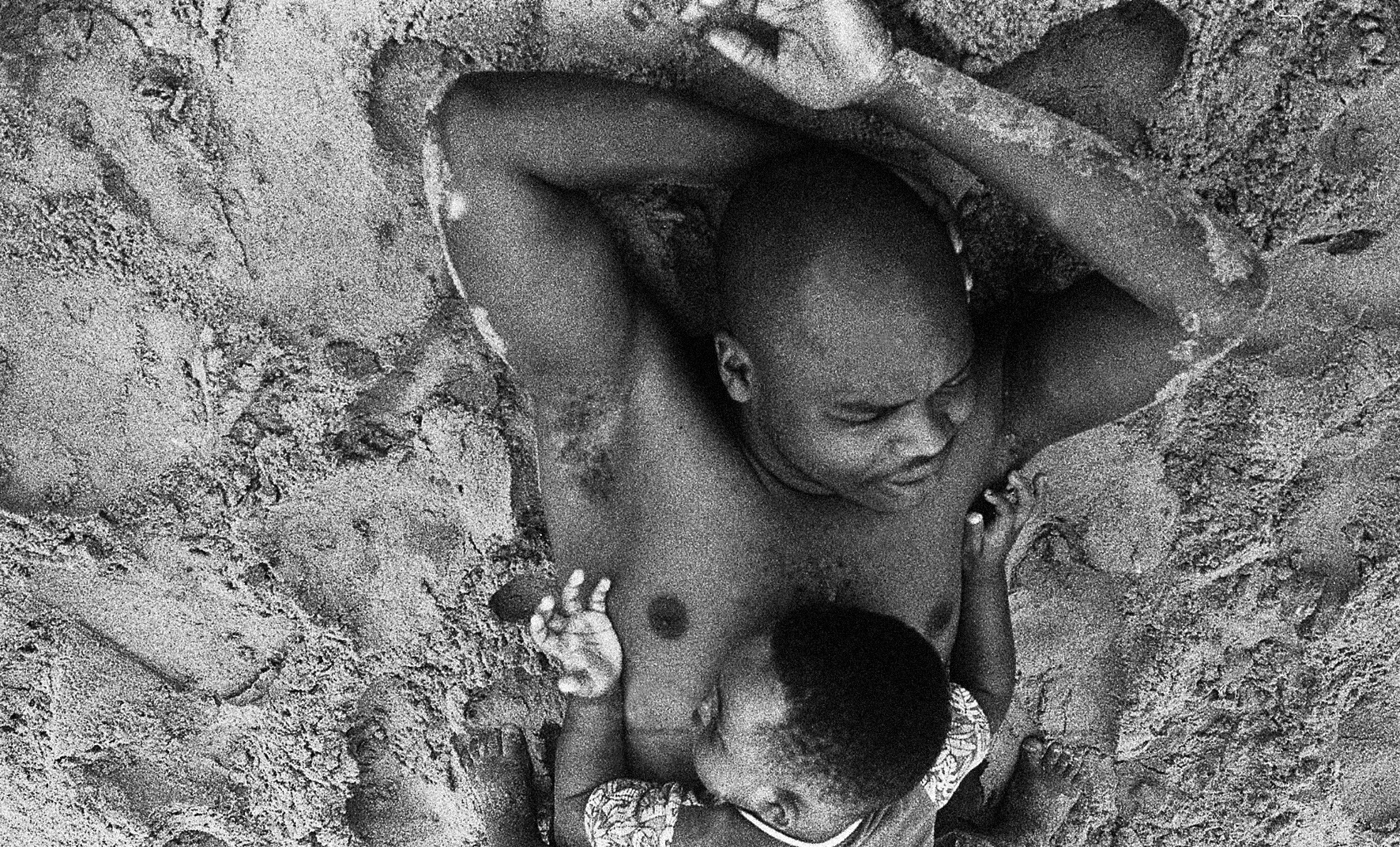
Sabelo Mlangeni, North Beach, meeting of strangers (2023). Courtesy of KZNSA Gallery.
There is also another group of people who were visiting for the Christmas holidays. I never really thought about the violence of water, how violent water is. A group of them were swimming, and they got into trouble. Luckily, the lifesavers were close by and were able to jump in and quickly save them. When they came out, I was already there, and I took just a few shots, but I wasn’t really interested in making photographs of that moment. It was afterwards, when they were walking down after being taken out of the sea, and there was this disbelief in their faces that they had almost lost their lives. I walked around with them in this shocking moment, and that’s when I decided I would make photographs of them. In the exhibition, there are three of those photographs.
Speaking about violence, the exhibition also presents the violence of the July unrest, and the violence of the floods. This work is questioning the happily ever after. One student asked me if my work is political, because she had read the titles of the photographs and felt that the work is more than just about weddings and honeymoons. And it is true. Even in the part of the work where I’m looking at the relationship with water, there is the question of what that relationship means in a country that has never had time to address, to talk about, healing. I have witnessed people take the sea as a space of healing, not just of leisure and pleasure. Some people go there to throw away their past; it’s a place of cleansing. There are characters like that in the work.

Installation View: Honeymoon. The happily ever after? Courtesy of KZNSA Gallery.
The series, perhaps a bit different from previous works, includes variations in terms of style – we find architectural images, fragments of bodies, figures, sites, etc., in black and white alongside colour across varying sizes. Can you reflect on your choices to work in this way for this series?
When you speak of cities, it’s mostly black and white, but in this work we find these different forms, bodies and architecture together. I wouldn’t say it’s the first time in my work, but I did add colour photographs here. The colour was also about finding expired films; I was collecting expired films because I was interested in a certain kind of colour, and in the meaning of using old film. You get a little bit of colour shift with expired film, and I was interested in that.
This is also the body of work where, for the first time, I made photographs in colour that feel the same as how I see black and white. I’ve been working in colour and practising, but I’ve noticed in myself that the thinking is not the same when there is colour film in my camera and when there is black and white. They are two different ways of thinking. So this was a way, for the first time, to put out there how my eye sees colour.
As I explained before, a space influences or affects you in a certain way over time, and I think that is reflected in the work. Because I live and work between Johannesburg and Durban, I mention the light: it is crisp and clear in Durban, the same as the soul and energy of that city. It is calm and relaxed. It’s different from Johannesburg, the city of hustlers, where everyone is moving, and the energy is different. The soul is a little bit greyish. Those feelings and emotions come out and can be enhanced by how the work is presented.
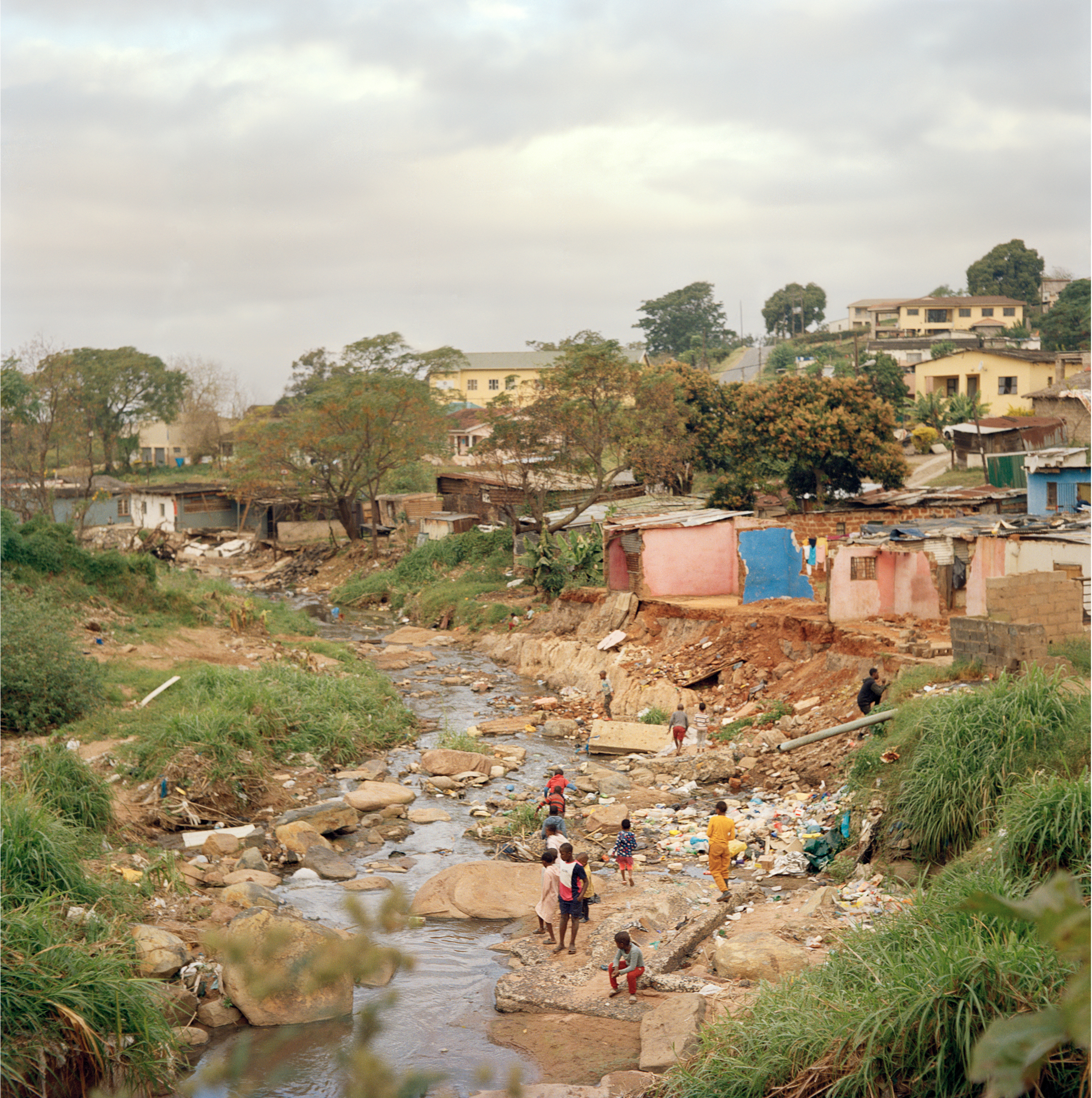
Sabelo-Mlangeni, Six months after the flood, Mvuzane Clermont, (2022). Courtesy of KZNSA Gallery.