February is art month in Cape Town, and with it comes an abundance of works, projects and quirky experiments to enjoy across the city. Amid the plethora of visual stimulation, one small slice of art that often gets overlooked is that of the 20th century.
We spotlight a few works created by artists working in the late 20th century, a time marked by significant social, political and economic changes globally. These artists, who could be classified as ‘modernists’, moved away from traditional methods toward experimentation and play with form, material and process.
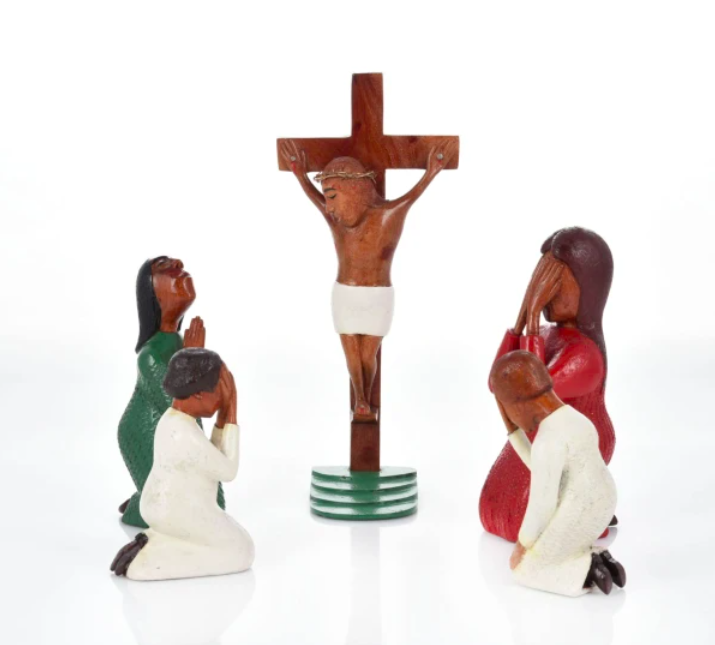
Johannes Segogela, The Crucifixion, Painted Carved Wood,2004
Johannes Segogela
Figures in Communion
At Isaac Benigson | Old and Interesting Art
Pop Up Exhibition
14 – 21 February 2026
The remarkable master woodcarver Johannes Mashego Segogela (1936 – 2018) is a significant figure in the aesthetic history of 20th-century South Africa. A visionary artist, Segogela’s striking evangelical sculpture-making went hand in hand with the saving of souls.
A faithful and devout Christian, Segogela used angelic and satanic tableaux to produce theatrical critiques of apartheid politics and policies, with depictions of the devil frequently standing in for the Nationalist government. His sculptures of the everyday, alongside the divine, became his instruments for saving the world from senseless violence and damnation.
Text Source: https://isaacbenigson.com/exhibition/figures-in-communion/
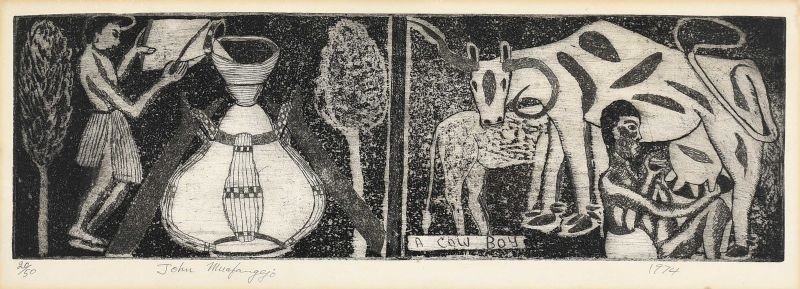
John Muafangejo, A Cow Boy, 1974
John Muafangejo
Viewing Room
At Stevenson
07 February – 21 March 2026
In the work of John Muafangejo (1943–1987), printmaking meets prose as the artist anecdotally narrates incidents in pastoral living, biblical scenes and moments from his life. Although often misidentified as South African, Muafangejo was born in Angola and later moved to South West Africa, now Namibia, after his father’s passing. Following his relocation, Muafangejo learnt English and studied scripture at the Epinga missionary outpost in his new home. In 1968-69, he received tutelage from the Rorke’s Drift Art Centre, built by the Evangelican Lutheran Church in what is now Kwa-Zulu Natal. Reflecting the influences of his context, Muafangejo’s work centers Christian iconography, yet these religious overtones are suffused with tenderness through his accompanying captions, distinguishing him from his peers and alluding to a more universal feeling of faith.
Text Source: Mosa Molapo for Stevenson

Installation View, ‘Does it end in a miracle’, 2026, Everard Read, Cape Town. Photographer: Michael Hall.
Helen Sebidi
Group Exhibition ‘Does it end in a miracle?’
At Everard Read
5 February – 28 February 2026
Mmakgabo Sebidi lays some of the groundwork. Her practice serves as a touchstone for understanding resilience, passion and innovation, all of which we witness in artists that follow her path. Spanning over five decades of creation, Sebidi’s work is instructive. From a technical perspective, she mastered painting and sculpture at a time and in a place where many like her were not allowed and did not have the opportunity to make art. Following her dreams, especially in the literal sense, Sebidi created a palimpsest upon which generations of contemporary artists can build their legacies.
Often, we see figures that morph into each other, connected through limbs or multiple heads. Animals, too, play an important part in her depictions, particularly the fish, the animal that represents her clan, Batho Batlhaping. Weaving together dreams, ancestry, landscape and fantasy, Sebidi’s visual language is entirely her own. She is a great colourist and an even greater provocateur.
Text Source: Nkgopoleng Moloi, Exhibition Text for ‘Does it end in a miracle?’

Atta Kwami, Untitled 5, Courtesy Goodman Gallery
Atta Kwami
Dynamic Equilibrium
At Goodman Gallery
07 February – 11 April 2026
The second solo exhibition of the Ghanaian painter with the gallery, the show spans works made between 1999 and 2020. The exhibition highlights the breadth of Kwami’s singular practice and reaffirms his place as one of the most important African abstract painters of the late 20th and early 21st centuries.
Kwami spent the first fifty years of his life in Africa, a period that shaped his artistic vision in lasting ways. Early influences included the kiosks, hand-painted signage and improvised architecture of West African towns – structures whose forms translated into his paintings in ways that always suggested scale, even in the smallest works. These environments, together with Ewe and Asante textile design, jazz, and the tradition of mural painting, offered him a vocabulary of grids, rhythms and chromatic relationships through which he developed a profoundly original language. Whether in architectural structures or textiles, Kwami found vehicles for exploring the expressive and structural potential of colour: blocks and stripes of uneven sizes converge and diverge in patterns that evoke cadence, syncopation and the paradoxical tensions he sought to hold “in a moment”.
Text Source: https://goodman-gallery.com/exhibitions/cape-town-gallery-atta-kwami-dynamic-equilibrium

Irma Stern, Portrait of a Woman, Irma Stern Trust
Irma Stern
A Life of Displacement
At Norval Foundation
12 February 2026 – 17 August 2026
A landmark series of exhibitions tracing the extraordinary life, journeys, and artistic legacy of one of South Africa’s most celebrated modernists, Irma Stern. Drawing exclusively on material from her extensive archive and Collection, this opening exhibition of the series forms part of a new, unique multiyear collaboration between the Norval Foundation, the Irma Stern Trust and Nedbank.
Text Source: https://www.norvalfoundation.org/irma-stern-a-life-of-displacement/