‘Viscous porosity’ is the term that I think of when I consider Jeanne Gaigher and Lukhanyo Mdingi’s collaborative pieces in the recent BRIDGES COLLECTION. The term ‘viscous porosity,’ coined by eco-feminist theorist Nancy Tuana, alludes to a feminist discourse of comprehending the human body as not separate from the material of the world, but wholly, and uncomfortably, hinging on the flesh of it.1For example, we tend to view plastic waste as emblematic of our strangling effect on ocean life, while we ourselves now birth placenta that contain micro-plastics.
Gaigher, a visual artist, works primarily in the medium of paint. She incorporates peculiar materials, such as scrim and bookbinding mull, to dress and undress her canvases. She reads prose about mud as a nuptial bed for germinal procreation before making new works. Her practice is grossly and sumptuously bodily.
Lukhanyo Mdingi is a beloved luxury everyday-wear label founded in Cape Town by Mdingi himself. Privileging the integrity of raw materials, a Lukhanyo Mdingi piece is a meditation on the body, synonymous with a silkworm cocooning itself into form. Unlike the lesser-advertised processes of silk-production, Mdingi is transparent about whose hands share in the production process. Mdingi foregrounds the work of the crafters whose dextrous hands have threaded embodied knowledge into the DNA of the label. Collaboration is a conscious mode for the conceptualisation of pieces; material interlocutors are sought on the basis of trust. On his decision to work with Gaigher, Mdingi says, “There’s something within her paintings that I saw — especially the one that I have within my studio, Sudden Wave; it’s quite layered; it has scrim and canvas, and I really wanted to see how that could be brought into something that is wearable.”
I think of Gaigher’s microbes pouring into Mdingi’s folds as his fellow hand-crafters translate a painting about the fleshy body for the body, or many bodies, who will wear this piece. Practicing mutual permeability between the uneasy symbolic capital of a ‘fine art’ painting and the sartorial garment, Gaigher, Mdingi and the hand-crafters anticipate the body collectively.
On Gaigher as a fermenter
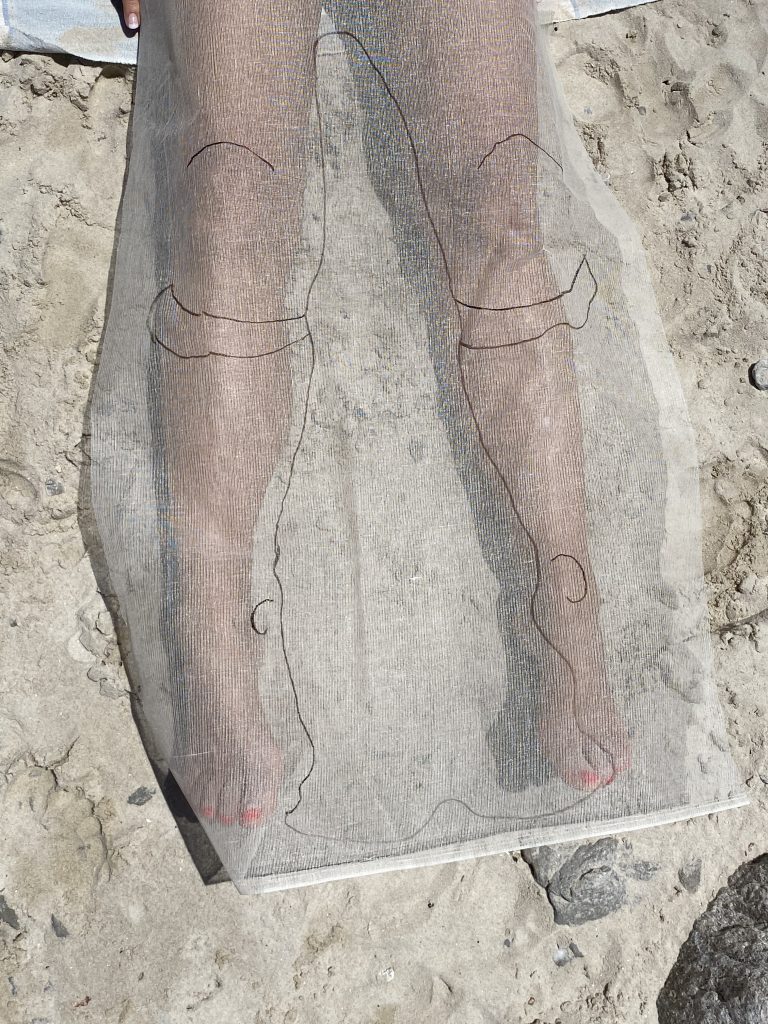
In her studio, Gaigher shows me two large patterns she has cut out of the bookbinding mull she uses as tracing canvas. The first she describes as the space between her mother’s legs; the second is the space between two tree trunks in her garden. The former initially reads as a delicate anatomical sketch. Gaigher flips it upside down and holds it to her own legs. Two thick, strong pillars curl at the ankle bones. Diagonal straps around the knees and half moons at the tops of the thighs indicate the form of a body splayed out on a surface. She holds the two-tree canvas up to her own torso; it reads as a pinafore of sorts, with three asymmetrical ‘straps’ to tie to an absent partner. She describes her canvases as patterns for garments “pregnant with anticipation” for the body as a performative act.
-

- Jeanne Gaigher, process image, 2021.
-
- Jeanne Gaigher, process image, 2021.
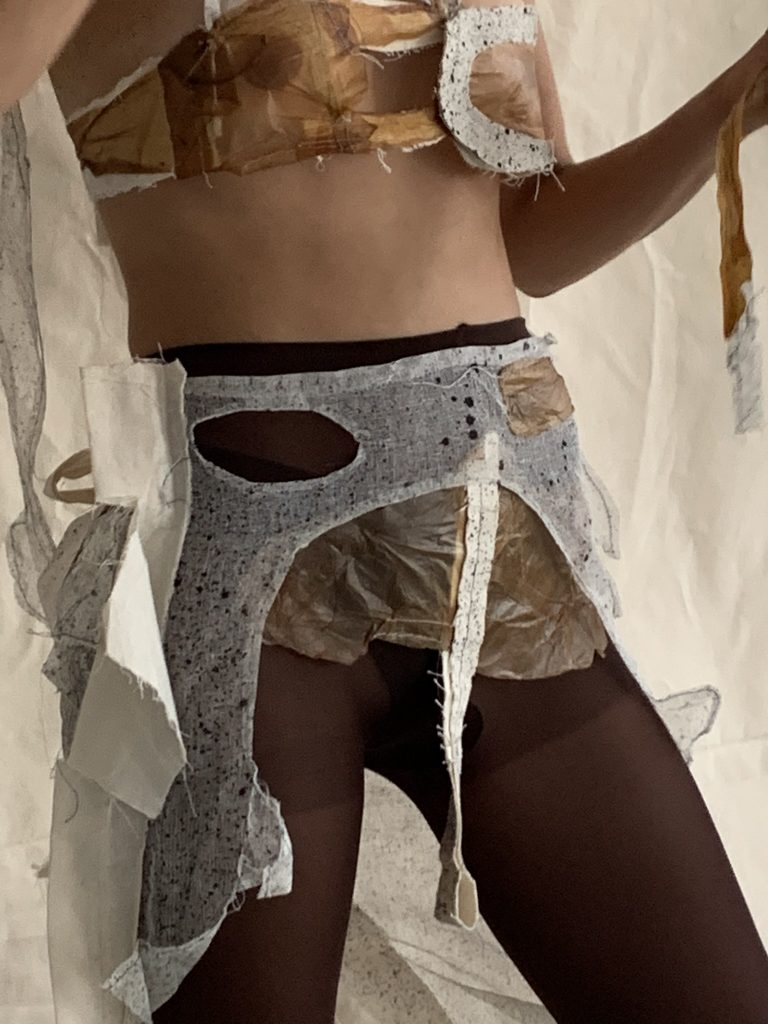
When I think of the body as a performance, I think about fermentation. I see Gaigher as less so a painter than she is a fermenter.
Gaigher lent me a single-issue independent Belgian magazine called Rot, which includes an article on pasteurian practices: “When I was 7 years old I suffered from a strange disease. From being a child, I turned into a brewery. My stomach fermented the food I ate into alcohol and my blood got poisoned. I was drunk for 3 weeks.”2Gosie Vervloessem, “Artistic Research as a Post-Pasteurian Practice,” Rot, Issue Zero (2020): 16. 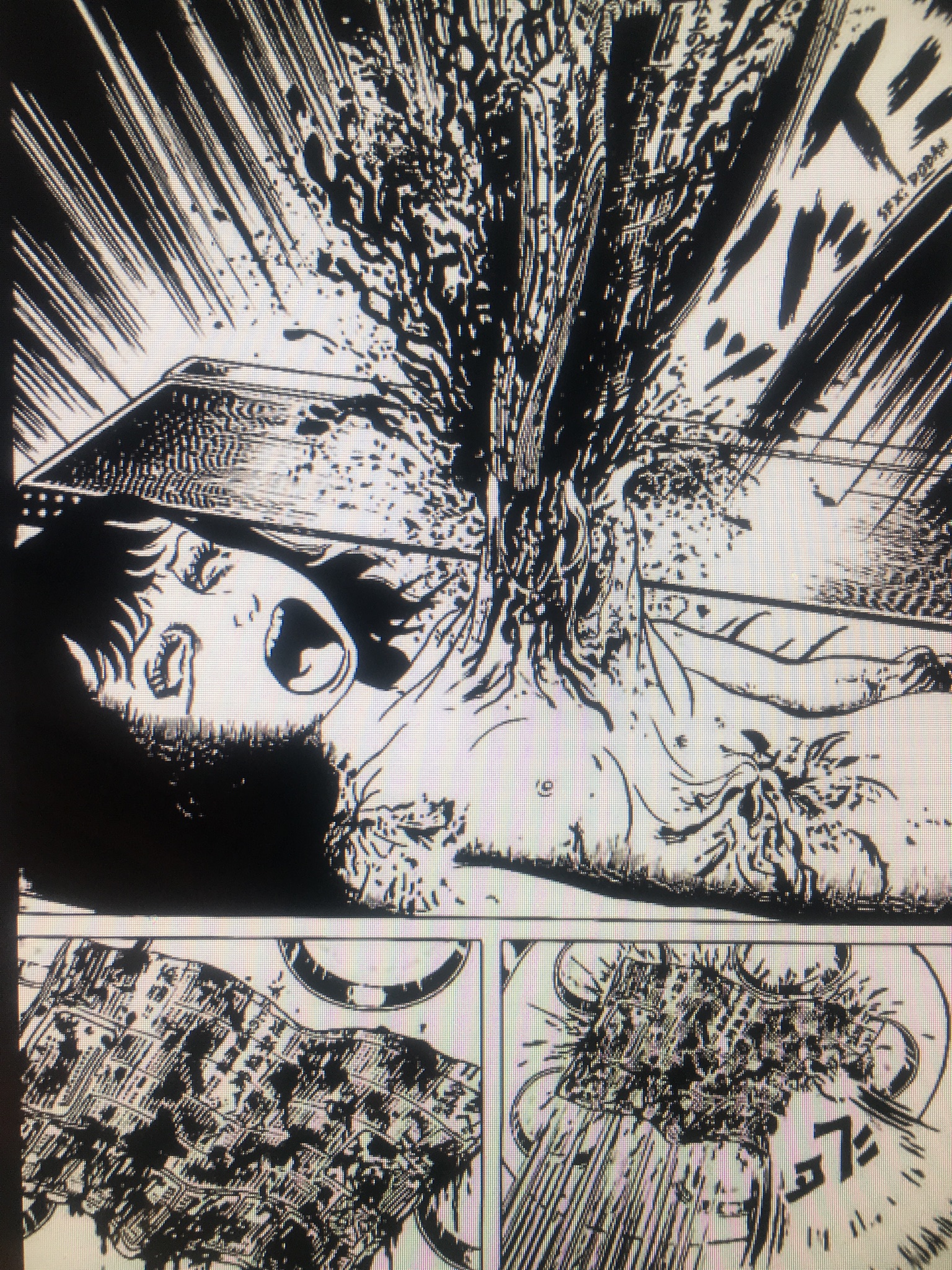 The human body can affect fermentation by converting lactic acid in the cells to produce energy when it does not receive enough oxygen to sustain itself. This process takes place during fast-paced exercise and asphyxiation. The odour of sweat is the smell of secretious fluid being digested by the microbes that live in the clammy parts of the body. In death (and without interference), the body as a multiverse of microbial interactions gets to work on its own decomposition. Gaigher’s paintings magnify and fictionalise the intricacies of this multiverse. “My microbial religion!” she exclaims.
-
- Jeanne Gaigher, process image, 2021.
-
- Jeanne Gaigher, Spring (detail), 2021.
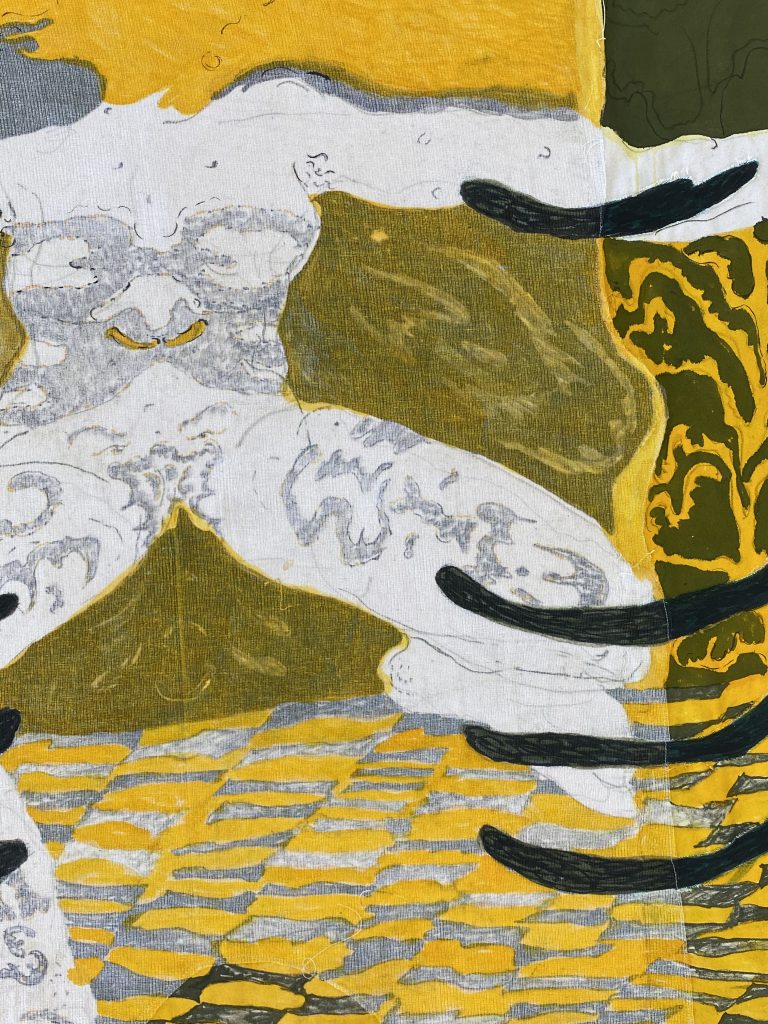
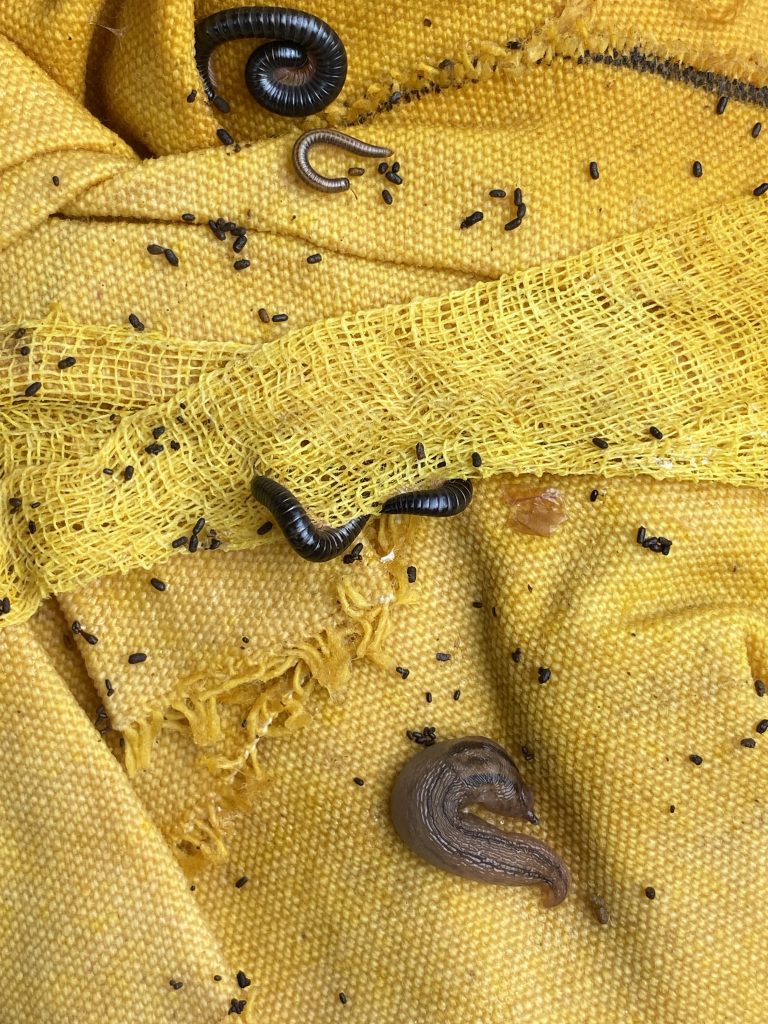
Over a voice note, Gaigher adds, “My friend always tells me how my colours (especially the yellows) make her think of bodies decomposing.” Gaigher recently experimented with cultivating scoby in plastic vats in her studio. Initially, she wanted to grow the cellulose mats to make an alternative to leather with it, but scoby grows at its own logic. A scoby is materialised through special strains of yeast and bacteria to make the popular fermented tea drink, kombucha. This process is affected via lactic acid fermentation. Once a good scoby is cultivated, it can be sectioned off and passed on to others. This flesh is called ‘the mother.’ Gaigher describes the relationship between her painting process and the flesh-forming interactions of the scoby as a symbiotic one. She populates her canvas-patterns-for-bodies with “over-defined surfaces” of microbialesque forms, “almost [as] a way of choreographing the body for the viewer.”
I am reminded of Donna Haraway’s doctrine of feminist objectivity: to speak from the body from which one encounters the world. Perhaps unconsciously, Gaigher understands the assignment; canvas patterns are charged with bodies known to her intimately and in turn, she charges them with a “world of fleshy beings with their own needs, claims and actions.”3Stacey Alaimo, Bodily Natures: Science, Environment and the Material Self (Bloomington: Indiana University Press, 2010), 2.
Mdingi on the poetics of material translation
Tuana describes porosity of flesh as “[T]he hinge through which we are of and in the world.” In this instance, raw materials mediate the interaction of the commercial fashion label, Gaigher’s fine art practice and the applied knowledge of crafter Makaita Gobvu of the cowgirlblues team. “I knew cowgirlblues would be the perfect company to work with,” Mdingi says, “Mohair and silk marino wool would be the perfect raw materials to just bring that essence of Jeanne Gaigher as well as Lukhanyo Mdingi together.” In our conversation, Mdingi asserts, “The premise of our label is human beings more than anything else… I think there is something quite unparalleled with the human hands.” During the drafting process, Gaigher conjured a fictional set of a-symmetrical ribs curling down the centre of the body, which Gobvu then translated into a set of symmetrical lines with a hand-knitting machine. Gaigher discerns the differences between her lines and Gobvu’s machine as two different choreographies of the hand. I think of Gaigher’s hand choreography as also linguistic: the impossibility of a direct translation from one language to another.
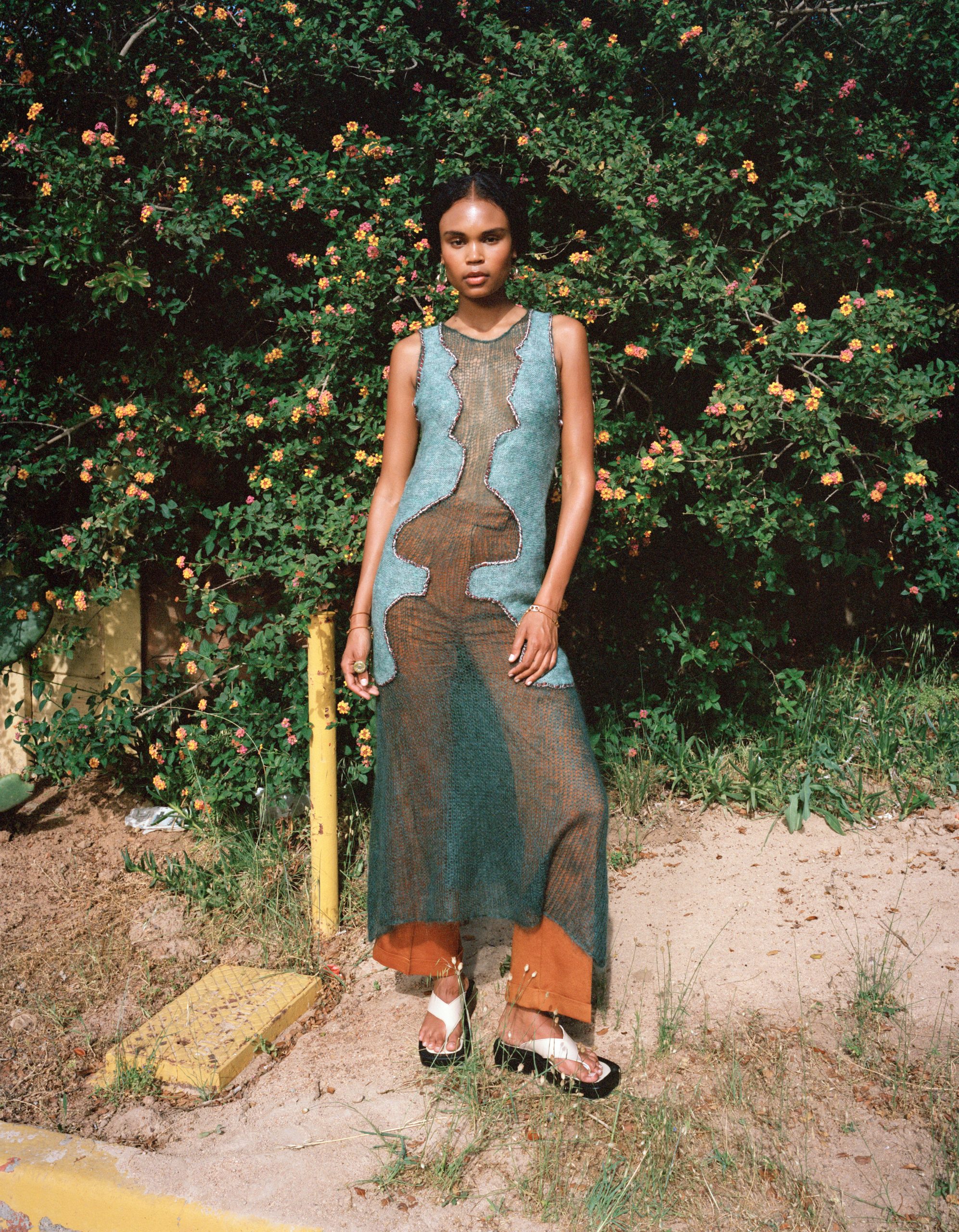
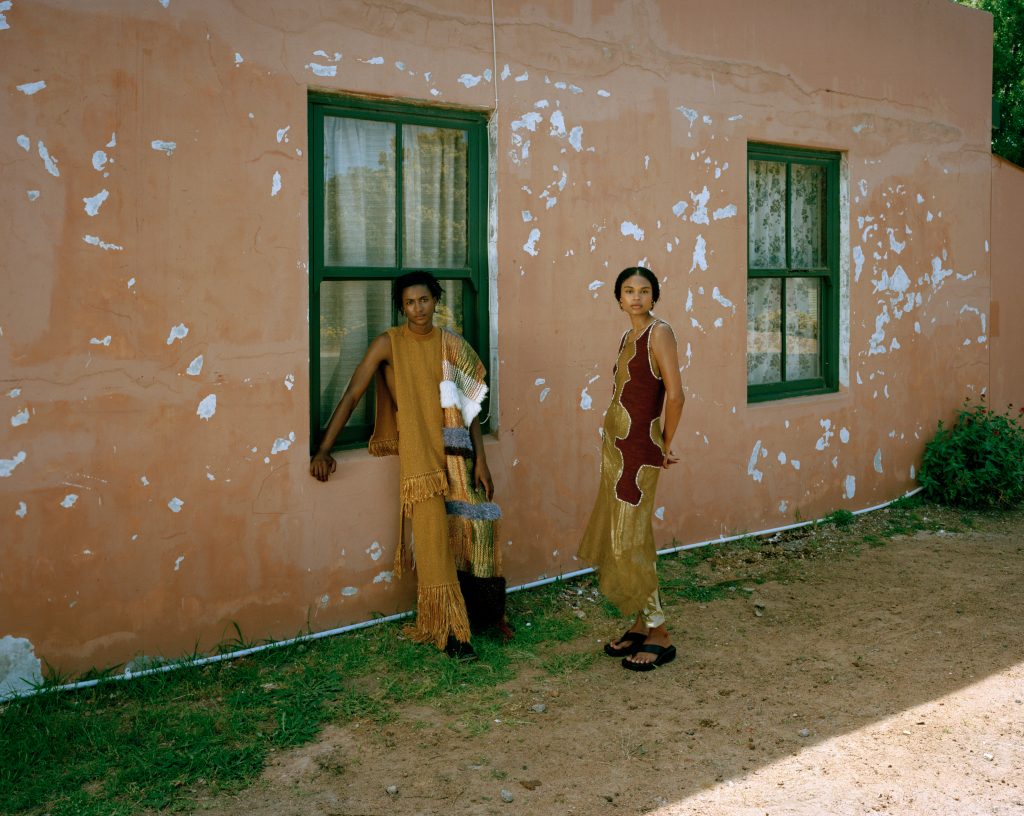
Lukhanyo Mdingi & Jeanne Gaigher, BRIDGES COLLECTION, 2021. Photograph by Johno Mellish.
On the body, the silk and wool blend reads as a soft forest-green cobweb mould that threads its way up from the hemline of the garment. The opaque green-grey panels, which flank the curling ribs, are bordered with a deep brown and white stitching, which makes me think of an elegant line of decaying flesh. When viewed from afar, the garment reads as a microbial interaction; a fruiting body pouring into form.
I love this piece because it reminds me of a scoby in that it reflects the conceptual and material processes of its fabrication in the same way that fermentation can be read in the form of a scoby – the flesh of the object literally smells like vinegar. Thus, I cannot read this garment without also contemplating the material of my own living body as a hyper-space for activity. It has nothing to do with me, and yet, it constitutes my material world. Likewise, Mdingi’s reverence for the highly skilled crafters who choreographed the piece from a pattern for a fictional body into a real garment commands me to perceive the garment through the hands that have spun it into being. One not only wears fictional microbial universes, but they are also, quite literally, inaugurated into those of the hands that have touched it into being.